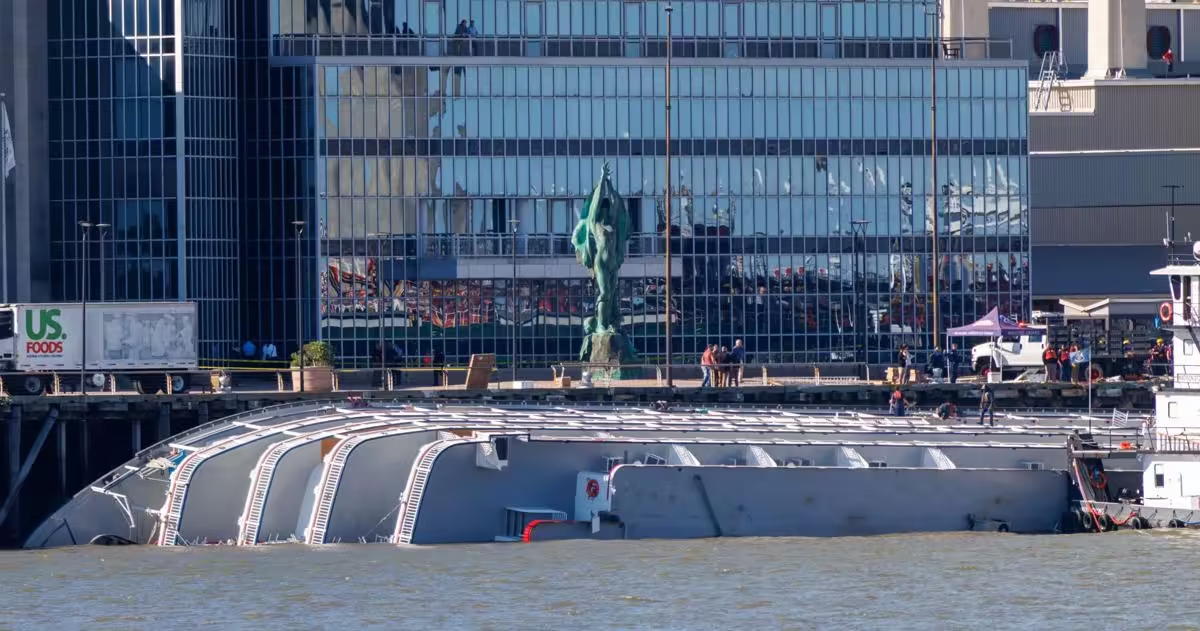

The asphalt tanker that veered into a luxury paddleboat cruise ship Friday on the lower Mississippi River in downtown New Orleans had a history of infractions logged by the U.S. Coast Guard and European shipping regulators over the past two years, records show.
Coast Guard officials dinged the Marshall Islands-flagged vessel, the Atlantic Asphaltin June for faulty electrical wiring in the ship’s pump room, according to records The Times-Picayune | The Advocate obtained through the military branch. Last year, inspectors found its rescue boats were unprepared to launch swiftly in an emergency.
In 2024, inspectors twice logged breakdowns in the Atlantic Asphalt’s navigation systems. That September, the vessel “experienced loss of communication between the bridge and main engine,” Coast Guard officials in Wilmington, Delaware wrote in an after-action report. Two months earlier, the ship’s automatic pilot system malfunctioned while it approached Baltimore.
Miraculously, officials said no one was killed when the 15,000-ton asphalt tanker appeared to lose steering control, veering starboard and crunching into the docked riverboat with nearly 200 people aboard. In a Saturday update, local officials said eight remained hospitalized, with two in serious condition.
None of the tanker’s recorded deficiencies appear, at first, glance to be directly linked to circumstances of Friday’s crash, said an attorney who reviewed the records for the newspaper. The records indicate the ship’s crew took steps to address the issues.
Still, the pattern of shortcomings for the relatively young tanker, built in 2017, is likely to emerge as a key area of scrutiny for federal safety investigators set to arrive Saturday in New Orleans to begin unraveling the disaster’s causes.
“As a whole, it does stand out that there are so many ‘improper/lack of maintenance’ deficiencies,” said Carra Miller, an attorney who practices maritime law in Louisiana and Texas. “Though none stand out as directly related to this incident, it shows a pattern. This is particularly notable because it is a young ship.”
Public maritime records show inspectors with the Canadian Coast Guard and a European shipping regulator also dinged the Atlantic Asphalt for deficiencies in 2025.
The river cruise boat American Heritage lies on its side, partially submerged beside a dock on the Mississippi River in New Orleans on Friday, Nov. 13, 2026. The tanker Atlantic Asphalt, in the background, struck the cruise boat earlier that day.
Representatives for the ship’s owners and a management company named as a defendant in a lawsuit filed late Friday by the Port of New Orleans over the crash could not immediately be reached.
So far, officials have said only that the crash appears to have been caused by a steering issue, which triggered a sudden hard-starboard turn into the port side of the docked American Heritage paddleboat.
Investigators from the National Transportation Safety Board and the Coast Guard will lead the after-action probe, though the team’s arrival was delayed by a nationwide pause in commercial flights caused by malfunctioning air traffic control systems.
Such reviews, which are typical after major maritime disasters, can take months or even years. They seek to reveal any previous problems with a vessel’s systems, whether those issues may have contributed to the disaster, whether the ship’s live-in crew was aware of the problems and, if they were, whether they failed to properly report them to maritime authorities.
Those questions will level scrutiny upon the ship’s live-in crew who travel with the vessel year-round, rather than the temporary Mississippi riverboat pilot who was navigating the Atlantic Asphalt at the time of the crash, Miller said. A longtime river pilot from the New Orleans-Baton Rouge Steamship Pilots Association (NOBRA) was on board when the vessel crashed, a river pilot source with direct knowledge of the situation confirmed
“The videos show the riverboat pilot did what he needed to do,” Miller said. “He dropped both anchors, but vessels don’t have breaks.”
What happened?
A video rendering of the ship’s path shows it traveling upriver early Friday afternoon. It passed Algiers Point at 12:20 p.m., moving at nine knots. At 12:26 p.m., the ship began to veer starboard just before passing under the Crescent City Connection. (Gov. Jeff Landry has said that state engineers checked the bridge and confirmed the ship did not strike or damage it.)
The ship was traveling up a section of the lower Mississippi regarded by seafaring professionals as among the most perilous maritime corridors in the country, if not the world, Miller said.
“The current on the lower Mississippi River can change on a dime, making things very difficult,” Miller said. “At that particular area, there’s Algiers Point. It’s a hairpin turn.”
The ship’s speed slowed to seven knots, then six as its bow turned toward the docked American Heritage. Video from the scene showed the Atlantic Asphalt dropping the vessel’s anchors in the moments before the crash. The Atlantic Asphalt struck the American Heritage at a near-90 degree angle.
Captain Corey Snyder, a cruise ship navigation officer who worked aboard the American Heritage until 2024, said the riverboat, like peer vessels, lacked watertight doors and other anti-sinking measures seen on offshore industrial ships expected to weather tougher conditions.
“Once water’s in the hull, it’s going to go the length of the boat,” Snyder said. “If you look at the video, it sank relatively quickly.”
When a moving vessel strikes a docked ship, maritime law terms the incident an “allision.” The moving vessel is presumed to be at fault under long-standing doctrine known as the Oregon Rule, said New Orleans-based maritime law attorney Tom Shlosman.
“To overcome that presumption, it must show that the docked vessel was to blame, that its own crew acted with reasonable care, or that the crash was truly unavoidable,” Shlosman said.

Louisiana Gov. Jeff Landry and Mayor Helena Moreno take turns speaking at a news conference near Mardi Gras World on Friday, Nov. 13, 2026. Officials said everyone aboard the river cruise boat American Heritage was accounted for after the tanker Atlantic Asphalt struck it while it was docked on the Mississippi River. (Photo by Chris Granger, The Times-Picayune)
Multiple legal battles likely
Legal fights over the crash are likely to play out on several fronts. NTSB investigators will review whether the ship’s live-in crew worked to meet standards issued by the Coast Guard and the ship’s classification society — a third-party group that issues certifications allowing vessels to operate internationally.
The Marshall Islands, where the Atlantic Asphalt is flagged, is known as a “flag of convenience” country, according to maritime law specialists. “Flag of convenience” nations, Miller said, are viewed as regulatory havens with more lax requirements over flagged vessels in areas including crew training and ship construction.
“The Marshall Islands has been making strides the last few years to become a more regulated flag state or, at least, to beat the bad reputation,” Miller said.
The disaster is also likely to trigger a wave of civil lawsuits. Officials with the Port of New Orleans filed the first of those claims late Friday, suing a Liberia-based company that owns the ship and a Singapore-based firm that managed its travel.
The Port of New Orleans owns the Thalia Street Terminal where the American Heritage was docked. The lawsuit, filed in the New Orleans-based U.S. District Court for the Eastern District of Louisiana, says the terminal was “significantly damaged” through carelessness or negligence of the companies, Liberia-based Nave Shipping and Singapore-based Thome Shipping Management.
Damages are expected to exceed $1 million, attorneys for the port wrote, “with additional substantial direct, indirect and consequential damages anticipated.” The attorneys sought a warrant to hold the ship in New Orleans while the litigation unfolds.
Rarely do maritime wrecks of this scale prompt criminal investigations, according to maritime law attorneys. An exception came when the U.S. Justice Department filed criminal charges against operators of the Dali cargo ship, which in 2024 struck the Francis Scott Key Bridge in Baltimore, killing six people.
Echoes of history
The Atlantic Asphalt wreck appeared strikingly similar to another maritime disaster on the lower Mississippi three decades ago.
On Dec. 14, 1996, a 69,000-ton freighter called the Bright Field carrying soybeans up the river rammed into a wharf-side shopping mall in downtown New Orleans. The ship instantly destroyed 15 businesses as it sheared through the riverfront shopping mall. The disaster caused $20 million in damages, federal investigators later found.
A five-person NTSB investigative team arrived in New Orleans to investigate the disaster in the aftermath, along with lawyers from the federal agency and a member of the board itself, John A. Hammerschmidt.
It took about a year for the NTSB to issue its 99-page report on the disaster. When it did, the agency laid blame primarily upon the ship’s substandard engines and automation systems.
Source: www.nola.com