
Some of Brisbane’s oldest heritage-listed buildings are harbouring clues about the prehistoric past.
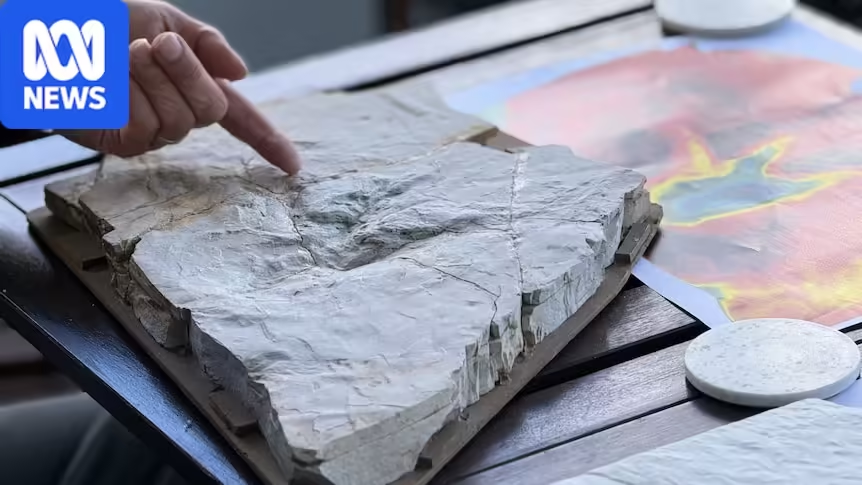
Fossilised footprints belonging to 230-million-year-old dinosaurs have been unearthed in Brisbane, imprinted in the same sandstone used to construct the city’s most recognisable buildings, such as the General Post Office.
“These buildings certainly capture my eye, and I do glance twice to see what evidence might be hidden within their own architecture,” Palaeontologist Anthony Romilio said.
Brisbane landmarks such as the General Post Office were built with sandstone from the same quarry. (ABC News: Lucy Loram)
Dr Romilio said two separate pieces of Brisbane-mined sandstone handed over to the University of Queensland’s Dinosaur Lab appeared to display the footprints of the Sauropodomorph.
“Instead of walking on all four legs, they walked on their back legs. They still retained a very long neck and tail, but they were more ancient than the more typical than the Brontosaurus,” he said.
One of the footprints was discovered by a teenager more than six decades ago at Petrie’s Quarry.
Anthony Romilio identified the footprints as likely belonging to a Sauropodomorph. (ABC News: Lucas Hill)
The history of Petrie’s Quarry
Before the inner-north neighbourhood of Albion became the sought after suburb it is today, it was Petrie’s Quarry.
Educator Sue-Belinda Meehan said the Petrie family opened the quarry in the 1860s, 30 years after the family settled in Brisbane, which was then known as the Moreton Bay Penal Colony.
“If the Petries hadn’t recognised the quality of that sandstone, we wouldn’t have the sandstone that literally built Brisbane,” she said.
A woman stands at Petrie’s Quarry, which would one day become the suburb of Albion. (Supplied: State Library of Queensland)
The General Post Office, All Hallows School, and the Old Customs House were all made up of the creamy, white stone.
“When you think about the number of buildings that were constructed from it, it’s quite extraordinary … it’s probably easier to mention buildings that weren’t made from it than buildings that were,” Ms Meehan said.
St Stephen’s Cathedral, St John’s Cathedral and St Paul’s Presbyterian Church are among the other builds that feature Petrie sandstone.
Sue-Belinda Meehan says the quarry supplied the sandstone that “built Brisbane”. (ABC News: Lucy Loram)
“They were very much equal opportunity builders. It didn’t matter what brand of religion you were, the Petries would build you a church,” she said.
All the while, they were working with stone that had been touched by dinosaurs.
“The thing that really tickles me is that there were stonemasons looking at big blocks of sandstones going, ‘Oh heaven’s, there’s a flaw in it, there’s a footprint’ … and cutting it out.“
The General Post Office, located on Queen Street, was built in 1875. (Supplied: State Library of Queensland)
Aquatic Albion
As work at the quarry ceased and the suburb of Albion slowly started to grow around it, the site was often visited by adventurous school children and aspiring geologists.
But Ms Meehan said remnants of the once active quarry remained today.
“If you go out to Albion and drive down Crosby Road, and look up to St Margaret’s, you can see the scar in the mountain that was Petrie’s Quarry,” she said.
Layers of white sandstone are still visible in Albion today. (ABC News: Liz Pickering)
Dr Romilio said the white hills of Albion were made up of layers of sand that were deposited when the landscape was traversed by dinosaurs.
“If you were to travel 230 million years ago, you would find a very flat area,” he said.
“There wouldn’t be much in the way of trees in that immediate area because you’re looking at a very wide river.
“It would have been shallow enough for a two-legged dinosaur to walk past.”
But the Sauropodomorph was not the only prehistoric creature walking in what is now Albion.
“It would have also been an environment in which aquatic creatures lived as well. So giant salamander-like animals are known to have existed in that same time as well,” Dr Romilio said.
Fossil discoveries
Both pieces of sandstone that had dinosaur footprints and were handed over to the Dinosaur Lab were discovered during the 1950s.
Dr Romilio said he was often approached with information about Brisbane’s Petrie Quarry site.
“It may seem unusual in a capital city that we find evidence of dinosaurs, but really all you need is the right aged material and a keen eye, and some conviction to investigate,” Dr Romilio said.
St Stephens Cathedral sits in a forest of modern buildings today. (ABC News: Lucy Loram)
Ms Meehan said not all dinosaur discoveries happened in outback Queensland.
“Queensland is just awash with wonderful dinosaur relics from the past, and to know that we have them here in Brisbane just makes it an even more fabulous city,” she said.
Source: www.abc.net.au