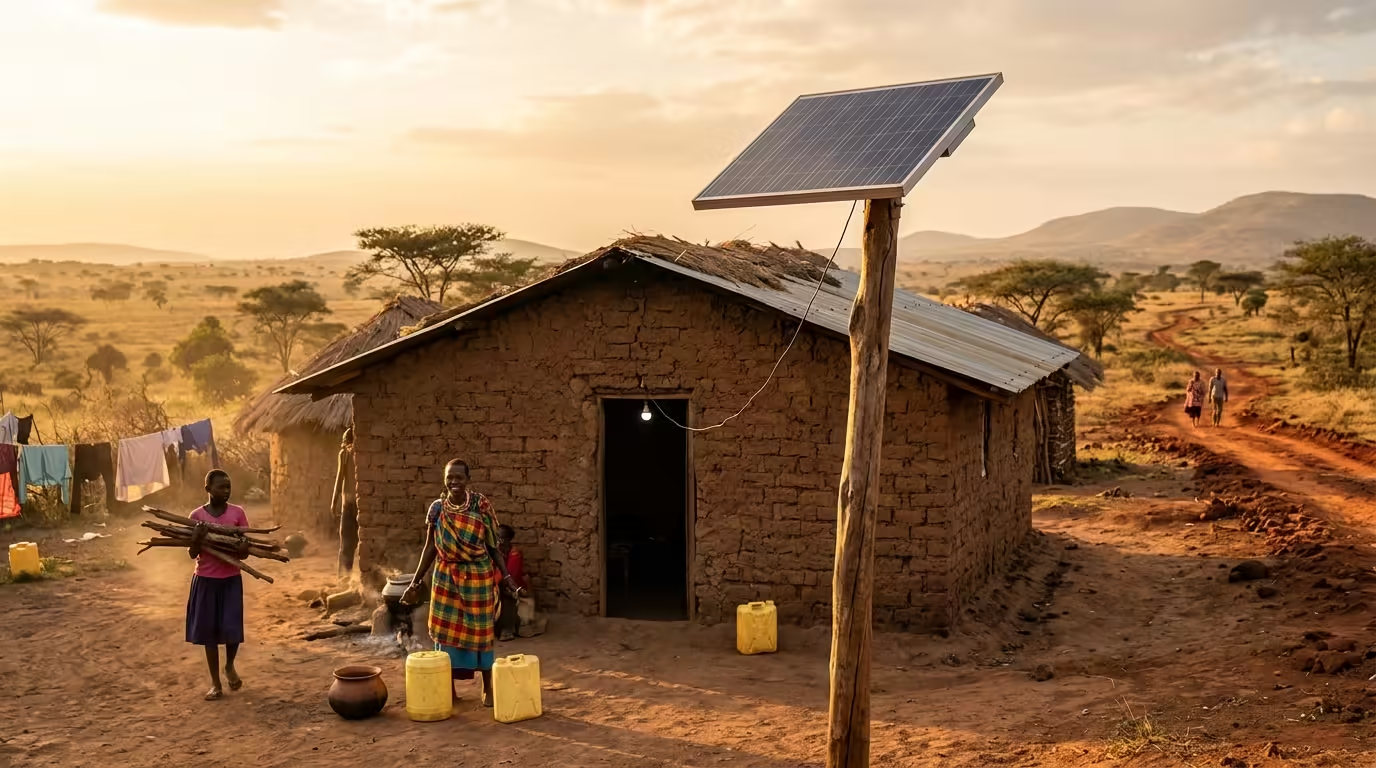

A comprehensive econometric evaluation tracking thirty Sub-Saharan African economies from 1996 to 2021 has revealed that expanding gross domestic product alone cannot guarantee a cleaner energy landscape, because widespread headcount poverty actively suppresses the adoption of clean technology. The empirical investigation, which assessed macroeconomic and environmental data covering more than seventy percent of Africa’s aggregate population and nearly sixty-nine percent of Sub-Saharan economic output, determined that income growth in isolation increased renewable energy intensity by 1.89 percent under baseline panel estimation. However, when economists modeled the interactive relationship between national economic growth and extreme deprivation, the presence of headcount poverty reversed these gains. Differentiating the model across poverty metrics demonstrated that an increase in economic growth in the presence of heightened headcount poverty actually decreased renewable energy intensity by 0.26 percent. This empirical dynamic underscores that the persistent structural burden of poverty diverts indispensable financial reserves away from capital-intensive infrastructure, fundamentally neutralizing the environmental modernization benefits that typically accompany expanding national output.
Understanding renewable energy intensity is vital for the region because conventional energy metrics often track gross renewable consumption or total energy intensity in complete isolation from economic production. In this investigation, renewable energy intensity was formally evaluated as the physical throughput of renewable fuels relative to national income, operationalized through the ratio of quadrillion British thermal units of renewable consumption to total gross domestic product measured in United States dollars. Because African economies have historically relied on carbon-dense fuels such as coal and petroleum to fuel primary industrial activities, transitioning toward lower-emission pathways requires understanding how cleanly economies produce output rather than merely observing the total volume of energy consumed. The research team emphasized that while fossil fuel combustion doubled Africa’s carbon dioxide emissions from roughly 600 metric tons to more than 1200 metric tons over the past two decades, renewable energy penetration remains constrained at an average share of only 23 percent of total final energy consumption across the examined panel.
To capture these structural relationships without falling victim to spurious regressions or unobserved heterogeneity, the investigators constructed an econometric framework anchored in the Driscoll-Kraay Fixed Effects estimator, the Cross-Sectionally Augmented Autoregressive Distributed Lag model, and the one-step System Generalized Method of Moments. Diagnostic testing confirmed that the underlying panel data exhibited significant cross-sectional dependence, serial correlation, and group heteroskedasticity, rendering first-generation panel tests invalid. Consequently, second-generation panel unit root procedures, including the Cross-Sectionally Augmented Dickey-Fuller and Cross-Sectionally Augmented Im-Pesaran-Shin tests, established that the variables achieved stationarity upon first differencing. Long-run structural cointegration was verified using tests formulated by Kao, Pedroni, and Westerlund. The subsequent integration of Driscoll-Kraay adjusted standard errors eliminated bias arising from shared cross-country economic shocks, while System Generalized Method of Moments estimators successfully resolved endogeneity and potential reverse causality between renewable energy intensity, national income, and foreign direct investment through internal instrument transformation.
Across the baseline Driscoll-Kraay fixed effects estimations, direct renewable energy consumption emerged as a reliable positive determinant of renewable energy intensity, where each one percent rise in consumption generated a 0.187 percent increase in intensity. This positive relationship remained robust across alternative modeling methods, delivering a 0.123 percent increase in the short run and a 0.124 percent increase in the long run under the Cross-Sectionally Augmented ARDL framework, alongside a 0.078 percent increase in the System Generalized Method of Moments specification. The researchers contextualized this behavior through the economic lens of the Jevons Paradox and rebound effect theory, which posit that technological efficiency gains lower the effective unit cost of renewable utilization, thereby spurring greater cumulative throughput within developing economic systems. In contrast, headcount poverty—defined as the share of national population living beneath the threshold of 2.15 dollars per day—exerted a direct contractionary effect on renewable energy intensity of 0.11 percent, reflecting how widespread income deprivations restrict household purchasing capacity, compress fiscal revenues, and limit collective funding for modern energy technologies.
The baseline model further demonstrated that foreign direct investment inflows and carbon dioxide emissions exerted positive pressures on renewable intensity, whereas rapid population expansion created substantial headwinds. Specifically, a one-unit increase in net foreign direct investment inflows as a percentage of gross domestic product elevated renewable energy intensity by 0.402 percent, functioning as an external conduit for vital technical expertise, international capital, and advanced renewable infrastructure. Emissions of carbon dioxide likewise registered a modest positive coefficient of 0.068 percent, suggesting that intensifying environmental degradation stimulates compensatory regulatory attention and policy incentives favoring renewable alternatives. Conversely, a one-unit increase in population growth reduced renewable energy intensity by 8.44 percent. This finding aligns with the Downward Spiral Hypothesis and classical Malthusian constraints, indicating that rapid demographic expansion within developing economies lacking extensive human capital development places immense strain on limited public revenues, inevitably diverting state capital toward urgent subsistence requirements rather than sustainable energy transitions.
Recognizing that continent-wide aggregations often conceal sharp institutional and geographic distinctions, the authors divided the thirty-country sample into distinct sub-regions, revealing profound heterogeneity across Western, Eastern, Central, and Southern Africa. In Western Africa, where headcount poverty averages 36.8 percent and exceeds 60 percent in populous nations such as Nigeria, renewable consumption increased renewable intensity by 0.165 percent, while a one-unit rise in poverty produced a stark 0.69 percent contraction. In Eastern Africa, renewable consumption stimulated intensity by 0.19 percent, but population growth exerted an acute suppressive effect of 17.61 percent, illustrating how demographic pressures outstrip localized capital formation. Central Africa displayed an exceptional dynamic: income growth and foreign direct investment expanded renewable energy intensity by 1.73 percent and 1.45 percent, respectively, but population growth curtailed intensity by 12.04 percent, while improvements in composite governance scores unexpectedly correlated with a 21.34 percent reduction, an anomaly attributed to institutional fragility and weak administrative enforcement capabilities across the sub-region.
Southern Africa produced the single largest positive response to renewable energy consumption observed anywhere on the continent, with a one percent increase in consumption yielding a 0.2086 percent expansion in renewable energy intensity. This outsized responsiveness reflects the superior financial resources and industrial capacity of relatively wealthier economies such as South Africa and Botswana, which possess the domestic financial infrastructure necessary to commercialize capital-intensive clean installations. Surprisingly, however, foreign direct investment inflows in Southern Africa displayed a negative relationship with renewable energy intensity, contracting it by 1.83 percent. The authors explained this counterintuitive outcome by highlighting the historical orientation of private foreign capital toward extractive fossil fuel reserves, particularly extensive coal operations in South Africa.
These marked sub-regional divergences lead the authors to conclude that standardized, one-size-fits-all energy policies deployed across Sub-Saharan Africa by multinational organizations will inevitably produce suboptimal or counterproductive results.
Despite the depth of the thirty-country balanced panel, the investigators acknowledged several essential methodological and data limitations that qualify the scope of their conclusions. Africa comprises fifty-four sovereign nations possessing highly diverse energy structures and natural endowments, meaning that the thirty countries studied cannot fully reflect institutional nuances present in excluded territories, particularly in Northern Africa, which was excluded from the sub-regional econometric decomposition. Furthermore, the limited size of the sample available for Central Africa restricts the statistical power and generalizability of its specific sub-regional findings. The researchers also noted that macroeconomic indicators including foreign direct investment, population growth, and governance performance scores exhibited sensitivity across estimators, losing significance in certain dynamic ARDL and GMM specifications due to common global shocks.
Subject of Research: Econometric analysis of the drivers and poverty-moderated dynamics of renewable energy intensity across Sub-Saharan Africa
Article Title: Determinants of renewable energy intensity in Sub-Saharan Africa
Article References: Osei-Gyebi, S., Adenikinju, A., Adeniyi, O., & Ajayi, P. (2026). Determinants of renewable energy intensity in Sub-Saharan Africa. Discover Energy, 6(1), Article 61. https://doi.org/10.1007/s43937-026-00188-7
Image Credits: AI Generated
DOI: 10.1007/s43937-026-00188-7
Keywords: renewable energy intensity, Sub-Saharan Africa, headcount poverty, economic growth, energy transition, Driscoll-Kraay fixed effects, Cross-Sectionally Augmented ARDL, System GMM, foreign direct investment, carbon dioxide emissions, population growth, regional heterogeneity, rebound effect, dematerialization theory, governance performance, energy economics, clean technology adoption
Source: bioengineer.org