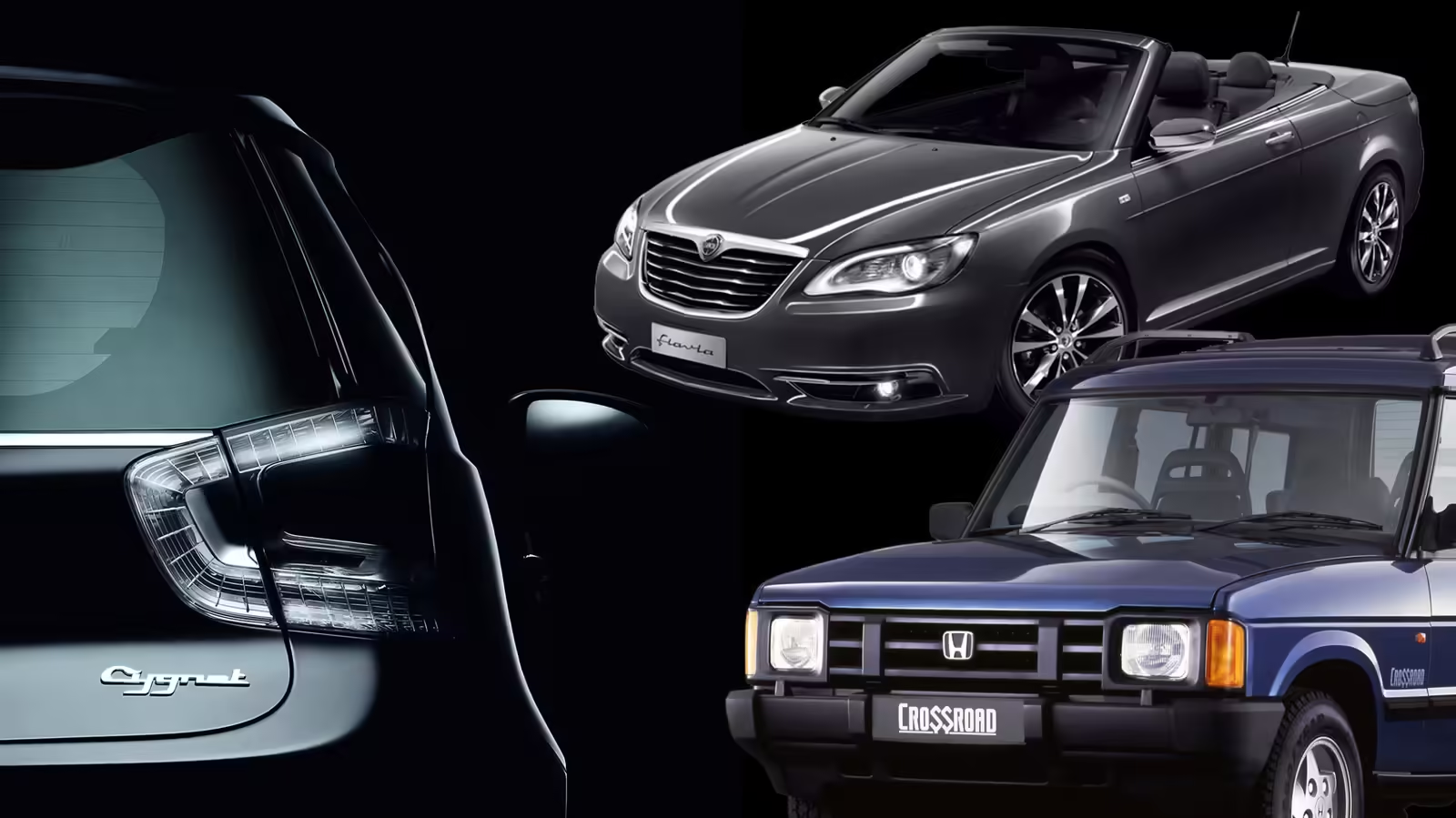

Platform sharing is one of the most common strategies in the automotive industry, and the best way to reduce R&D costs by taking advantage of the economy of scale. While shared underpinnings can lead to successful models with distinct identities, there is also the case of rebadging where brands sacrifice their styling integrity in order to enter new segments or comply with regulations in different markets around the world. Rebadged models are often criticized by automotive enthusiasts, so we decided to gather the five worst examples of badge engineering we could think of in a single story.
With countless cases to choose from, compiling the list proved to be tough. Still, we tried our best to choose vehicles that did very little to adapt into the lineup of the brand they migrated to, and didn’t make sense from a branding standpoint. Think Cadillac Cimarron and Honda Crossroad. Out of the five spots in the wall of shame, one model comes from the 1980s, two from the 1990s, and two from the early 2010s. So let’s check them out in chronological order.
1982 Cadillac Cimarron (Chevrolet Cavalier)
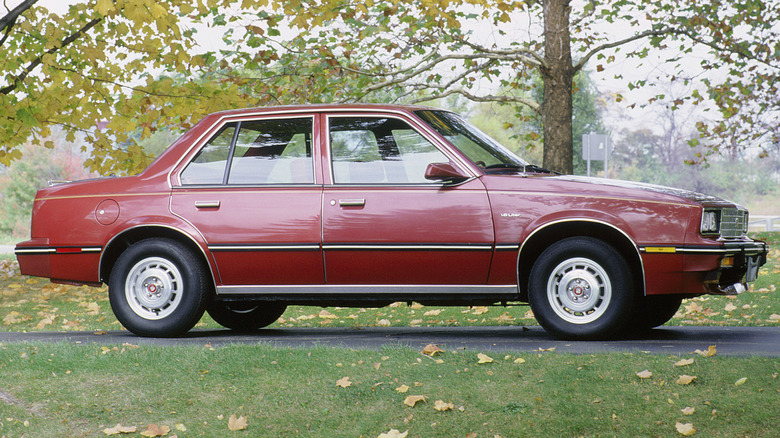
Cadillac is positioned as a premium brand, going against the likes of BMW and Mercedes-Benz. Still, there was a time that General Motors executives decided it would make sense to rebadge Chevrolet’s entry-level sedan as a potential rival to the BMW 3-Series E30 and the Mercedes 190E W201. The Cadillac Cimarron didn’t only share the J-body platform and powertrains with the Chevrolet Cavalier, but also carried over most of its design.
Changes were limited to the Cadillac-specific grille, extra chrome trim, wraparound taillights, alloy wheels, and the optional vinyl roof. Inside, the Caddy came fitted with more heavily bolstered seats upholstered in leather, fake aluminum or fake wood trim, and more generous standard equipment that included air conditioning. Still, the biggest problem was pricing. Back in 1982, the Cadillac started at around $12k when its humble Chevrolet twin could be yours for $7k. This limited its target group to buyers who didn’t care about the essence of the vehicle and only wanted the bragging rights of owning a Cadillac.
1993 Honda Crossroad (Land Rover Discovery)
The Japanese market has many automotive oddities, but only a few can give you a brain freeze like the first generation of the Honda Crossroad. The off-roader was introduced in 1993 and remains the only V8-powered Honda ever made. However, as you might have guessed from the photo, it is not actually a Honda. The Crossroad is nothing more than a Land Rover Discovery Series I with Honda emblems on the grille, tailgate, steering wheel, and center caps.
The rest of the bodywork, interior, V8 engine, full-time 4WD system, and ladder-frame chassis are carried over from the British 4×4. It was available in three-door guise with five seats, or as a five-door model with seven seats. Predictably, the Honda Crossroad struggled to find traction with Japanese buyers, who were shocked to see a Discovery sitting in Honda showrooms alongside true Hondas such as the Civic, the Accord, and the original NSX.
1996 Kia Elan/Vigato (Lotus Elan)
Back in the ’90s, Kia wanted to change course and produce a sportscar to compete with the Mazda MX-5. While the young brand didn’t have the funds to develop a model on its own at the time, an amazing opportunity arose when Lotus decided to discontinue one of its nameplates. The front-wheel-drive Lotus Elan M100 went out of production in 1995, after suffering a defeat from the aforementioned rear-wheel-drive MX-5 NA. Interestingly, Kia decided to acquire the tooling to produce the Elan, along with the license to sell it with its own badges.
This signaled the birth of the Kia Elan in Korea, which was also exported to Japan as the Kia Vigato. Besides the emblems, changes in the Kia version were limited to unique taillight clusters, new wheels, and a revised suspension setup with increased ground clearance. The fiberglass body and steel backbone chassis were carried over, but the Isuzu-sourced engine of the original was swapped for a Kia-built naturally aspirated 1.8-liter mill. Priced at ₩27,500,000, the Lotus-derived sportscar was one of the most expensive models in the Korean market and failed to attract a large number of buyers.
2012 Lancia Flavia Convertible (Chrysler 200 Convertible)
Fans of Italian cars will probably agree with this entry. After Fiat acquired a stake in Chrysler in 2009 and before the formation of FCA Group in 2014, the company found a cheap way to expand the lineup of a storied brand. Lancia, which sold the Ypsilon supermini, the Mussa subcompact minivan, and the Delta hatchback at the time, suddenly gained three new models — the Flavia Convertible, the Chrysler 300 alter-ego Thema sedan, and the Voyager minivan (they didn’t even bother changing its name to Phaedra).
What we would like to forget is that the newcomers were rebadged versions of the Chrysler 200, 300, and Voyager, respectively. The worst of the three was the Flavia, reviving an iconic moniker from Lancia’s rich heritage without the required credentials. The company originally announced sedan and convertible body styles, but only the latter was offered for sale.
The only Italian features of this rebadged Chrysler were a slightly tweaked grille and the name. The American convertible was largely rejected by European buyers, which led to it being discontinued in 2014. Ultimately, this failed attempt to help Lancia grow brought it closer to extinction before the more recent rebirth under the Stellantis umbrella with the new Gamma HF Integrale.
2011 Aston Martin Cygnet (Toyota/Scion IQ)
We couldn’t write a story about the worst badge-engineering projects and not include the Aston Martin Cygnet. The notorious model appeared in 2011 and while it would easily pass for an April Fool’s prank it was absolutely real. Aston Martin rebadged the Toyota IQ, creating the most expensive — and luxurious — city car with little effort.
To be fair, Aston designers did apply the brand’s styling language to the pint-sized Toyota. Highlights included a redesigned front bumper with the signature grille and additional intakes next to the headlights, fake vents on the tiny hood, side gills, deeper side skirts, bespoke taillights with extensions, and a tweaked rear bumper. Likewise, the interior received hand-stitched full-grain leather upholstery, Alcantara, and other premium materials. Still, there were no changes under the skin, with the 1.3-liter four-cylinder engine sending power to the front wheels via a CVT.
However, the biggest problem was the £30,000 price tag which was triple the cost of a Toyota IQ. So why did Aston Martin bother with the city car segment? The answer lies in fleet emission regulations set in the European Union. The little Toyota allowed Aston Martin to lower its fleet average without having to engineer a new powertrain for its sports cars and GTs. Ultimately, the Cygnet was a commercial failure that didn’t meet initial targets.
In 2018, Aston Martin’s Q division created a one-off version of the Cygnet for a special customer, cramming a Vantage-sourced V8 with 430 horsepower into the city car. The pocket rocket received custom upgrades including a rear-wheel-drive conversion, wide fender extensions, and an entirely new suspension setup, getting it closer to the performance you’d expect from an Aston Martin. However, the modifications were quite costly, increasing its value to an estimated £450,000.
Source: www.carscoops.com