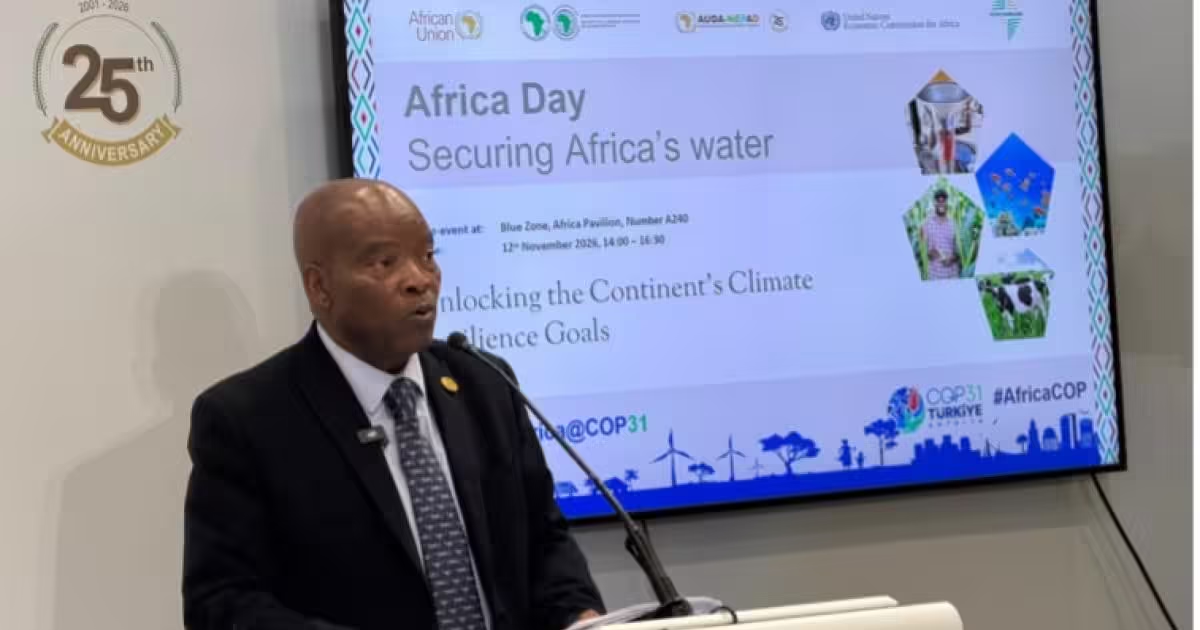

Statement by H.E. Moses Vilakati on behalf of the Chairperson of the African Union Commission
at the Ministerial Segment of Africa Day at the Thirty-First Session of the Conference of the Parties (COP31) to the United Nations Framework Convention on Climate Change
Theme: Securing Africa’s Water: Advancing Climate Resilience, Early Action and Climate Finance
Blue Zone – Side Event Room 4 (Aşık Veysel)
Antalya, Republic of Türkiye
14 November 2026
- Honourable Minister responsible for Water and Sanitation of the Republic of Senegal and Chair of the African Ministers’ Council on Water (AMCOW),
- Honourable Minister of Water and Sanitation of the Republic of South Africa,
- Honourable Ministers, Members of the Pan-African Parliament,
Honourable Chairs of the African Ministerial Conference on Meteorology (AMCOMET), the African Ministerial Conference on the Environment (AMCEN) and the African Group of Negotiators, - Executive Secretary of the United Nations Economic Commission for Africa,
- Presidents of the African Development Bank and Afreximbank,
- Chief Executive Officer of AUDA-NEPAD,
- Executive Secretaries of the Regional Economic Communities,
- Director General of ACMAD,
- Representatives of the Climate Funds and Development Partners,
- Distinguished Delegates, Ladies and Gentlemen
————————————————————————————————————–
It is my honour to address this Ministerial Segment of Africa Day on behalf of H.E. Mahmoud Ali Youssouf, Chairperson of the African Union Commission, who has asked me to convey his warm greetings and sincere appreciation for your continued commitment to advancing Africa’s climate and water agenda.
I wish to express our gratitude to the Government and people of the Republic of Türkiye for their warm hospitality. I also extend our appreciation to ACMAD and our ClimDev-Africa partners — the African Development Bank, Afreximbank, the United Nations Economic Commission for Africa and AUDA-NEPAD — for their continued commitment and partnership in convening this important dialogue.
Just two days ago, during the High-Level Segment, our Heads of State and Government delivered a clear and unequivocal political message: securing Africa’s water is fundamental to strengthening the continent’s climate resilience, safeguarding food security and accelerating economic transformation.
Honourable Ministers, you are entrusted with translating this political commitment into action. Your leadership will determine whether these ambitions are reflected in national policies, credible investment pipelines, institutional capacity and tangible results for our people.
Excellencies, Honourable Ministers,
Our theme today, “From Early Warning to Early Action: Financing Africa’s Water and Climate Resilience,” captures one of the most pressing challenges and opportunities facing our continent. It is firmly aligned with the African Union Theme of the Year for 2026: “Assuring Sustainable Water Availability and Safe Sanitation Systems to Achieve the Goals of Agenda 2063.” It also underscores the need to move beyond identifying climate risks towards financing and implementing solutions that protect lives, livelihoods and development gains.
Across Africa, climate change is increasingly experienced through water. Droughts are becoming more severe, floods more destructive and rainfall patterns increasingly unpredictable. The anticipated 2026–2027 El Niño further heightens the urgency of preparedness and anticipatory action. The challenge before us is no longer simply to understand and anticipate these risks; it is to ensure that our institutions, systems and financing arrangements are sufficiently prepared to respond before climate hazards become humanitarian and economic crises.
Honourable Ministers,
Allow me to highlight four priority areas in which your political leadership and collective action will be particularly decisive.
First, developing bankable investment pipelines for water security and climate resilience.
The Continental Africa Water Investment Programme provides an important continental framework for mobilising and coordinating investments in water security and sanitation. However, its success will ultimately be determined by our ability to translate this framework into well-prepared, bankable projects that attract financing and deliver measurable development outcomes.
I therefore urge Ministers responsible for water, finance, agriculture and environment to strengthen intersectoral coordination, accelerate project preparation and integrate water security into national development strategies, Nationally Determined Contributions (NDCs) and National Adaptation Plans (NAPs).
Our continental financial institutions, particularly the African Development Bank and Afreximbank, have an important role to play in supporting project preparation, mobilising innovative financing and leveraging public and private capital. We must work together to move from investment commitments to projects that are ready for financing and implementation.
Second, translating early warning into early action.
Africa has made important progress in strengthening climate services and early warning capabilities. Nevertheless, significant gaps remain in the generation, accessibility and communication of climate information, particularly at the local and community levels. Too many warnings still fail to reach those most at risk, while insufficient financing and preparedness arrangements constrain timely action.
The ongoing El Niño preparedness efforts led by the African Union Commission, the African Risk Capacity (ARC), ACMAD, the Regional Climate Centres and National Meteorological and Hydrological Services demonstrate the importance of coordinated continental and national action.
Working through AMCOMET and our regional and national institutions, we must accelerate investment in hydrometeorological infrastructure, strengthen forecasting and climate information services, and establish mechanisms that link early warnings to pre-arranged financing and anticipatory response plans. We must also accelerate the implementation of the Early Warnings for All initiative across all African Union Member States.
Our objective must be clear:
Third, recognising and financing ecosystems as natural water infrastructure.
Africa’s forests, wetlands, river basins, drylands and coastal and island ecosystems are indispensable to water security and climate resilience. They regulate water flows, recharge groundwater, reduce flood and drought risks, conserve biodiversity and sustain millions of livelihoods.
Initiatives such as the Congo Basin conservation efforts and the Great Green Wall, alongside investments in Africa’s island and coastal ecosystems, demonstrate the strategic importance of ecosystem-based approaches. We must therefore move beyond treating ecosystem restoration as a complementary environmental intervention and recognise it as an essential component of our water security and climate resilience infrastructure.
This requires stronger domestic resource mobilisation, increased international climate finance and innovative financing mechanisms to support nature-based solutions, ecosystem restoration and the sustainable management of our natural resources.
Fourth, advancing Africa’s common position in the international climate negotiations.
Our technical and policy interventions must be matched by a strong, coordinated and unified negotiating position. The African Group of Negotiators, guided by the African Ministerial Conference on the Environment (AMCEN) and supported by the Committee of African Heads of State and Government on Climate Change (CAHOSCC), continues to play a critical role in advancing and defending Africa’s Common Position on Climate Change.
In this regard, we must remain firm in calling for a substantial scale-up of adaptation finance, in line with the needs and priorities of developing countries, and for the effective operationalisation of the Global Goal on Adaptation, supported by clear and adequate means of implementation.
We must also press for the Fund for Responding to Loss and Damage to become more accessible, responsive and effective in addressing the needs of climate-vulnerable countries and communities. Similarly, the Green Climate Fund, the Adaptation Fund and other climate finance institutions must simplify their procedures, accelerate disbursements and ensure that African countries can access the resources required to implement their climate priorities.
Africa is not asking for commitments on paper; we are calling for climate finance that reaches countries, communities and projects where it is most urgently needed.
Excellencies, Honourable Ministers,
The African Union Commission remains committed to supporting Member States in translating these priorities into concrete action. Through our continental institutions, Regional Economic Communities, regional climate institutions, Climate Commissions and ClimDev-Africa partners, we will continue to strengthen capacities in climate services, adaptation planning, early warning, investment mobilisation and climate-informed decision-making.
Our collective success, however, will depend on stronger coordination, sustained political commitment and effective partnerships across the continent.
As we look ahead to COP32 in Addis Ababa in 2027, the African Union Commission reaffirms its full support to the Federal Democratic Republic of Ethiopia in its preparations to host this important Conference. Today’s ministerial recommendations should directly inform and strengthen Africa’s preparations for COP32. We have an opportunity to ensure that Addis Ababa becomes a defining milestone for climate implementation, equitable partnerships, increased investment and climate justice.
Honourable Ministers, the task before us is clear. We must leave this meeting with a renewed commitment to translate political declarations into practical results: investment-ready water and climate resilience projects, early warning systems backed by financing and capable of triggering anticipatory action, and ecosystems that are effectively protected, restored and sustainably managed.
Let us strengthen our collective resolve to ensure that Africa’s climate priorities are not only heard in international negotiations but are adequately financed and implemented on the ground.
Africa has the knowledge, the institutions and the ambition to lead. What we must secure now are the partnerships, resources and collective determination to deliver at the scale and speed that our people deserve.
Excellencies, Honourable Ministers, Ladies and Gentlemen,
I thank you for your kind attention.
Source: au.int