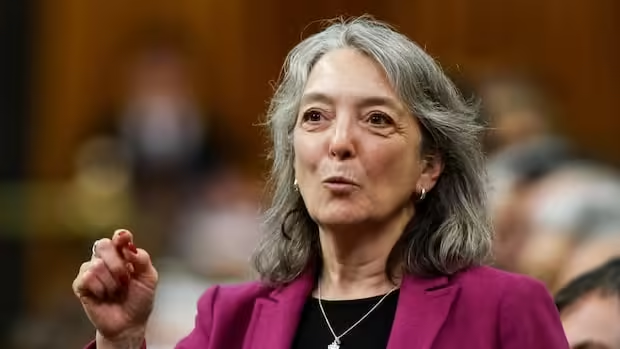

As It Happens6:59Environment minister defends Canada’s climate record from COP31
Environment Minister Julie Dabrusin says Canada is being hailed as a leader in the fight against climate change at the COP31 conference in Turkey.
This, despite that the Liberal government’s recent investments in the oil-and-gas industry have raised the hackles of climate scientists, environmental advocates and former environment ministers.
When United Nations Secretary General António Guterres addressed COP31 UN climate conference on Friday, he called for an “accelerated transition away from fossil fuels.”
But under Prime Minister Mark Carney, Canada has tabled legislation to bypass environmental safeguards to speed up major projects, sought international investment for a West Coast oil pipeline that could threaten endangered whales, created a tax benefit for oil extraction, quietly ended its work to end thermal coal exports, and most recently, opened the door to potential future Arctic oil drilling.
Dabrusin, however, says Canada is getting a warm reception at COP31, where, along with the U.K., it has committed funding to fight climate change in vulnerable countries. What’s more, she says, Canada’s plan to reduce methane emissions and expand electrification are being hailed as beacons of light at the conference.
The minister spoke to As It Happens host Nil Kӧksal on Friday from Antalya, Turkey. Here is part of their conversation.
Minister Dabrusin, you heard what António Guterres said … so what kind of reception is your government’s renewed commitment to Canada’s oil-and-gas sector getting at this COP?
Canada is getting a really warm reception here. We’re a leader in the fight against climate change, and very much in every room that I’ve been in, I have seen that support and warmth.
We’re only one of two developed countries that has recommitted to our international climate finance, and so that is recognized as a space of leadership for Canada here at COP.
We’re one of the countries that has the strongest regulatory regimes when it comes to reducing methane emissions. In fact, we just recently updated our regulations so that we will be reducing methane emission from oil and gas by 72 per cent by 2030.
So, Minister, no one has stopped you and said ‘Canada has been a leader, but we look at all of these recent announcements and decisions and we’re kind of worried that that’s a little bit shaky, that kind of leadership?’ No one has stopped you to express even a modicum of concern, even gentle concern?
We’re talking about recent decisions. Like the international climate finance being recommitted is a recent decision from just earlier this year. The decision to strengthen our methane regulations was just at the end of last year. And the work that we’re doing on oceans is something that’s very much a present moment thing that we are doing in the lead up as well to our oceans conference.
The work that we’re doing on clean electricity and on electrification, which is a focus here at COP, is something that’s recognized. Our budget from last week put its emphasis on doubling our electricity grid, putting the money towards that, also towards electrification.
Those are things that people are talking here about, about how countries can do that. Canada’s doing it and we’re putting the money forward to do it domestically and we are also helping other countries through international climate finance.

At COP31, Canadian company AtkinsRealis and Turkish stat nuclear energy company TUNAS sign a deal to explore expansion of Turkey’s nuclear power. From left to right: AtkinsRealis CEO Ian L. Edwards, Dabrusin, Turkish Energy Minister Alparslan Bayraktar, AtkinsRealis nuclear president Joe St. Julian, and TUNAS General Manager Necati Yamac. (Kaan Soyturk/Reuters)
Domestically, there is certainly concern that that cannot be denied. As you know earlier this week, the prime minister was asked about $11 million in the latest budget to “support the governance and oversight of offshore oil-and-gas activities in the Arctic Ocean.” He told reporters: “This is not a decision about lifting that moratorium, but about respectful engagement” with Indigenous leadership. Could that engagement, though, ultimately lead to oil or gas drilling in the Arctic? Yes or no?
There is no decision in this budget to lift the moratorium on oil and gas. He was clear about that, and I will be clear about it as well. That’s not what this funding is about.
Can you say … that there’s not going to be oil or gas drilling in the Arctic after that period of engagement?
What I’m saying is that there is funding in this budget to make sure that we can engage with northern communities, Indigenous communities about resources, but that it is absolutely not a decision in this budget.

COP31 has started in Turkey, where the Canadian delegation will be defending its own climate record as the government pushes to expand oil and gas production. It’s the first UN climate change conference without the participation of the United States.
Former Liberal Environment Minister Catherine McKenna posted this week — she’s at the summit as well — saying: “Detailed analysis by Climate Action Tracker shows Canada’s policies and actions are ‘critically insufficient’ and aligned with a 4+ degree warmer world.'” What would you say to people, Minister, including many young Canadians who say your government is failing them?
I think this is actually very important for young Canadians. It’s important for all Canadians that we continue to fight against climate change. We’re actually very much committed to doing that. We’re also really committed to do it in a way that responds to the needs of Canadians.
When we look at this last budget, Budget 2026, you can see that we put in place the building blocks that we need to be able to make sure that we can transition to electricity.
We’ve actually made the largest investment in North American history in clean energy with Churchill Falls.
We are doubling the EV charging network in Canada.
We’re actually helping Canadians to switch to heat pumps and to retrofit their homes. One million homes is the announcement that we made.
And then we also are working towards energy efficiency.
Even with all of that … if there is still a foot, maybe two feet, still firmly planted in oil and gas, or even … openings for potential growth in those sectors, can you see why young Canadians, in particular, are finding it difficult to trust that at the end of this, beyond this budget, that the results aren’t going to be harmful to the environment that they have to live in?
The proof is in where we put the money in this budget, which is towards electrification, which is exactly what we need to do as a country if we want to move to electrification. At this COP that’s the focus.
And I am absolutely committed, our government is absolutely committed, to continuing that work to make sure that Canada domestically does reduce its emissions and moves to electrification.
But we’re also … committed as only one of only two developed countries to actually do the international climate finance that we need to make sure that other countries, too, can take advantage of these opportunities.
Source: www.cbc.ca