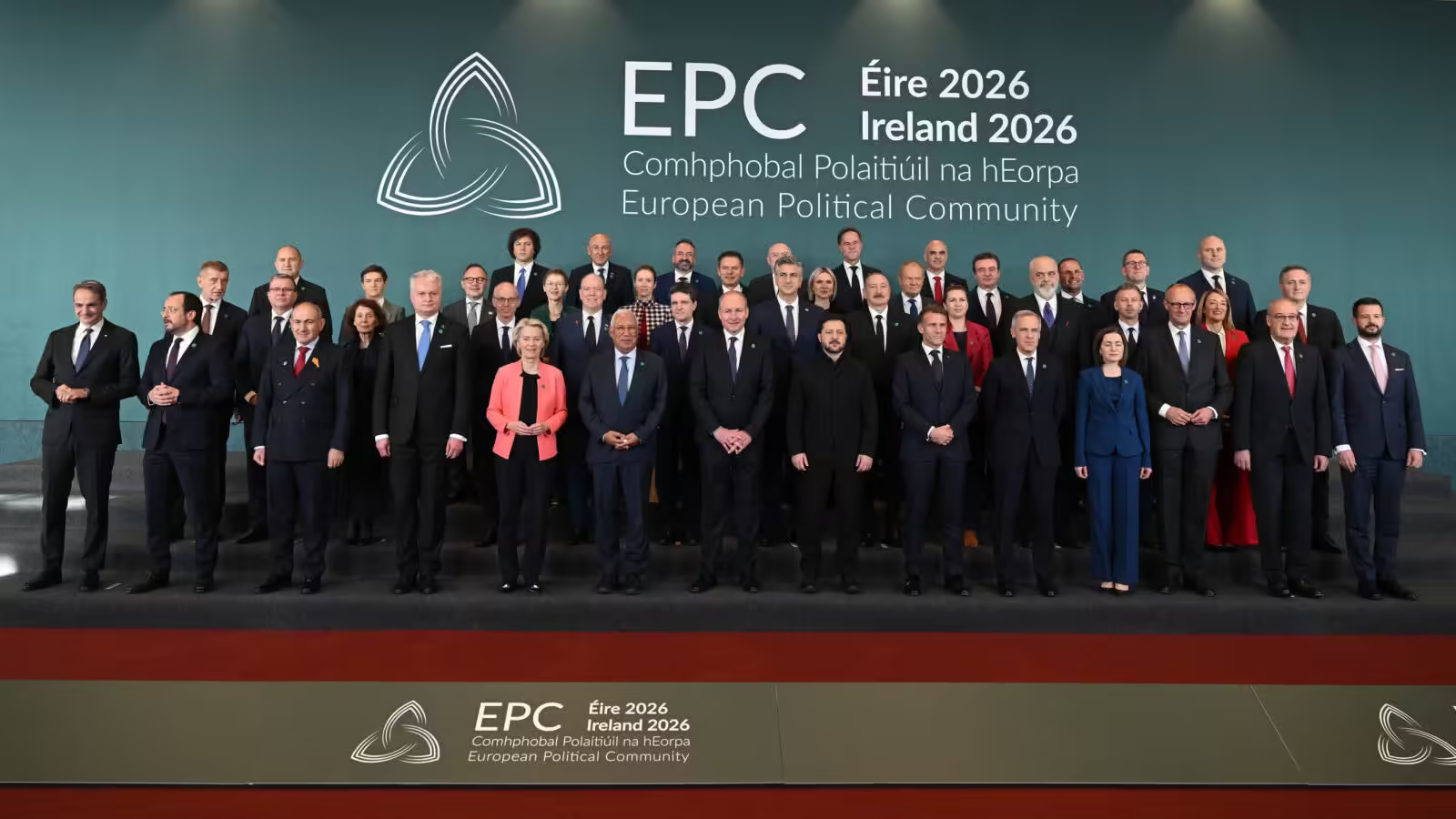

Yesterday, 40 European countries signed a “Declaration on key principles of European security” on the margins of the European Political Community (EPC) Summit in Dublin. The declaration is political in nature, not legally binding, and it lays out 10 principles and 13 “common objectives” on European security. One of its intentions is to demonstrate Europeans’ political unity and support to Ukraine. Only seven of the entire EPC membership—which spans all the way from Iceland to Azerbaijan, except Russia and Belarus—withheld signature (including Serbia and Switzerland).
But beyond unity, the declaration allows European nations to state their vision of the future security framework. They are signaling that they will not accept being circumvented from discussions on their own security, and that they fundamentally reject Russia’s “spheres of influence” approach. To enhance security, European states are highlighting two main types of objectives: on one hand, reinforcing their posture and autonomy, particularly by increasing defense cooperation, and on the other hand, anticipating how certain norms can help regulate competition, specifically risk management and reduction mechanisms.
This declaration comes just after the Abu Dhabi talks, where European states participated. The statements released by U.S. envoy Steve Witkoff and the European Council on November 10 regarding those discussions highlighted the “shared commitment to a strong post-war European security architecture and arrangements.”
Yet a declaration like this usually takes weeks to prepare, so it was likely not triggered by the Abu Dhabi talks. In fact, European states have been working on their future security framework for some time: In his March 2026 Île longue speech, French President Emmanuel Macron stated that “initial work ha[d] started” with Germany and the United Kingdom on “how Europe’s stability should be organized” and invited other European nations to join that work. The speech also outlined a methodology: first establishing Europe’s security interests, then “open[ing] a negotiation framework in order to control certain conventional capabilities and their positioning.”
Russia Wants Spheres of Influence in Europe
European nations’ concern is that Russia could use the negotiations with the United States on the Ukraine war to push demands that exceed the war itself and touch on wider European security. As stated in the declaration, “future developments in European strategic stability will be conditional upon the conclusion of the war in Ukraine.”
Russia’s calculation is that the Trump administration wants to end the war and avoid escalation and that it could consider accepting Russia’s wider European claims as a means to an end, either by pressuring European nations or by acting on the levers it controls directly—e.g., U.S. deployments in Europe—or in a context of burden shifting and the Force Posture Review. Russia could also bet that some of the United States’ views—particularly as outlined in its 2025 National Security Strategy—are not incompatible with its “spheres of influence” vision.
Russia’s wider claims on Europe essentially involve reshaping the continent into two spheres of influence: an Eastern one led by Russia and a Western one led by the United States. This was apparent in the two draft “agreements” (one with the United States, the other with NATO members) circulated by Russia in late 2021. They included demands such as ending NATO nuclear sharing arrangements, forbidding NATO enlargement, and forbidding foreign deployments on the territories of states that joined NATO after 1997 (primarily central and eastern allies), thus creating zones of differentiated security.
It seems it would not be in the United States’ interest to accept these wider Russian demands. That is because those would weaken NATO’s deterrence and defense posture and therefore increase the risk of a Russian “test” on the alliance. If the United States’ objective through burden shifting is to free up its resources so they can be reallocated to the Indo-Pacific, a prerequisite is to prevent an Article 5 circumstance, because that would reabsorb U.S. resources. This is why burden shifting should occur in a planned and sequenced manner, with the goal of ensuring the overall deterrence and defense posture is not weakened.
Against that backdrop, the declaration helps infer several signals from European states about their vision for the future security framework.
Reaffirming Existing Principles
European states are rejecting out of hand Russia’s spheres-of-influence approach. The declaration lists principles “which form the foundations of peace and stability on the European continent,” including territorial integrity and states’ right to freely determine their relations with other states.
European nations are highlighting that there already was a European security architecture before Russia violated it. The declaration reaffirms the centrality of several agreements, including the Helsinki Final Act (1975), the Charter of Paris for a New Europe (1990), and the Istanbul Charter for Security in Europe (1999). These are all documents that Russia signed but went on to violate.
Also, Europe is countering Russia’s narrative that it is “pro-peace” while European states are supposedly “pro-war”: a vast majority of them (40 signatories) just declared they are “committed to peace.” Europe’s intention here is to thwart Russia’s classic playbook of claiming it wants peace, only to blame its attacks on European nations’ supposed refusal to engage. On November 10, U.S. envoy Jared Kushner stated in Abu Dhabi that “the Russians” are “really ready for peace . . . under the right conditions,” but they ask, “are [the Ukrainians and Europeans] really genuinely ready for peace?” As surprising as that framing was, the declaration offers a definite answer.
European States Will Not Accept Being Circumvented
European states are signaling that they will not accept being circumvented on their own security. The declaration states that “any matter affecting European security should be decided with the Europeans.”
In his March 2026 Île longue speech, President Macron had already deplored that the old European security architecture was often negotiated about European security, but without Europeans. In June, the leaders of France, Germany, and the United Kingdom released a joint statement where they expressed willingness to participate actively in a “direct dialogue between Ukraine and Russia . . . to bring about a ceasefire and support further negotiations.”
This is not just a matter of principle, but also a strategic reality: European states control key levers that will shape the future security framework, including capability developments, arms for Ukraine, agreements on EU membership, sanctions, and more.
Security as a Balance of Strength and Norms
Security is the result of two tracks, one focusing on strength (to deter and defend, individually or collectively), and another focusing on norms (to regulate competition). This is consistent with the “dual-track” approach forged by NATO in 1979 to address the Euromissile crisis: restoring a balance of force vis-à-vis Russia by deploying missiles, and negotiating arms control, which led to the Intermediate-Range Nuclear Forces (INF) Treaty.
The relative importance of these two tracks varies over time, but they are complementary: Norms without strength to back them up would not be credible. In fact, the very expression “European security architecture” is discarded by several European states and scholars who understand it as meaning solely norms and believe that it harks back to a failed paradigm of cooperative security and trust.
The declaration remains general: It does not recall the framing above, nor does it use the expression “security architecture.” But its contents touch on both tracks mentioned above, i.e., strength and norms.
Strength
The declaration is consistent with the fact that European nations’ current priority is to reinforce their posture and close capability gaps with Russia, especially with the Force Posture Review. They want to influence Russia’s calculations away from seeking destabilization.
The first “common objective” in the declaration states that European nations will “uphold security, peace and stability in Europe” under the UN Charter and under various frameworks as applicable: NATO, the European Union, and bilateral agreements. While this does not create new obligations, it sends a signal of determination to Russia, especially because Ukraine—a candidate for joining the European Union and being covered by the Treaty on European Union’s “mutual assistance clause”—is among the signatories.
The declaration highlights that European states “bear a primary responsibility . . . for the security of Europe.” This is not novel, but it is interesting to note the avenues outlined in the declaration to get there. They are generally focused on cooperation, as if to defragment European defense: strengthening Europe’s defense industrial base, building joint capabilities, joint planning, conducting strategic dialogues, and increasing resilience vis-à-vis actions “below the threshold of armed aggression.”
Norms
While European states’ focus is on reinforcing their posture, they are also anticipating the “norms” track. The reality is that Russia will continue to pose a durable threat and be their immediate neighbor. If European nations only rely on strength, that could be insufficient to address the threat and could generate inadvertent escalation, possibly arms racing. Norms can help, but only if they can enhance security and they are not sought for their own sake. The declaration incorporates two main signals on norms. The first one is the principles listed above, which could be interpreted as red lines for Europeans in any discussion.
The second signal is that the signatories “support discussions on further risk management and reduction mechanisms.” These mechanisms would presumably be proposed to the adversary, i.e., Russia, although the declaration specifies discussions would occur “once the conditions are met and peace restored.”
This type of norm is not as far-reaching as arms control. Arms control involves limiting or reducing weapons, while risk reduction generally treats armament levels as a given and focuses on avoiding inadvertent escalation, such as by establishing military exercise notifications and communications channels. Therefore, the benefit of risk-reduction measures is that they would not impede European nations’ ongoing posture reinforcements, which are their priority. In contrast, if European states went too early into arms control, they could “lock in” the capability gaps they are looking to close with Russia. This could also give Russia an opportunity to generate new capability gaps by violating its commitments, as it did with the INF Treaty. Therefore, the declaration’s focus on risk management and reduction could suggest that European states are exploring norms where the impact of noncooperation from the adversary on their security can be managed and where lack of trust is less of an issue.
Where Next?
To deliver their objectives, European nations will now seek to translate political principles into more detailed commitments. In doing so, they will face three main challenges:
- European states will want to ensure they keep their seats at the table. To do so, they will have to counter Russia’s attempt to deal only with the United States on European security.
- Europe will need to maintain unity. In terms of the strategy, some European nations—likely those most directly exposed to Russian threats—could be uncomfortable with discussing norms with Russia, even risk management, for fear that it would distract from reinforcing deterrence. It will be easiest for European nations to attempt to defend their red lines, but if discussions advance and states are led to consider making trades or concessions, it could expose differences between them. It will be a tall order to align European nations that have diverse strategic circumstances.
- European nations will need to implement the objectives they set out. Increasing defense industrial cooperation will require overcoming the difficulties revealed by the failure of the Franco-German Future Combat Air System in June. Increasing autonomy will require making a success of NATO burden shifting. European states will need to make sure to avoid a pitfall where they spend more, but in ways that do not truly increase autonomy and their own way of war.
These challenges are surmountable. There was irony in seeing Russia deride European states’ presence in Abu Dhabi, because in truth, the question of Europe’s security framework is one where European nations have become more proactive and assertive than in the past—one more way in which the Ukraine war backfired on Russia.
Jérôme Sansonetti is a visiting fellow in the Europe, Russia, and Eurasia Program at the Center for Strategic and International Studies in Washington, D.C.
Source: www.csis.org