

Presented to Parliament by the Secretary of State for the Home Department by Command of His Majesty
CP 1707
November 2026
Foreword from the Home Secretary
My parents came to this country from rural Kashmir more than fifty years ago. They came because they knew they would be treated fairly here. Their experience has shaped my view of the migration system. The British people are welcoming and generous to those who come here, but they also have an expectation that those who come here will contribute to their community and play their full part in the country that has given them a new home.
Fairness underpins my vision for the new migration system. It must be fair to those who come here legally, contribute and build their lives in our communities. And it must also be fair to the British people, who rightly expect the system to be controlled and its rules to be respected.
Settlement – the right to live permanently in the United Kingdom and share fully in the security and opportunities our country provides – is one of the most significant rights we can grant.
Today, it is granted near automatically, largely on the basis of time served. It is this Government’s view that this is insufficient. The right to settle should instead reflect a lasting commitment to this country, demonstrated through contribution, integration and respect for our laws and values.
That is the principle behind earned settlement. It creates a clear connection between permanent status and the responsibilities that come with it. It recognises those who contribute and play their part, while ensuring that those who break the law, abuse the system or disregard its rules do not benefit in the same way.
Contribution cannot be reduced to a single measure. People support our country in different ways, including through their work, their service to others and their efforts to integrate. A fair system recognises the breadth of that contribution, while maintaining clear and consistent expectations for everyone.
More than 200,000 people responded to our consultation. I am grateful to everyone who shared their views and experiences. We have listened to the points raised about fairness, contribution and the different circumstances in which people build their lives here. Those responses have helped us refine our approach while remaining true to the fundamental purpose of these reforms: that settlement must be earned, and not automatic.
Britain welcomes those who want to contribute to this country and build a better life. We will continue to offer sanctuary to those fleeing war and persecution. But that openness will only endure if the public can see that the system is controlled, contribution is encouraged and rewarded, and permanent status is granted fairly.
This policy of earned settlement is critical to achieving that. It recognises contribution, supports integration and strengthens the shared responsibilities on which our society depends. In doing so, it is fair to those who come here and play their part. It is fair also to the British people, and so is capable of commanding their lasting confidence.
The Rt Hon Shabana Mahmood MP
Home Secretary
Introduction
Settlement is one of the most significant forms of status the United Kingdom can grant. It gives people the right to live in the UK permanently, unrestricted access to the labour market, and access to public funds and social housing. It can also provide a route to British citizenship, and children born in the UK to a settled parent automatically acquire British citizenship.
Under the current system, most migrants on routes to settlement apply after five years, subject to meeting the relevant route-specific requirements. This means there is limited differentiation between people who make very different contributions to the UK, or who have different records of integration and compliance.
The Immigration White Paper, published in May 2025, committed to increasing the standard qualifying period for settlement from five to ten years. A Fairer Pathway to Settlement, published in November 2025, consulted on the design of a new Earned Settlement framework, including on shorter pathways for those making a greater contribution and longer pathways for those who do not comply with the rules.
More than 200,000 people responded. We have listened and made changes to the original proposals as a result. The final framework is simpler, recognises a wider range of contributions, supports families to settle together and provides targeted protections for vulnerable and transitional cohorts.
Under the new Earned Settlement framework:
Everyone will need to meet a minimum set of requirements.
The time it takes to qualify for settlement will reflect an individual’s contribution, integration and compliance.
Minimum standards for settlement
All applicants seeking settlement will need to meet minimum mandatory requirements. These cannot be offset by higher earnings, public service or other positive contributions.
- The applicant must demonstrate good character and suitability.
- The applicant must not have any outstanding Government debt.
- The applicant must demonstrate strong English language ability.
- The applicant must be able to evidence that they have passed the Life in the UK test.
- The applicant must demonstrate sustained contribution to the UK.
The time it takes to qualify for settlement
As set out in the Immigration White Paper published in May 2025, the starting point for settlement will move to 10 years, with faster and slower paths available depending on four key principles:
- Character – The reformed system will reward those who play by the rules, while those who break our rules will be on a longer path to settlement, or won’t be able to settle at all. This is covered in Chapter 1: Character.
- Contribution – The reformed system will reward individuals who have made a sustained and measurable contribution to the UK. This is covered in Chapter 2: Contribution.
- Integration – The reformed system will ensure that applicants demonstrate meaningful engagement with British society. This is covered in Chapter 3: Integration.
- Residence – The reformed system will recognise lawful, continuous residence on a qualifying route in the UK. Individuals will not, however, qualify on the basis of residence alone. This is covered in Chapter 4: Residence.
Further chapters then explain how the framework will apply to dependants (covered in chapter 5), vulnerable groups (covered in chapter 6) and refugees (covered in chapter 7), and the transitional arrangements for people already in the UK (covered in chapter 8).
Consultation responses
The consultation received 204,667 responses, including 202,241 from individuals and 2,426 from organisations. 73% of individual respondents were current visa holders and 18% were British citizens, while organisational responses came from across a range of sectors and included both visa sponsors and non-sponsors. Further detail on the consultation findings has been published alongside this response.
The consultation was open to everyone and respondents were self-selecting. The findings therefore represent the views of those who chose to respond and should not be treated as representative of the general public or stakeholders as a whole.
The government has considered these responses alongside written submissions, wider stakeholder engagement and recommendations from the Home Affairs Select Committee and Justice and Home Affairs Committee.
This response
This response summarises the main issues raised and sets out the government’s final approach, including where the proposals have changed in response to the consultation. It does not provide an exhaustive account of every response.
Before implementation, the government will publish further guidance setting out additional technical and operational detail, informed by continued engagement with affected groups and stakeholders.
Chapter 1: Character – what attributes will be required in order to settle
What we consulted on
The consultation sought views on the role of character within the Earned Settlement framework. We proposed that settlement should have strengthened character requirements, including on criminality, conduct and compliance with obligations owed to the state. We also sought views on whether character should remain a mandatory requirement, regardless of a person’s contribution, integration or length of residence in the UK.
What respondents told us
Respondents generally agreed that character should be considered as part of settlement. However, many argued for these requirements to be clear, objective and applied fairly. Respondents sought greater clarity on how criminality, immigration history and debt would affect eligibility for settlement.
Government response
The government believes settlement should be reserved for those who follow the law, meet their obligations and play by the rules. Criminality and specified debts owed to the state will therefore prevent settlement, while immigration breaches will extend the pathway to settlement.
Other suitability requirements set out in the Immigration Rules will continue to apply.
‘No criminality’ requirement
Settlement is a significant permanent status and should be reserved for those who respect the law. Criminal conduct should not be offset by higher earnings or positive contributions in other areas.
Under the current rules, an application must be refused where an applicant has received a custodial or suspended sentence of 12 months or more. Mandatory refusal also applies to repeat offenders who show a disregard for the law and to offences that have caused serious harm. Where an applicant has received a custodial or suspended sentence of less than 12 months, a non-custodial sentence or a recorded out-of-court disposal, refusal is discretionary rather than automatic.
In A Fairer Pathway to Settlement, we committed to strengthening the criminality requirements for settlement and conducting a root-and-branch review of the thresholds that apply.
Under Earned Settlement, the criminality requirement will be significantly strengthened. Any adult applicant with a criminal record in the UK will be refused settlement.
A criminal record includes custodial or suspended sentences, out-of-court disposals such as absolute and conditional discharges, conditional cautions, court-imposed fines, community sentences, detention and training orders, and civil orders where there has been a conviction.
Overseas convictions will also lead to refusal where the underlying conduct would constitute a criminal offence in the UK. However, discretion will be retained to take account of differences between legal systems, including where the conduct is criminalised overseas but would not constitute an offence in the UK.
As under the current system, discretion will also remain to refuse settlement where an offence was committed while the applicant was under 18, taking account of the circumstances and seriousness of the case.
‘No government debt’ requirement
Settlement represents a permanent immigration status, with significant rights and entitlements. It is therefore reasonable to expect applicants to demonstrate that they have met their financial obligations to the UK before becoming eligible for settlement.
Under the current rules, certain debts owed to the state can affect an application for settlement, but refusal is discretionary and applies only where the relevant conditions are met – for example, where the debt meets a certain threshold and individual circumstances are considered.
In A Fairer Pathway to Settlement, we committed to making the absence of outstanding Government debt a mandatory requirement for settlement.
Under Earned Settlement, this requirement will be significantly strengthened and expanded. Applicants will be required to have no outstanding Government debt before they can settle. This will include NHS debt; tax debt, including unpaid tax; and National Insurance contributions; and litigation debt owed to the Home Office.
This reflects a basic principle of fairness: those seeking the rights and security of permanent status should first have met their financial obligations to the state and the taxpayer.
Immigration breaches
Under the current rules, a previous immigration breach does not result in a permanently longer pathway to settlement. An individual may still qualify once they have subsequently completed the required period of lawful residence and meet the relevant requirements.
In A Fairer Pathway to Settlement, we consulted on whether specified immigration breaches should lead to an additional 5, 10, 15 or 20 years before settlement.
Under Earned Settlement, specified immigration breaches committed as an adult will place an applicant on a 20-year pathway to settlement, regardless of higher earnings or other positive contributions.
This reflects the government’s view that settlement should recognise sustained compliance as well as contribution. Someone who has breached the immigration rules should have to demonstrate a longer period of lawful residence before receiving permanent status.
The qualifying immigration breaches will be set out in the Immigration Rules and will include overstaying a visa, breaching a condition attached to immigration permission, using deception in an application, and taking action to frustrate immigration controls. Further detail on the treatment of illegal entry is provided in Chapter 7: Refugees, but applies to all migrants.
We recognise that children may lack autonomy in determining their immigration status. As such, this requirement will only apply to individuals who are adults, aged 18 or over, when they enter illegally, commence or commit a qualifying immigration breach.
Chapter 2: Contribution – what contributions are required in order to settle
What we consulted on
The consultation sought views on how contribution should be recognised within Earned Settlement. It proposed that people making greater contributions to the UK should generally qualify for settlement more quickly, while preserving a pathway to settlement for those meeting the minimum requirements of contribution (£12,571). The consultation also sought views on the role of earnings, public service, public funds and wider forms of contribution.
What respondents told us
Respondents expressed mixed views about linking settlement to earnings. Some supported the principle that those making the greatest economic contribution should qualify sooner. Others argued that salary alone does not adequately reflect contribution and highlighted the importance of public service roles, caring responsibilities and wider social contribution. Many respondents also raised concerns about regional pay differences and the impact on lower-paid but socially valuable occupations.
Views were also divided on the role of public funds in the settlement system. While some respondents considered access to public funds relevant to assessing contribution, others argued that migrants who pay tax should not face additional penalties for accessing support when needed.
Many respondents supported the principle that contribution should include participation in local communities. However, respondents raised concerns that volunteering would be difficult to define, evidence and assess consistently. Many also argued that volunteering could unfairly disadvantage people with caring responsibilities, disabilities, long working hours or other commitments that limit their ability to participate in formal volunteering activities.
Government response
The government believes settlement should recognise sustained contribution to the UK. Those seeking settlement will need to demonstrate a minimum level of economic contribution, while those making a greater contribution may qualify sooner.
We have listened to concerns that salary alone does not capture every form of contribution. The final framework will therefore recognise contribution through earnings, qualifying public service, family contribution and specified British connections.
Earnings
Under the current rules, there is no single minimum earnings requirement applying to everyone seeking settlement, although individual routes may have their own salary requirements.
In A Fairer Pathway to Settlement, we committed to making sustained economic contribution a requirement for settlement and consulted on how long applicants should need to demonstrate earnings above the minimum threshold. We also consulted on reducing the qualifying period to settlement for people earning above £50,270 and £125,140.
Under Earned Settlement, applicants will need to demonstrate a minimum level of economic contribution. Applicants must meet a threshold of £12,571 a year for at least three years, aligned to the basic rate of income tax.
Higher earnings can lead to faster settlement:
- three years for the highest economic contributors (earning at least £125,141, in line with the additional rate of income tax)
- five years for higher earners (earning at least £50,271, in line with higher rate of income tax); and
- ten years as the default for those making a sustained contribution of £12,571
The earnings thresholds will remain linked to the relevant income tax thresholds and will therefore move in line with any future changes to those thresholds.
This ensures that permanent settlement reflects sustained economic participation, while setting the minimum threshold at a level that remains achievable for people working part-time or in lower-paid employment.
Exemptions will apply where it would be inappropriate to require someone to demonstrate a minimum income requirement of £12,571. This will include children, people aged 65 and over, and those unable to meet the requirement because of a physical or mental condition.
How earnings will be assessed
The government recognises that people’s earnings do not always follow a steady path. Someone may have a period of lower earnings because they take maternity or parental leave, have caring responsibilities or experience ill health. It would not be fair for a temporary period away from work to automatically put someone on a longer pathway to settlement.
We will therefore assess earnings over an extended period and allow applicants to rely on the years in which they met the relevant earnings threshold. This is our ‘best years’ approach:
- for the three-year pathway, applicants must meet the £125,141 earnings threshold in three of the four years immediately before applying for settlement. This means that one of those four years can be below the threshold.
- for the five-year pathway, applicants must meet the £50,271 earnings threshold in three of the five years immediately before applying for settlement. This means that two of those five years can be below the threshold.
- for the ten-year pathway, applicants must meet the £12,571 earnings threshold in the five of the seven years immediately before applying for settlement . This means that two of those seven years can be below the threshold.
For example, someone on the standard 10-year pathway earns above £12,571 for three years, then takes two years of maternity leave during which her earnings fall below the threshold. She then returns to work and earns above £12,571 for a further two years. In total, she has met the earnings threshold in five of the seven years immediately before applying for settlement, so she meets the contribution requirement.
Public service: eligible health and education occupations
The government recognises that salary alone does not always reflect the value of an individual’s contribution to the United Kingdom.
Under the current rules, working in public service does not generally provide a separate, shorter pathway to settlement.
In A Fairer Pathway to Settlement, we consulted on whether workers on national pay scales in certain public services (e.g. health and education) should qualify for a shorter pathway to settlement.
Under Earned Settlement, eligible workers in specified health and education occupations (for instance, doctors, nurses and teachers) will be able to qualify for settlement after five years, provided they meet the other settlement requirements. The qualifying occupations will be those health and education public-sector roles that are already identified in the Immigration Rules as being paid according to national pay scales. This follows the independent advice of the Migration Advisory Committee on the treatment of these occupations. A full table listing all eligible public service occupations is included in Annex C.
This recognises that salary alone does not always capture the value of an individual’s contribution in essential public services such as health and education, particularly where pay is set through national pay structures rather than the wider labour market.
Separate, one-off transitional arrangements will apply to specified public service workers who were already in the UK before publication of the Immigration White Paper but whose occupations do not qualify for this permanent five-year pathway. These are set out in Chapter 8: Transitional Arrangements.
Household income
Under the current rules, dependant partners are assessed under the requirements of their immigration route and can often settle with the principal applicant once they have completed the relevant qualifying period. There is no general requirement for each partner to demonstrate an individual economic contribution before settlement.
In A Fairer Pathway to Settlement, we consulted on whether dependant partners should earn settlement in their own right, with their qualifying period determined by their individual circumstances.
Having considered the consultation responses, under Earned Settlement eligible couples will be able to combine their earnings to meet the minimum economic contribution requirement. The household income threshold will be £25,142, twice the individual minimum income requirement. It will remain set at twice the individual rate and will therefore change in line with any future changes to the National Insurance threshold.
For example, one partner could meet the household income threshold through their earnings alone, or both partners could combine their earnings to reach it. A partner who works fewer hours, for example because they are caring for children or other family members, will not necessarily need to meet the individual £12,571 threshold themselves, provided the couple meets the combined partner threshold together.
This recognises that families make decisions about work and caring together. One partner may work fewer hours or leave work temporarily to care for children, older relatives or family members with disabilities, while the household as a whole continues to make a sustained economic contribution.
A partner must be in a genuine and subsisting relationship with the main applicant, and only one person may rely on the other’s income for this purpose.
British connection
Under the current rules, specified family and ancestry routes recognise a strong connection to the UK through their existing settlement arrangements. This includes partners and parents of British citizens, people on the UK Ancestry route, and other specified cohorts.
In A Fairer Pathway to Settlement, we committed to continuing to recognise a uniquely strong connection to the UK through a shorter pathway to settlement. This element of the framework was not subject to consultation.
Under Earned Settlement, recognised British connections will continue to qualify for a five-year pathway, provided the applicant meets the relevant route and mandatory settlement requirements.
This reflects the strength and permanence of those connections while maintaining clear minimum standards for settlement.
A recognised British connection will include:
- eligible partners, parents and children of British citizens; and
- Commonwealth citizens who qualify through the UK Ancestry route on the basis of having a UK-born grandparent.
Public funds
Under the current rules, most immigration routes restrict access to public funds, but there is no common requirement across the settlement system that applicants must not have accessed public funds.
In A Fairer Pathway to Settlement, we consulted on whether accessing public funds should add five or ten years to the settlement pathway.
Under Earned Settlement, applicants seeking to qualify through the three, five or ten-year pathways will be expected not to have accessed specified public funds during the five years immediately before applying for settlement. Alternatively, if they continue to access public funds, they will have to complete 20 years on a qualifying route before being eligible for settlement, provided they meet the other mandatory requirements.
This reflects the government’s view that permanent settlement should follow a sustained period of economic contribution and reduced reliance on taxpayer-funded support.
In the first instance, the government will follow the existing definition of public funds, as set out in the Immigration Rules and Home Office guidance . The government will then determine which benefits and forms of support are taken into account for this requirement, including where safeguards or exemptions are appropriate for vulnerable groups. Further detail on safeguards or exemptions will be set out before implementation.
Volunteering
Under the current rules, volunteering does not reduce the time required to qualify for settlement.
In A Fairer Pathway to Settlement, we consulted on whether volunteering and wider community contribution should reduce the qualifying period by between three and five years.
Respondents, including voluntary-sector organisations, raised significant concerns about making volunteering part of the settlement system, including around safeguarding, verification, and the risk that vulnerable people could be pressured into unpaid activity.
The government will therefore not use volunteering to reduce settlement periods under the new Earned Settlement model.
Contribution requirements: In practice
Individual A: Public sector worker
Individual A is a social worker earning below the salary threshold of £50,271 required for accelerated settlement under the three or five-year pathway. Because social work is a qualifying public service profession, they can still access the 5-year route.
Individual B: British connection
Individual B earns £42,000 and is married to a British citizen. Because they have a recognised British connection, they qualify for the five-year pathway despite not meeting the higher earnings threshold.
Individual C: Combined income
Individual C works part-time while caring for children and does not meet the contribution requirement of £12,571. Their household meets the combined partner income requirement (£25,142). They are therefore able to qualify once they have completed the required residency period, provided they meet all other mandatory requirements.
Individual D: Accessed public funds
Individual D has accessed specified public funds during the five years immediately before applying for settlement and does not qualify for an exemption. They must either complete a continuous five-year period on a qualifying route without accessing public funds or wait until they have completed 20 years on a qualifying route before they can qualify for settlement, provided they meet all other mandatory requirements.
Chapter 3: Integration – what engagement with British society is required in order to settle
What we consulted on
The consultation sought views on how integration should be recognised within the Earned Settlement framework. It proposed that settlement should reflect not only contribution and lawful residence, but also an individual’s ability to participate fully in British society. The consultation sought views on how integration might best be assessed, including through English language ability, knowledge of life in the UK and wider indicators of participation in society.
What respondents told us
Respondents generally agreed that integration should form part of the settlement system. However, many emphasised the need for any integration requirements to be clear, objective and applied consistently. Respondents were concerned that subjective assessments could lead to unfair outcomes and argued that individuals should understand what is expected of them before they apply for settlement.
Many respondents highlighted the importance of English language ability in supporting integration. Others argued that contribution through work, family life and participation in local communities already demonstrates a significant degree of integration.
There was general support for clear and objective measures of integration, such as formal tests or qualifications, rather than broader assessments of social or community participation.
Government response
Having considered the views received, the government has decided that integration will be assessed through English language ability and knowledge of life in the UK. These requirements are well understood, capable of consistent application and provide clear expectations for applicants.
English language
Under the current rules, applicants who are required to demonstrate English for settlement generally need to meet B1 level (equivalent of GCSE in a foreign language), subject to existing exemptions.
In A Fairer Pathway to Settlement, we committed to increasing the minimum English-language requirement for settlement to B2 (equivalent of A level in a foreign language) and consulted on whether applicants who demonstrated a higher level of English (C1) should qualify for a shorter pathway to settlement.
Under Earned Settlement, B2 will be the standard English-language requirement for settlement, subject to the existing exemptions for children, people aged 65 and over, and those unable to meet the requirement because of a physical or mental condition. C1 English will not provide a further reduction in the qualifying period for applicants.
English supports independence, integration and participation in work and wider society. The government therefore believes that B2 represents an appropriately demanding standard for permanent settlement, while avoiding unnecessary complexity by creating different settlement periods for different levels of English.
Knowledge of life in the UK
Settlement represents a permanent commitment to life in the UK. The government therefore believes it is reasonable to expect applicants seeking settlement to demonstrate an understanding of the UK’s history, institutions, laws, customs and values before being granted permanent status.
Under the current rules, most applicants for settlement must pass the Life in the UK test. Applicants are exempt if they are under 18, aged 65 or over, or have a physical or mental condition which prevents them from meeting the requirement.
In A Fairer Pathway to Settlement, we committed to retaining the Life in the UK test as a mandatory requirement and consulted on how integration should be assessed.
Under Earned Settlement, the Life in the UK test requirement will continue, with the existing exemptions. The government is also reviewing the test to ensure it better reflects life in modern Britain.
Chapter 4: Residence – which routes will and will not count towards settlement
What we consulted on
The consultation sought views on which immigration routes should count towards Earned Settlement and whether lawful and continuous residence should continue to play a role in determining eligibility for settlement. The consultation also sought views on which groups, if any, should remain outside the Earned Settlement framework.
What respondents told us
Respondents generally supported the principle that lawful and continuous residence should be recognised within the settlement framework. However, many respondents raised concerns about applying residence requirements too rigidly and argued that applicants should not be unfairly penalised for short-term absences or breaches arising from exceptional circumstances or factors beyond their control.
Many respondents also argued that people who had built long-term lives in the UK should continue to have a pathway to settlement, regardless of the route through which they had originally arrived.
Government response
The government believes that residence should remain an important part of the pathway to settlement, reflecting the sustained connection someone builds with the UK over time. But time spent in the UK should not, by itself, be enough to earn permanent status.
In particular, time spent in the UK on a route which is explicitly temporary should not count towards settlement. Someone who comes to the UK to study, to undertake a temporary period of work or to pursue another time-limited purpose should not build up a right to permanent settlement simply through the passage of time.
Under Earned Settlement, residence will therefore be linked more clearly to the purpose of an individual’s immigration route. Time on a qualifying pathway to settlement will count; time on temporary routes will not. This will ensure that the residence requirement reflects a sustained journey towards permanent status, alongside the contribution, integration and compliance expected of those who settle in the UK.
Which routes will count towards settlement
Under the current rules, whether time spent in the UK counts towards settlement depends on the individual immigration route. However, a person can also qualify for settlement through the Long Residence route after 10 years of continuous lawful residence in the UK. Time spent with permission on most immigration routes can count towards that 10-year period, including time on temporary routes which do not themselves lead directly to settlement, such as Student and Graduate routes.
In A Fairer Pathway to Settlement, we proposed that there would no longer be a separate Long Residence route. Its purpose would instead be superseded by Earned Settlement, where the standard qualifying period could be shortened or lengthened according to an individual’s level of contribution, integration and character.
Under Earned Settlement, the Long Residence route will close. Time spent on temporary routes will no longer build towards settlement simply because an individual subsequently reaches 10 years of lawful residence. Only time spent on specified routes intended to support long-term residence will count towards settlement.
This will create a clearer distinction between temporary permission and routes intended to lead to permanent status. It will ensure that time spent in the UK for a temporary purpose does not automatically build an entitlement to settlement.
The routes that will count towards settlement are:
- longer-term work, talent and family routes, referred to as core permission
- specified talent and innovation routes, referred to as the high talent group
- Family and Private Life
- Core Protection Work and Study
- Core Protection; and
- Safe and Legal routes
Applicants must also meet the minimum standards and any additional requirements applying to the relevant pathway.
It should be noted that not all immigration routes qualify for all settlement pathways. To qualify through a particular pathway, an applicant must hold permission on an immigration route that is eligible for that pathway and meet the relevant contribution, integration, character and residence requirements.
For example, permission granted under the Family and Private Life routes will not qualify a person for the three or five-year settlement pathways. Applicants on those routes may instead qualify through the relevant 10 or 20-year pathway if they meet the applicable requirements.
Which routes will not count towards settlement
Under the current rules, temporary routes such as the Student and Graduate routes do not themselves lead directly to settlement. However, lawful time spent on these routes can count towards settlement through the separate 10-year Long Residence route.
In A Fairer Pathway to Settlement, we proposed that there would no longer be a separate Long Residence route.
Under Earned Settlement, time spent on temporary routes will not count towards the qualifying residence period for settlement. These routes were established for specific temporary purposes and were not intended to provide a pathway to permanent residence in the United Kingdom.
This gives effect to a clear principle: temporary routes should remain temporary. People coming to the UK for study, post-study work or another time-limited purpose should not build up qualifying residence towards permanent settlement simply by spending time on a temporary route.
The routes that will not count towards settlement are:
- Visit
- Student
- Global Business Mobility
- Temporary Worker Routes
- Youth Mobility
- Seasonal Worker
- Overseas Domestic Worker
- Graduate and High Potential Individual
- Ukraine Scheme routes, including the Homes for Ukraine Sponsorship Scheme, the Ukraine Family Scheme, the Ukraine Extension Scheme and the Ukraine Permission Extension Scheme
- Leave Outside the Rules (LOTR)
Combining time on different routes
Under the current rules, time spent on different immigration routes can in some circumstances be combined towards settlement, including through the Long Residence route.
In A Fairer Pathway to Settlement, we proposed that applicants would need to complete the relevant qualifying period on a route, or combination of routes, that lead to settlement.
Under Earned Settlement, time spent on protection or human-rights routes (for example, refugee or Article 8 routes) will not be able to be combined with time spent on work or family routes to meet the qualifying residence period. Where someone moves between these routes, the qualifying period for the new settlement pathway will start when they move onto it.
This prevents people from ‘topping up’ time accrued on one type of route with time on a fundamentally different route in order to reach settlement sooner. For example, someone who comes to the UK on a work visa and later claims asylum will not be able to count their previous work-route residence towards the qualifying period for settlement through the protection system.
Which routes are outside of the Earned Settlement framework
Under the current rules, a small number of groups have distinct settlement arrangements reflecting specific government commitments and the circumstances in which their routes were established. These groups are listed in the below subsections.
Those settlement pathways will remain outside the main Earned Settlement framework, and the government will continue to honour the commitments already made to those groups. This recognises the distinct basis of those routes without creating a wider exemption for other people already living in the UK.
However, individuals on these routes will need to meet the strengthened requirements that will apply generally to settlement, including the new criminality requirements and the B2 English language standard, unless an existing exemption or safeguard applies.
Existing government commitments
The Government has made specific commitments on settlement to a small number of groups, reflecting the particular circumstances in which those routes were established. We will continue to honour those commitments under the new framework.
- Hong Kong BN(O): Settlement after five years, subject to route requirements.
- Afghan Schemes: Immediate settlement, subject to scheme eligibility.
- Legacy Safe and Legal Routes: Settlement after five years, subject to route requirements.
- Windrush: Eligible individuals can have their existing British Citizenship or settled status confirmed, no qualifying period required.
Exceptional service to the UK
Some groups have provided exceptional service to the UK and should continue to benefit from separate arrangements reflecting that contribution.
- HM Armed Forces (including Gurkha and Hong Kong military unit veterans discharged before 1 July 1997): Service personnel qualify for settlement after at least four years’ reckonable service, while their partners and children qualify after five years’ continuous residence, subject to the existing route requirements.
Particular vulnerability
Some groups face exceptional circumstances which mean it would be disproportionate to require them to follow the standard Earned Settlement pathways. They will therefore remain on their existing settlement arrangements. Where appropriate, they will still need to meet the strengthened minimum standards that will apply generally to settlement, including requirements relating to criminality and English language, with existing exemptions and appropriate safeguards continuing to apply.
- Bereaved partners: Eligible applicants will continue to be able to apply for settlement immediately where the partner on whom their immigration status depended on has died, rather than completing a standard Earned Settlement qualifying period.
- Unaccompanied asylum-seeking children: Existing five-year settlement arrangements.
- Children in local authority care: Existing bespoke settlement arrangements.
- Children and young adults with insecure immigration status who have grown up in the UK: Existing 5-year settlement arrangements.
- Victims of domestic abuse: Eligible applicants will continue to be able to apply for immediate settlement where the relationship on which their immigration status depended has broken down because of domestic abuse.
Separate statutory or legacy arrangements
The following routes already operate under separate arrangements (most of which are now fully closed) and are not affected by the Earned Settlement reforms:
- EU Settlement Scheme (EUSS): the deadline for applying for most people was 30 June 2021. However, someone may still apply where their deadline was after this date or if they have reasonable grounds for applying now.
- Turkish businesspeople and workers under the European Communities Association Agreement (ECAA): closed to new main applicants.
- Tier 1 (Investor): closed route
- Pre-2012 Overseas Domestic Worker: closed route
- Children brought to the UK from the Calais camps (Calais and Section 67): closed routes
Chapter 5: Dependants – how and when will dependants qualify for settlement
What we consulted on
The consultation sought views on how dependants should qualify for settlement under the Earned Settlement framework. In particular, we asked whether partners and children should be required to earn settlement independently, whether families should generally settle together, and how the framework should apply to children and young adults.
What respondents told us
Most respondents disagreed that partners or children should be required to earn settlement entirely in their own right. Respondents emphasised the importance of family unity and argued that families generally make decisions, including financial decisions, as a household. Many also argued for special consideration for children and young adults, particularly where they have grown up in the UK or have limited control over their immigration status.
Respondents expressed concerns that requiring family members to qualify separately could increase uncertainty, place additional pressures on families and potentially lead to different settlement outcomes within the same household.
Government response
The government recognises that migration and settlement decisions affect whole families. The final framework will therefore support families to settle together, while ensuring that adult dependants meet appropriate requirements and complete the relevant period of residence.
Having considered the consultation responses, the government has moved away from a wholly individualised model for dependants. The final approach will place greater weight on family unity, shared household contribution and the continuing dependency of children and young adults.
Partner dependants
Under the current rules, dependant partners can generally settle with the principal applicant once they have completed the qualifying period required by their route and meet the relevant settlement requirements.
In A Fairer Pathway to Settlement, we consulted on whether adult dependant partners should earn settlement in their own right, with the qualifying period determined by their individual circumstances.
Having considered the consultation responses, under Earned Settlement, a partner who arrives with the principal applicant will continue to be able to settle at the same time, provided they meet the relevant requirements. A partner who joins later will need to complete the same qualifying residence period before settling.
This supports family unity while ensuring that each applicant builds the required period of residence in the UK.
Child dependants under 18
Under the current rules, children can generally settle with their parents where the relevant family and route requirements are met. Children and young adults who have spent seven years or the majority of their life in the UK can settle after five years of a bespoke permission in their own right.
In A Fairer Pathway to Settlement, we consulted on how dependants (including child dependants under 18) should qualify for settlement.
Under Earned Settlement, children under 18 will continue to be able to settle with their parents. They will be exempt from the income, government debt, English language and Life in the UK test requirements, but will remain subject to the relevant suitability and criminality requirements.
Children who have spent seven years or the majority of their life in the UK will remain on their existing settlement arrangements. This is covered in more detail in Chapter 6: Vulnerable Groups.
Child dependants aged 18 to 24
Under the current rules, a young person who entered as a child dependant can, in some circumstances, continue to qualify for settlement as a dependant after turning 18 where they remain dependent on their family and meet the route requirements.
In A Fairer Pathway to Settlement, we consulted on whether all adult dependants would need to qualify for settlement in their own right.
Under Earned Settlement, young adults aged 18 to 24 who retain child-dependant status will continue to be able to settle alongside their family. They will be expected to meet the adult mandatory requirements, but will not need to meet the individual income/earnings requirement.
This recognises that many young adults remain dependent on their families while completing education or training or taking their first steps into employment, while also expecting them to meet the wider requirements appropriate to an adult seeking permanent status.
Independent settlement at age 25
Under the current rules, there is no single age at which someone who continues to meet the requirements for child-dependant status must establish an independent route to settlement.
In A Fairer Pathway to Settlement, we consulted on whether all adult dependants would need to qualify in their own right.
Under Earned Settlement, someone who is aged 25 or over when their family becomes eligible for settlement will be expected to qualify independently or move onto an appropriate immigration route in their own right. The age of 25 reflects the existing threshold for young people under the Skilled Worker rules.
This will principally affect young adults whose family has not yet reached settlement by the time they turn 25, for example because the family is on a longer settlement pathway. By that stage, the government considers it reasonable normally to expect an adult to establish an independent basis for settlement, while retaining appropriate safeguards.
Dependants: In practice
Individual A: Partner dependant who arrives at the same time as their partner
A lead applicant and their partner arrive in the UK at the same time. The lead applicant qualifies for a five-year pathway to settlement and their partner remains in the UK as their dependant throughout that period.
After five years, they can apply for settlement together, provided they each meet the relevant requirements.
Individual B: Partner dependant who arrives later
A lead applicant comes to the UK on a five-year settlement pathway. Their partner joins them as a dependant two years later.
The lead applicant can apply for settlement after five years. The partner will normally need to complete five years as a dependant and can therefore apply two years later.
Individual C: Child dependant
A 14-year-old holds child dependant status. Both of their parents qualify for settlement and apply together. The child may also apply for settlement as their dependant, subject to the relevant suitability and criminality requirements. They will not be expected to meet the income, debt, English language or knowledge of life in the UK requirements.
Individual D: Child dependant over 18
A 22-year-old university graduate remains in the UK with child dependant status. They can settle as a dependant only when both of their parents settle. Alternatively, they may apply for settlement independently if they meet all the mandatory and qualifying requirements of a relevant pathway.
Individual E: Child dependant at age 25
A 25-year-old who still holds child dependant status has been unable to settle as their parents have not met the requirements of a settlement pathway. They will be able to apply independently if they meet all the mandatory settlement requirements. If they do not qualify, they will be expected to move onto an appropriate immigration route in their own right.
Chapter 6: Vulnerable groups – how will vulnerable groups be treated
What we consulted on
The consultation sought views on how Earned Settlement should apply to people whose age, disability, health condition, caring responsibilities or personal circumstances may affect their ability to meet the standard requirements for settlement. We also sought views on whether particular vulnerable groups should benefit from exemptions, safeguards or alternative pathways to settlement.
What respondents told us
Respondents strongly supported retaining protections for vulnerable groups. Many argued that settlement requirements should take account of circumstances beyond an individual’s control and that some groups should continue to benefit from exemptions or tailored arrangements.
Particular concern was expressed in relation to:
- children and young adults who had grown up in the UK
- people with disabilities
- people with long-term health conditions
- those with caring responsibilities
- bereaved partners and parents; and
- victims of domestic abuse
Many respondents argued that treating these groups in exactly the same way as all other applicants could lead to unfair outcomes and undermine the wider objectives of the settlement system.
Government response
The government believes that Earned Settlement should set clear expectations for those seeking permanent status, but those expectations must be reasonable and proportionate. Some people cannot reasonably be expected to meet particular requirements because of their age, disability or personal circumstances, while in a small number of cases it would be inappropriate to require someone to complete the standard Earned Settlement journey at all.
The final framework will therefore retain appropriate exemptions from individual requirements and separate arrangements for a small number of defined groups. This ensures that Earned Settlement remains robust while recognising circumstances which are genuinely outside an individual’s control. Where appropriate, they will still need to meet the strengthened minimum standards that will apply generally to settlement, including on criminality and English language, with existing exemptions and appropriate safeguards continuing to apply.
Given the particular circumstances of these groups, it is important that we engage carefully with those affected, the organisations that support them and other stakeholders. We will use this engagement to inform the detailed arrangements, which will be set out in guidance next year.
Age and disability exemptions
Under the current rules, applicants can be exempt from the English language and Life in the UK requirements because of their age or because a physical or mental condition prevents them from meeting those requirements.
In A Fairer Pathway to Settlement, we proposed retaining appropriate exemptions from the mandatory requirements where an individual could not reasonably be expected to meet them.
Under Earned Settlement, these existing exemptions will continue. Applicants will continue to be exempt from the English language and Life in the UK requirements where the relevant age, physical or mental condition exemption applies.
This ensures that people are not prevented from obtaining settlement solely because they are unable to meet requirements that would be inappropriate in light of their circumstances.
Maternity leave, caring responsibilities and long-term illness
The government recognises that periods of maternity leave, parental leave, caring responsibilities and certain periods of ill health may temporarily affect an individual’s ability to meet contribution requirements.
Applicants will therefore benefit from a ‘best years’ approach within Earned Settlement. This means contribution will be assessed over a longer period than the minimum qualifying period. For example, on the five-year pathway, we will consider an individual’s strongest three years from a five-year period. This ensures that periods of maternity leave, parental leave, caring responsibilities or ill health do not automatically place someone on a longer route to settlement. This is covered in more detail in Chapter 2: Contribution.
Groups with separate settlement arrangements
For a smaller number of groups, an exemption from individual requirements is not sufficient because their circumstances make the standard settlement journey itself inappropriate. Separate settlement arrangements will therefore continue for these groups.
Bereaved partners
Under the current rules, eligible partners can apply for settlement if the partner on whom their immigration status depended on dies, without needing to complete the normal qualifying period.
In A Fairer Pathway to Settlement, we proposed that the existing settlement arrangements for bereaved partners should remain outside the standard Earned Settlement framework.
Under Earned Settlement, this arrangement will continue. Eligible bereaved partners will continue to be able to apply for settlement without completing the standard qualifying period. They will, however, need to meet suitability and character requirements unless an exemption applies.
This recognises that bereavement is outside an individual’s control. A person who would otherwise have continued towards settlement with their partner should not lose that pathway, or face a substantially longer wait, because their partner has died.
Vulnerable children and young people
The government recognises that some children and young people may have had little or no control over their immigration status or the decisions made on their behalf. This includes children in local authority care, and young people who have grown up in the UK and reach 18 having lost the path to settlement through their parents or are faced with an undue time to settlement for a similar reason.
Under the current rules, these children and young people are subject to different immigration and settlement arrangements depending on their individual circumstances.
In A Fairer Pathway to Settlement, we recognised that children and young people may require different treatment within Earned Settlement and consulted on how vulnerable groups should be treated.
Under Earned Settlement, these groups will remain on their existing settlement arrangements and will not be brought into the standard Earned Settlement framework.
Given the particular circumstances of these groups, the government will continue to engage affected children and young people, the organisations that support them, local authorities and other stakeholders to inform our detailed guidance.
Victims of domestic abuse
The government recognises that victims of domestic abuse may face exceptional circumstances which make it inappropriate to require them to complete the standard Earned Settlement journey. We are committed to ensuring that genuine victims can leave abusive relationships without fear that doing so will affect their immigration status.
Under the current rules, eligible victims of domestic abuse can apply for settlement where the relationship on which their immigration status depended has broken down because of domestic abuse.
In A Fairer Pathway to Settlement, we proposed that victims of domestic abuse should remain outside the standard Earned Settlement framework, recognising the exceptional circumstances they face.
Under Earned Settlement, eligible victims of domestic abuse will remain outside the Earned Settlement framework and continue to be able to settle on their existing arrangements.
Chapter 7: Refugees
What we consulted on
Under the current rules, people granted refugee status in the UK will normally receive five years’ permission, after which they can apply for settlement, subject to meeting the relevant requirements. The settlement pathway does not generally distinguish between refugees according to how they came to the UK or whether they subsequently move into work or study.
In A Fairer Pathway to Settlement, alongside the wider reforms set out in Restoring Order and Control, we proposed a fundamentally different approach. People granted protection after claiming asylum in the UK would move onto Core Protection. Core Protection would allow people who could not safely return to their country to remain in the UK while they continued to need protection, but the normal qualifying period for permanent settlement would increase to 20 years.
We proposed that people on Core Protection who subsequently moved into sustained work, education or training would be able to move onto the Protection Work and Study route and qualify for settlement sooner.
We also proposed that refugees admitted through designated Safe and Legal routes would retain a shorter route to settlement. This was intended to support the government’s wider objective of restoring order and control by providing the shortest settlement pathway for people using controlled and managed routes to the UK.
The consultation sought views on how illegal entry should affect settlement. It proposed that people who entered the UK illegally should ordinarily face an additional waiting period and asked whether that period should be 5, 10, 15 or 20 years. It recognised that any additional period would need to operate consistently with the UK’s obligations under the Refugee Convention.
What respondents told us
Respondents expressed a wide range of views on how refugees should qualify for settlement.
Many respondents argued that refugees face unique circumstances and may experience barriers to employment, education and language learning while rebuilding their lives in the UK. These respondents generally favoured shorter routes to settlement and reduced requirements.
Others argued that refugees seeking permanent settlement should meet broadly similar expectations to other migrants, particularly in relation to integration and participation in British society. Respondents also highlighted the importance of maintaining clear and understandable pathways to settlement.
A clear majority of respondents also supported longer settlement periods for those arriving in the UK illegally.
Government response
The government is committed to providing protection to those who need it. However, protection and permanent settlement are different. Refugees will continue to receive protection where they need it, while settlement will reflect how they came to the UK, how they have contributed and integrated after arrival, and whether they have complied with the rules.
Under Earned Settlement, the government will retain the overall architecture proposed in A Fairer Pathway to Settlement and Restoring Order and Control. This reflects the government’s stated ambition of encouraging the use of safe and legal routes, encouraging integration, and disincentivising the use of dangerous and illegal crossings.
Safe and Legal routes
Refugees admitted through designated Safe and Legal Routes will qualify for settlement after five years. This supports the government’s wider objective of restoring order and control to the immigration system by providing the shortest pathway to those who come through controlled and managed routes.
For settlement purposes, designated Safe and Legal Routes will include the UK Resettlement Scheme and specified resettlement and sponsorship routes. Entering the UK legally on another immigration route and subsequently claiming asylum will not place someone on the five-year pathway.
Refugees admitted through designated Safe and Legal Routes will be exempt from the requirement not to have accessed public funds during the five years before settlement. Those admitted through the UK Resettlement Scheme will also be required to demonstrate English at A2 (basic) rather than B2 (equivalent of A level in a foreign language), reflecting the particular vulnerability of that cohort and their shorter pathway.
Refugees who claim asylum in the UK
A different approach will apply to people granted protection following an asylum claim made after entering the UK outside of a Safe and Legal route.
They will ordinarily move onto Core Protection, the basic protection route for people who cannot safely return to their country. Core Protection allows them to remain in the UK while they continue to need protection, but does not provide the same pathway to permanent settlement as a designated Safe and Legal Route .
The normal pathway to settlement from Core Protection will be 20 years. However, refugees will be able to earn a shorter pathway by moving into sustained work, education or training. Those who do so will be able to move onto Protection Work and Study and may qualify for settlement after 10 years on that route, provided they meet the relevant requirements.
The 10-year qualifying period will begin when the individual moves onto Protection Work and Study. Time previously spent on Core Protection will not count towards that period. For those who receive protection status before the introduction of Protection Work and Study, we will set out further detail on whether and how time already spent in the UK will apply.
As elsewhere in Earned Settlement, applicants will need to demonstrate sustained contribution over time, rather than meet an earnings threshold continuously throughout their qualifying period. For those demonstrating contribution through work, this will mean earning at least £12,571 in three qualifying years.
This reflects the same principle as the ‘best years’ approach covered in Chapter 2: Contribution: temporary periods of lower earnings will not, by themselves, prevent someone from qualifying, provided they demonstrate the required period of sustained contribution.
Illegal entry
The government believes that illegal entry, including where a person arrives in a small boat, should have a meaningful consequence for permanent settlement, supporting the wider objective of restoring order and control to the immigration system. Of all those that claimed asylum between 2021 and 2025, 58% arrived via illegal entry routes.
In A Fairer Pathway to Settlement, the government sought views on whether illegal entry should add 5, 10, 15 or 20 years to the pathway to settlement. Having considered the responses, the government has decided that anyone who enters the UK illegally will ordinarily face an additional 10 years waiting period before becoming eligible for settlement, regardless of the immigration route on which they seek to settle.
This means that someone who enters illegally and later moves onto Protection Work and Study will face a 20-year pathway, while someone who enters illegally and does not enter work and study will face a 30-year pathway.
The additional 10 years will not apply where an individual is protected by Article 31 of the Refugee Convention, which provides protection from penalties for illegal entry for refugees who meet specified conditions, including that they have come directly to the UK. Further detail on how this safeguard will operate will be set out before implementation.
Requirements for settlement
Refugees will generally be expected to meet the same core requirements as other applicants seeking settlement, including requirements relating to contribution, English language, knowledge of life in the UK, criminality and use of public funds. Targeted adaptations will apply to reflect the circumstances of particular protection cohorts.
English language: Refugees on Core Protection and Protection Work and Study will be required to demonstrate English at B2 level (the equivalent of A level in a foreign language) before settlement.
Refugees admitted through the UK Resettlement Scheme will be required to demonstrate A2 (basic) English, reflecting the particular vulnerability of this cohort and the shorter five-year pathway available to them. They will remain exempt from the current Knowledge of Life in the UK test until an appropriate version is available for applicants at this level of English. Other designated Safe and Legal Routes will continue to have English language requirements (B2) which reflect the purpose and circumstances of those routes.
No debt: Refugees who claim asylum in the UK will generally be required not to have accessed public funds during the five years before settlement in order to access a settlement pathway less than 20 years. The government recognises that some refugees may need support or face particular vulnerabilities, and there will therefore be targeted safeguards for the most vulnerable.
In the first instance, the government will follow the existing definition of public funds, as set out in the current Immigration Rules and Home Office guidance . The detailed treatment of public funds and repayment obligations for refugees, including which benefits may be disregarded and the safeguards that will apply, will be set out before implementation.
Where an individual has received asylum support and is required to repay those costs, they will also need to demonstrate that they have met their repayment obligations. This will mean either repaying the amount owed in full or demonstrating sustained compliance with an agreed repayment plan.
Refugees: In practice
Individual A: Refugee arriving through Safe and Legal routes
Individual A comes to the UK through the UK Resettlement Scheme.
They will be able to apply for settlement after five years, provided they meet the requirements of the route. They will need to demonstrate English at A2 level but will not be subject to the requirement not to have accessed public funds during the five years before settlement.
Individual B: Refugee on Core Protection who moves into work
Individual B claims asylum in the UK and is granted protection. They initially move onto Core Protection, but after one year they move into sustained employment and onto Protection Work and Study.
Their 10-year qualifying period starts when they move onto Protection Work and Study. The year previously spent on Core Protection does not count towards that period.
Provided they meet the other settlement requirements, they could therefore become eligible for settlement 11 years after first being granted protection.
Individual C: Small boat arrival who moves into work
Individual C arrives in the UK illegally by small boat and is subsequently granted protection. They initially move onto Core Protection but later move into sustained employment and onto Protection Work and Study.
Protection Work and Study provides a 10-year pathway. Because the individual entered the UK illegally, an additional 10 years will apply. They could therefore become eligible for settlement after 20 years on Protection Work and Study, provided they meet the other requirements.
Individual D: Small boat arrival who does not move into work or study
Individual D arrives in the UK illegally by small boat and is subsequently granted protection. They remain on Core Protection and do not move into sustained work, education or training.
Core Protection ordinarily provides a 20-year pathway. Because the individual entered illegally, an additional 10 years will ordinarily apply. They could therefore become eligible for settlement after 30 years, provided they meet the other requirements.
Chapter 8: Transitional arrangements and existing care workers
What we consulted on
Under the current rules, people already in the UK generally progress towards settlement under the qualifying period and requirements of their existing immigration route. For many work routes, this means settlement after five years.
The Immigration White Paper announced that the standard qualifying period for settlement would increase from five to 10 years. A Fairer Pathway to Settlement then set out how that new framework could apply to people already living in the UK and sought views on the appropriate transitional arrangements.
The consultation proposed that many workers in occupations below Level 6 of the Regulated Qualifications Framework (RQF) would face a longer, 15-year pathway to settlement. It also asked whether specific transitional arrangements should apply to people already in the UK and, if so, which cohorts should benefit.
What respondents told us
There were respondents who argued that any reforms should recognise the circumstances of those already in the UK and provide a fair transition to the new system.
Particular concerns were raised about workers in lower-paid occupations and care workers. Respondents highlighted the circumstances in which many care workers had been recruited to the UK to address acute workforce shortages, as well as the abuse and exploitation experienced by some workers within the care worker route.
At the same time, many respondents accepted that any transitional arrangements should remain targeted and should not undermine the wider principle that settlement should be earned through contribution, integration and compliance with the rules.
Government response
Successive governments have always retained the ability to change the Immigration Rules. The courts have recognised that, unless transitional provisions are made, applications are ordinarily considered under the Immigration Rules in force at the date of settlement decision. Being in the UK does not give someone an automatic right to settle under the rules that existed when they first arrived.
The government has listened carefully to concerns about how the Earned Settlement reforms should apply to people already living in the UK and has refined the reforms in response.
The final framework is simpler than the model originally consulted on, provides strong protections for vulnerable groups, places greater emphasis on family unity and recognises a wider range of contributions to the UK. Workers in occupations below RQF 6 will no longer face the 15-year pathway proposed in the consultation. They will instead qualify through the 10-year pathway where they meet the strengthened minimum requirements, with opportunities to qualify sooner where they demonstrate the contribution required for an accelerated pathway. Existing exemptions and appropriate safeguards will continue to apply.
However, the consultation identified a small number of cohorts where the government considers more targeted transitional arrangements are justified. These arrangements apply to clearly defined cohorts who were already in the UK before publication of the Immigration White Paper in May 2025. They do not create a wider exemption for everyone already living in the UK.
Care workers
Following consultation, the government has concluded that care workers already living and working in the UK represent a unique cohort.
Between 2022 and 2024, overseas recruitment into adult social care expanded significantly in response to post Covid-19 crisis and acute workforce shortages. Many care workers came to the UK when the country needed them.
But the route was also abused. Rogue sponsors offered jobs or hours that did not exist, and a significant number of people who came through the route have not gone on to undertake the genuine care work required of them. In some cases, individuals have come to the UK without the skills or language to fulfil these roles. This is an abuse of our rules and undermines the integrity of the route. A fair response must recognise this full picture.
The government has therefore decided to introduce a targeted, one-off transitional arrangement for care workers who entered, or switched into, the route before publication of the Immigration White Paper in May 2025. The White Paper publicly announced the government’s intention to move the standard pathway to settlement from five to 10 years. Its publication therefore provides a clear and transparent cut-off point, after which new applicants would have been aware of the intended change in settlement policy.
Care workers who entered, or switched into, the route before publication of the Immigration White Paper in May 2025 will retain the existing five-year qualifying period for settlement where they meet the applicable salary (£25,000 a year), sponsorship and employment requirements. They will also need to meet the strengthened minimum requirements that will apply generally under Earned Settlement, including on criminality and English language, unless an exemption applies.
Those who do not meet the requirements will not qualify after five years.
There is, however, a case for giving those who do not qualify after five years a further opportunity to meet the requirements. The care sector saw exceptional levels of sponsor failure, exploitation and poor practice during the period in which this cohort was recruited. Some workers who came to the UK were left without the work they had been promised, making it harder for them to meet the requirements of the route.
We will therefore give these individuals a second opportunity to meet those requirements. Those who do not qualify for settlement after five years will be able to apply for a further five-year Health and Care visa, restricted to genuine work in the sector. This will give them additional time to meet the requirements before applying for settlement again. They will continue to have no recourse to public funds while on that further visa.
We recognise that some care workers have found themselves without a sponsor through no fault of their own, including where an employer has had its license revoked. In these circumstances, the government will continue to work with the care worker to help them find a new employer.
Given the exceptional levels of sponsor abuse and failure experienced on the care route, care workers who are employed by sponsors whose license has been revoked will also be given longer than other sponsored workers to secure new employment and regularise their immigration status. From 1 February 2027 care workers who have lost their employment due to the sponsor licence being removed will have up to 120 days to get a secure job offer, and a further 60 days to resolve their visa and employment status. If they are not able to secure a job offer within 120 days, or resolve their employment status within 180 days, we will curtail their visa, and the individual will need to leave the UK.
The government remains committed to tackling labour exploitation in the health and social care sector. Earlier this year, the Fair Work Agency (FWA) was established to ensure that the rights of workers could be effectively enforced. This new body, working closely with partners such as the Care Quality Commission and the Department for Health and Social Care, will continue to treat this as a priority area.
Together, these measures will give care workers who came to the UK a second chance to make the contribution they intended, while preserving the principle that settlement should follow genuine sponsored work and compliance with the route requirements.
These arrangements will apply only to care workers who entered, or switched into, the route before publication of the Immigration White Paper in May 2025.
Those entering after that point will qualify through the standard 10-year Earned Settlement pathway.
Public service: Health and education
The new framework already recognises the contribution made by RQF6 or above public-sector workers in health and education through a permanent five-year settlement pathway. However, there is a smaller group of existing workers in essential public services who fall below the skill level for that route and whose circumstances justify a one-off transitional arrangement.
Workers in healthcare and education occupations below RQF6 that are on a national pay scale for the purposes of the Immigration Rules, such as nursing auxiliaries and teaching assistants, will retain a five-year route to settlement if they came to the UK before the May 2025 Immigration White Paper publication and meet the requirements of their visa.
Like care workers, this cohort came to the UK and worked here during a period of significant workforce pressure. They have been making a sustained contribution in essential public services, but work in occupations where salaries and progression are often constrained by national pay structures. This follows the independent advice of the Migration Advisory Committee on the treatment of these occupations.
This is a one-off arrangement for the existing cohort, not a permanent five-year pathway for these occupations. Those arriving after publication of the Immigration White Paper in May 2025 will qualify through the standard 10-year pathway, with opportunities to qualify sooner if they subsequently meet the requirements for an accelerated pathway.
Pre-April 2024 cohort
Changes under the previous government in 2024 substantially increased the Skilled Worker salary threshold, with transitional arrangements for workers already in the route to extend their stay under the previous salary thresholds. At that time, these transitional arrangements were given a sunset date of 2030, designed to give workers a reasonable chance to complete their five-year qualifying period for settlement.
But with the qualifying period for settlement extended to 10 years for workers in roles below RQF6 (and who are not subject to other exemptions), we will provide a transitional arrangement for this cohort so they can extend their visas on their current terms until 2035.
Transitional Arrangements: In practice
Individual A: Existing care worker who meets the requirements
An individual entered the UK on a Health and Care visa in 2023 to work in adult social care. They have remained in genuine, sponsored employment and meet the applicable salary and other requirements of their existing settlement route.
Because they entered the route before publication of the Immigration White Paper in May 2025, they will retain the existing five-year pathway and may apply for settlement after five years, provided they continue to meet all the relevant requirements.
Individual B: Existing care worker who does not meet the requirements
Individual B entered the UK on a Health and Care visa in 2023 intending to work in adult social care. They have not met all the requirements for settlement after five years.
They will not qualify for settlement simply because they have completed five years in the UK. However, they will be supported to move into genuine, sponsored employment on a Health and Care route.
Individual C: Care worker who switched into the Care Route after May 2025
An individual switched onto the care worker route after publication of the Immigration White Paper in May 2025. The transitional arrangements do not apply. They will qualify through the standard 10-year Earned Settlement pathway, provided they meet the relevant requirements.
In summary
Table 1: Pathways to settlement
| Minimum Residence | Who is this pathway for? | Must have | Must not have |
|---|---|---|---|
| 3 years | People making an exceptional economic contribution to the UK. | One of: – Earned £125,141 for 3 years (or 3 of the last 4 years) – Qualifies through the Highest Talent Group | – Accessed public funds in the last 5 years – Committed a qualifying immigration breach |
| 5 years | People making a strong contribution to the UK, including higher earners, public service workers, people with a British connection. | One of: – Earned £50,271 for 3 of the last 5 years – Worked in an eligible public service occupation for 5 years – British connection – Meets all mandatory requirements | – Accessed public funds in the last 5 years – Committed a qualifying immigration breach |
| 10 years | The starting point for anyone playing by the rules and making a contribution to the UK. | – Earned £12,571 for 5 of the previous 7 years – Meets all mandatory requirements | – Accessed public funds in the last 5 years – Committed a qualifying immigration breach |
| 20 years | People whose immigration non-compliance or access to public funds prevents them from qualifying for an earlier pathway. | – Earned £12,571 for 5 of the previous 7 years – Meets all mandatory requirements | – None |
To note: All mandatory requirements apply to all settlement pathways.
To note: Some requirements will be applied differently to refugees. This is covered in the below refugee pathways to settlement summary.
Table 2: Refugee pathways to settlement
| Pathway | Who is this pathway for? | Minimum Residence Period | Must have |
|---|---|---|---|
| Safe and Legal Routes | Refugees admitted through the UK Resettlement Scheme and other designated resettlement or sponsorship routes | 5 years | Meet the requirements of the route. UK Resettlement Scheme refugees will need A2 English. There is no requirement to have been off public funds for five years. |
| Protection Work and Study | Refugees granted protection in the UK who move into sustained work, education or training | 10 years on this route | Be in sustained work, education or training. If working, earn at least £12,571 a year for three years; have B2 English; and pass the Life in the UK test. If required to repay asylum-support costs, repay them or keep up with an agreed repayment plan. Have not entered the UK illegally. |
| Core Protection | Refugees granted protection in the UK who do not move into sustained work, education or training | 20 years | Have B2 English and pass the Life in the UK test, alongside the other mandatory settlement requirements. If required to repay asylum-support costs, repay them or keep up with an agreed repayment plan. Have not entered the UK illegally. |
| Protection Work and Study following illegal entry | People who entered illegally, were granted protection and subsequently move into work, education or training. | 10 years on Protection Work and Study route + 10 years additional waiting period for illegal entry | Protection Work and Study requirements apply, with an additional 10 years for illegal entry. The additional period does not apply where Article 31 of the Refugee Convention applies. |
| Core Protection following illegal entry | People who entered illegally, were granted protection and remain on Core Protection | 30 years | Core Protection requirements apply, with an additional 10 years for illegal entry. The additional period does not apply where Article 31 applies. |
Annex A: Settlement forecast and pathways to settlement
In November 2025, within ‘A Fairer Pathway to Settlement’, the Home Office set out the evidence on settlement. This included a forecast of future settlement, characteristics of those expected to settle and contextual economic and fiscal impacts that made the case for change.
The Home Office still estimates that absent the changes set out in this document between 2026 and 2030 between 1.3 million and 2.2 million people would settle in the UK. The central estimate, if none of these changes were implemented, would be 1.9 million .
Figure A1: Forecast of settlement grants from 2026 to 2030 by initial route (thousands).
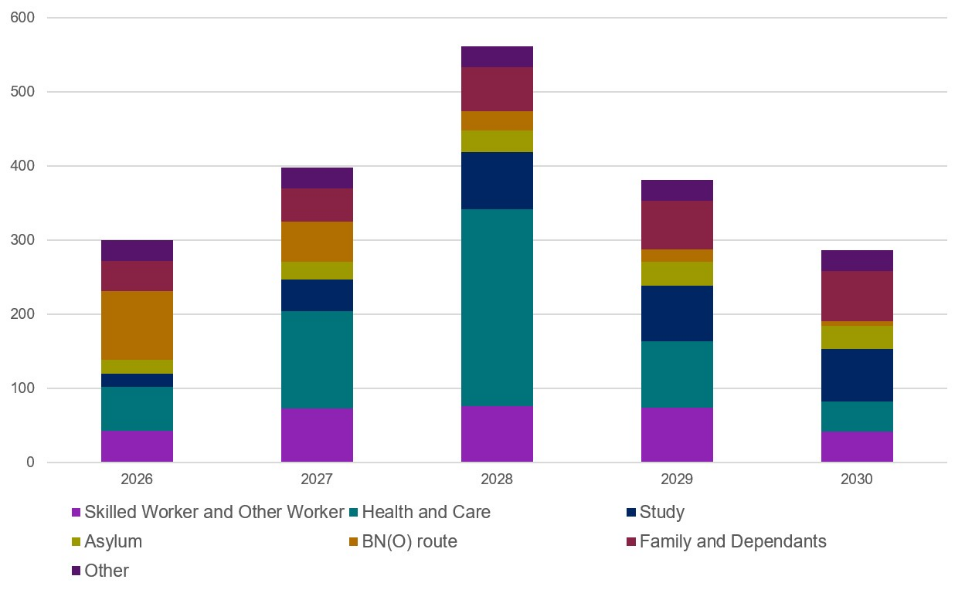
Tables 1 and 2 set out the pathways to settlement under the Earned Settlement framework. In the sections below, analysis has been undertaken to estimate how the volumes of those expected to settle between 2026-2030 in the forecast above fit into each of the pathways.
As set out below, as a result of Earned Settlement, over 500,000 people will now become eligible to settle later than they otherwise would have under current arrangements. This reduces the central estimate to 1.4 million. This includes those on work routes under a 10-year pathway, family not sponsored by a British citizen and refugees who settle in line with Table 2: Refugee Pathways to Settlement.
Illustrative volumes for those on Work routes, including High Talent
3-year pathway
Exceptional economic contribution
- 27,000 Skilled Workers and 17,000 associated dependants.
- 15,000 highly talented migrants on Global Talent and Innovator Founder routes, and 3,000 associated dependants.
5-year pathway
Strong contribution to the UK, including higher earners and public service workers
- 86,000 Skilled Workers and 52,000 associated dependants.
- 136,000 on the Health and Care route (excluding care workers) and 170,000 associated dependants.
- Any of the 196,000 care workers and 186,000 associated dependants who meet all the relevant requirements of their settlement route are eligible for transitional arrangements. (The size of this cohort is uncertain but indicatively it could be in the region of 146,000 care workers and 136,000 dependants.)
10-year pathway
Default for anyone playing by the rules and making a contribution to the UK
- 146,000 Skilled Workers and 85,000 associated dependants.
- Any of the 196,000 care workers and 186,000 associated dependants who do not meet all the relevant requirements of their settlement route and are able to secure further sponsorship. (The size of this cohort is uncertain but indicatively it could be in the region of 50,000 care workers and 50,000 dependants.)
- 6,000 care workers and 5,000 associated dependants who became care workers after the publication of the Immigration White Paper in 2025.
Illustrative volumes for those on non-Work routes
Those on non-work routes follow a range of pathways – the position of much of this cohort remains uncertain.
People on Family routes who have met the core requirements (have not needed to rely on exceptional circumstances) and are sponsored by a British Citizen have an unchanged residence requirement for settlement. Any of the 223,000 people sponsored by a British Citizen and arrived on a Family route that meet the core requirements will continue to be able to settle after 5 years.
The remaining 39,000 people who arrived on a family visa not sponsored by a British citizen will move to a longer pathway to settlement.
There are 105,000 main applicants and 26,000 associated dependants on other routes whose pathway would depend on individual circumstances, some of which may be outside of the Earned Settlement framework.
Illustrative volumes for refugees
There are 133,000 people whose first non-visit grant of leave was due to an asylum claim and 3,000 associated dependants who are expected to settle between 2026-2030. These refugees, as well as those who come in the future, will settle as detailed in Table 2: Refugee Pathways to Settlement. Aside from refugees admitted through the UK Resettlement Scheme and other designated resettlement or sponsorship routes, this cohort will therefore have a minimum 10 years residence requirement.
Some migrants who reach settlement via other routes will also be affected. Migrants who reach settlement via asylum, following entrance on a non-visit visa route, are included within the settlement forecasts for the other initial routes set out in this Annex. It is not possible to disaggregate these; however, this cohort will also have a minimum 10 years residence requirement.
There are 4,000 people on resettlement schemes (not including Afghan schemes) expected to settle between 2026-2030. This cohort would settle in 5 years subject to requirements as outlined in Table 2: Refugee Pathways to Settlement.
Illustrative volumes for those outside Earned Settlement
Outside the scope for Earned Settlement, there are:
- 117,000 BN(O) main applicant visa holders expected to settle along with 78,000 BN(O) dependant visa holders.
- 49,000 main visa holders who arrived on other out of scope routes, such as direct to settlement and Afghan schemes, and 22,000 associated dependants.
Annex B: The economic case for change
The Earned Settlement Framework requires migrants to make a genuine contribution to the UK. The reformed system will reward individuals who have made a sustained and measurable contribution to the UK, on the principle that any accelerated path to settlement should be earned through active participation in the economy.
At a minimum, individuals are required to make a genuine contribution to the UK by having annual earnings above £12,571 for a minimum of three years, in line with 2026/27 thresholds for paying National Insurance Contributions (NICs). Accelerated pathways to settlement are available for those who make a further sustained contribution either by earning over the higher tax rate threshold in England (£50,271) for a 5-year path or, the additional tax rate in England (£125,141) for a 3-year path. In addition, those who have made an active contribution in other ways, for example through working in a public sector occupation, will be on a 5-year path.
The fiscal contribution of migrants over a lifetime
Settlement confers the right to remain in the UK indefinitely, and it is therefore appropriate to consider the impact migrants with different economic characteristics make over their lifetime.
The Migration Advisory Committee (MAC) developed a modelling framework, set out in their 2025 publication The Fiscal Impact of Immigration: Static and Dynamic Estimates for the UK, which estimates the net fiscal impact of an individual over their lifetime. It compares the government revenue associated with an individual with the public expenditure allocated to them in each future year they are expected to remain in the UK.
The Home Office has undertaken analysis of the Earned Settlement framework using the MAC fiscal modelling framework to set out the case for change. The Home Office has made updates to the data and assumptions used in applying the framework which are set out at the end of this Annex. The resulting outputs are therefore Home Office estimates and responsibility for the analysis rests with the Home Office rather than the MAC.
Fiscal modelling – baseline contribution
The Earned Settlement framework will encourage migrants on non-sponsored routes to enter employment before applying for settlement, and reward those employed at higher salaries for their increased contribution. Home Office modelling illustrates the fiscal difference between the current Skilled Worker general salary threshold and the two earnings levels set out in this framework that lead to reduced settlement pathways.
An individual earning £41,700, the current Skilled Worker general salary threshold, is estimated to have a lifetime net fiscal impact of around £347,000.
An individual earning £50,271, the minimum to qualify for Settlement after 5 years, is estimated to have a lifetime net fiscal impact of around £456,000, around £109,000 higher than an individual earning £41,700.
An individual earning £125,141, the minimum to qualify for settlement after 3 years, is estimated to have a lifetime net fiscal impact of around £1.53m, around £1.08m higher than an individual earning £50,271.
Figure B1: Cumulative lifetime fiscal impacts of Skilled Workers by salary threshold and years since arrival
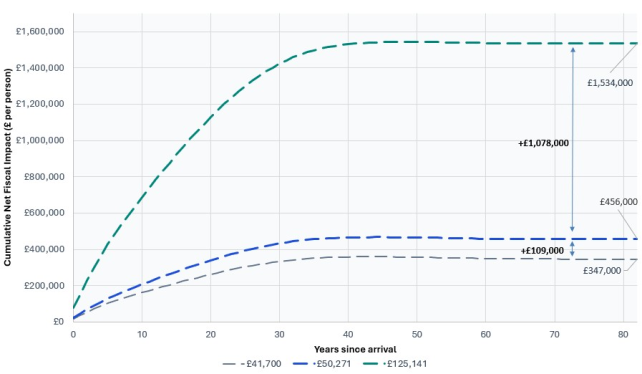
The examples above focus on the fiscal impact of the main applicant. However, the overall fiscal impact associated with migration also depends on any accompanying dependants. Therefore, a family level assessment needs to consider the fiscal contribution of the main applicant, alongside the revenues and public expenditure associated with adult and child dependants.
Adult dependants can contribute through employment and taxation, although their earnings and employment profiles may differ from those of the main applicant. Child dependants primarily accrue public expenditure costs while they are children, particularly through education and health care. As a result, a main applicant can have a strongly positive net fiscal impact while the fiscal contribution of the family as a whole is lower once dependants are included. The number and type of dependants is therefore an important part of the overall fiscal assessment.
Fiscal modelling – Impact of Earned Settlement
Earned Settlement has an impact through four primary channels:
For those on a path to settlement of 10 years:
Individuals could wait the additional 5 years to settle. In practice, this has a fiscally positive impact as it would result in delaying access to public funds for five years. There is a further ambiguous impact, as in one direction individuals are required to remain employed over this period, while in the other, evidence suggests removing sponsorship conditions when settled can lead to an increase in salary by allowing greater labour market flexibility.
Individuals could attempt to change their employment to a different occupation or employer to achieve settlement more quickly. In practice, for those that are able, this has a fiscally positive impact.
Individuals could choose to leave the UK, or future inflows could be deterred from coming. In practice this could have either a fiscally positive or a fiscally negative impact depending on salary and number of dependants.
For those on a path to settlement of 3 years:
- Additional future inflows with an exceptionally high salary could be incentivised to come to the UK. In practice this has a significantly fiscally positive impact.
Individuals on the 5-year pathway will not be impacted by the introduction of Earned Settlement and will remain on the current path to settlement of 5 years.
The magnitude of the impact of Earned Settlement will depend on the behaviour of the individuals in each of the respective pathways, set out in Annex A.
Recognising the importance of drawing out these impacts thoroughly, a full Impact Assessment will be prepared to accompany the implementation of Earned Settlement, drawing on the results of the Consultation and Targeted Research that have been published alongside this response.
Further detail on fiscal methodology
The dynamic fiscal model estimates the fiscal impact of migrants over the time they are expected to remain in the UK. It starts with information on characteristics such as age, earnings, employment and visa route, then projects how employment and earnings change over the lifecycle. These determine the government revenues associated with each individual, including Income Tax, National Insurance, indirect taxes and other revenues.
The model also estimates the public expenditure associated with that individual over time. This includes benefits where eligible, health care, education, public services, social care and State Pension expenditure. Combining these revenues and expenditures gives the net fiscal impact in each year. The lifetime estimate brings these annual impacts together, while allowing for the probability that an individual remains in the UK and survives to each future year. The model also applies growth and discounting assumptions.
Differences between the MAC and Home Office estimates
The Home Office’s analysis retains the broad structure of the MAC’s dynamic fiscal model, while updating some of the underlying evidence and assumptions to reflect more recent or refined data. This includes revised Home Office and HMRC data on migrant employment and earnings and, use of DWP RAPID data to better reflect migrants’ benefit receipts. Evidence on the likelihood of Health and Care Workers remaining in the UK has also been updated, resulting in a central settlement assumption of around 85% remaining, compared with around 67% previously. The updates affect the earnings, tax, benefit and population profiles captured over time and, consequently, the resulting lifetime fiscal estimates.
Lifetime fiscal impact: illustrative example for Skilled Workers
The three examples below illustrate how the different elements of the model combine to produce a lifetime net fiscal impact. During the main working years, earnings are associated with Income Tax and National Insurance contributions, as well as indirect taxes and other government revenues. These revenues are generally greater than the public expenditure attributed to the individual during this part of the lifecycle, so cumulative net fiscal impact rises over time.
As individuals become older, the balance gradually changes. Employment and earnings fall, reducing tax revenues, while expenditure on areas such as health care, social care and State Pension increases. The annual fiscal contribution becomes smaller and can turn negative later in life, causing cumulative net fiscal impact to flatten or decline.
Across the three examples, higher earnings are associated with stronger positive fiscal contributions over the working life, because they result in higher direct and indirect tax revenues. While all individuals face increasing public expenditure later in life, the larger working life contributions of higher earners mean that they retain a substantially higher positive lifetime net fiscal impact overall.
Figure B2: How net fiscal impact accumulates over the lifecycle for a Skilled Worker earning £41,700
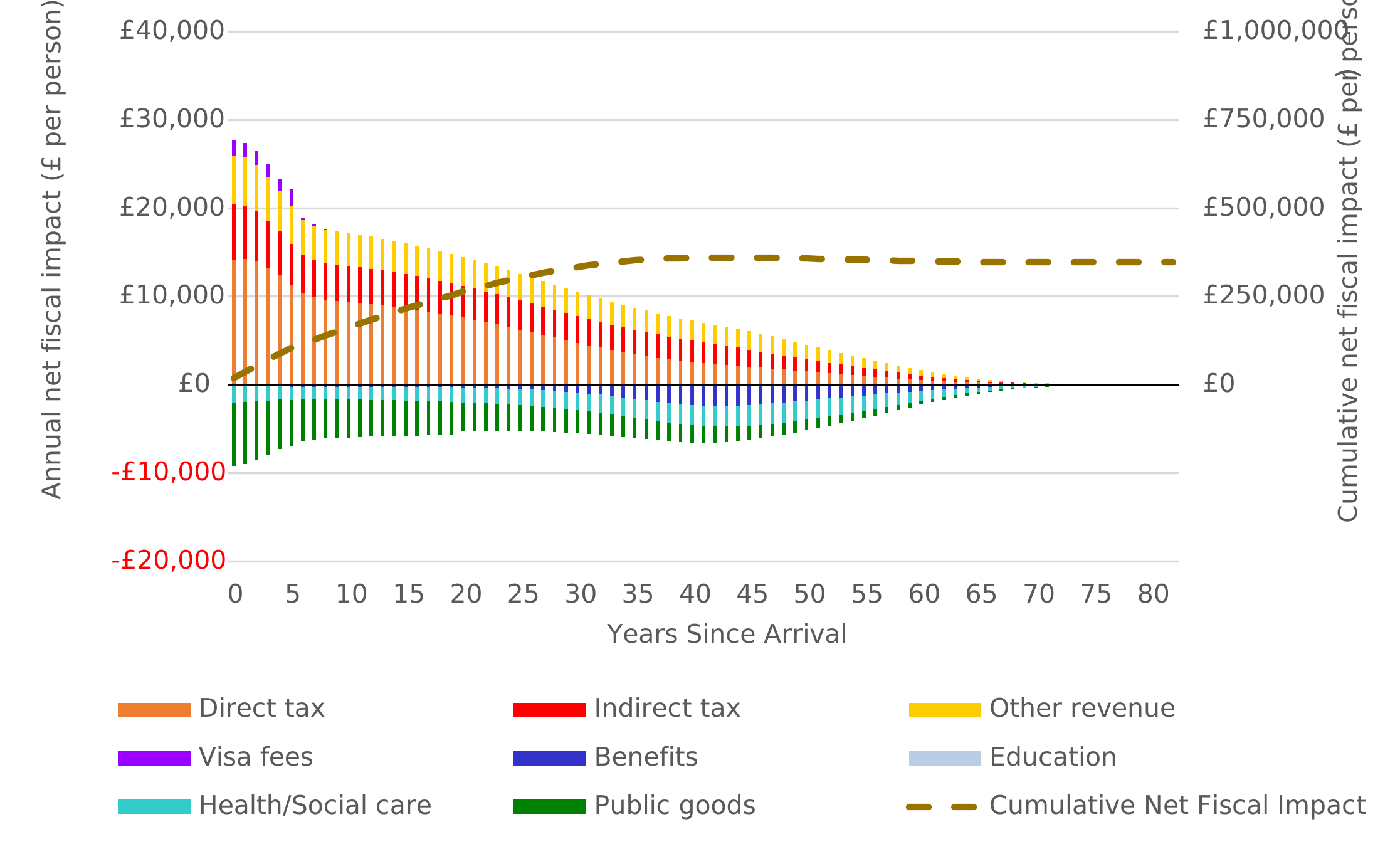
Figure B3: How net fiscal impact accumulates over the lifecycle for a Skilled Worker earning £50,271
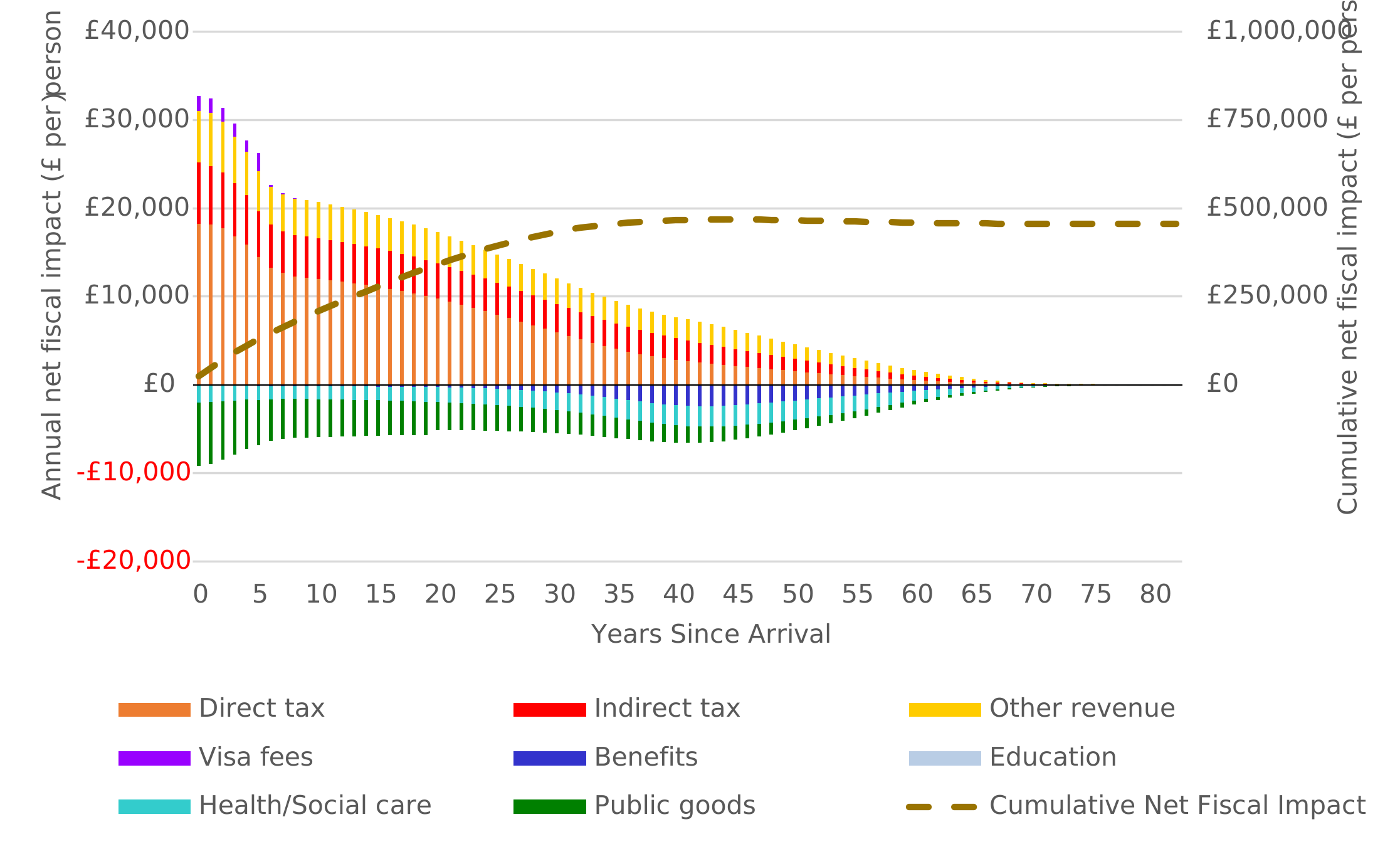
Figure B4: How net fiscal impact accumulates over the lifecycle for a Skilled Worker earning £125,141
Annex C: Qualifying public service occupations for the public service discount
The table below sets out qualifying occupations for the public service discount (enabling applicants to apply for settlement within the 5-year pathway). The list is derived from Table 3 Appendix Skilled Occupations (health and education SOC 2020 occupations where going rates are based on national pay scales)
Occupation code title
- Generalist medical practitioners
- Specialist medical practitioners
- Physiotherapists
- Occupational therapists
- Speech and language therapists
- Psychotherapists and cognitive behaviour therapists
- Clinical psychologists
- Other psychologists
- Therapy professionals not elsewhere classified
- Midwifery nurses
- Registered community nurses
- Registered specialist nurses
- Registered nurse practitioners
- Registered mental health nurses
- Registered children’s nurses
- Other registered nursing professionals
- Pharmacists
*Optometrists - Dental practitioners
- Medical radiographers
- Paramedics
- Podiatrists
- Other health professionals not elsewhere classified
- Further education teaching professional
- Secondary education teaching professionals
- Primary education teaching professionals
- Nursery education teaching professionals
- Special and additional needs education teaching professionals
- Head teachers and principals
- Social workers
Copyright
© Crown copyright 2026
This publication is licensed under the terms of the Open Government Licence v3.0 except where otherwise stated.
Where we have identified any third party copyright information you will need to obtain permission from the copyright holders concerned.
Enquiries
Any enquiries regarding this publication should be sent to us via:
or
Home Office
2 Marsham Street
London
SW1P 4DF
Source: www.gov.uk