
Since the late 1940s, the United States has been the leading military and diplomatic power on the world stage, navigating multiple international crises while also assuring relative global stability.
As president emeritus of the Council on Foreign Relations and former director of policy planning for the State Department during the George W. Bush administration, diplomat and scholar Richard Haass has, over three decades, witnessed various changes in American foreign policy.
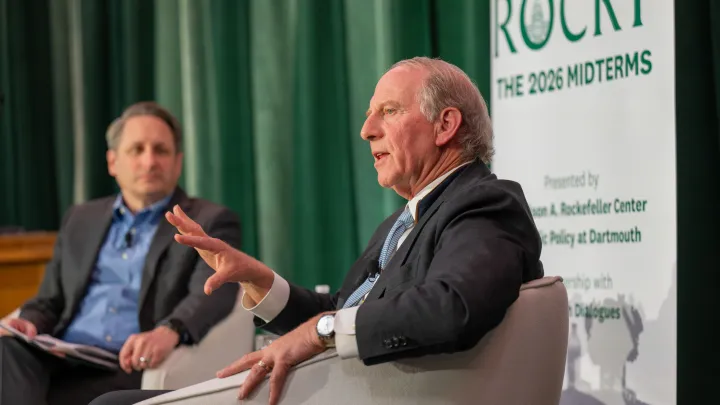
But during the second Trump administration, which has expressed skepticism about the value of international commitments, “the biggest single change in the world is that the United States has fundamental doubts, not about its ability, but about its willingness to play the sort of outsized role that we have played for 80 years,” Haass said during a Nov. 12 discussion sponsored by the Rockefeller Center for Public Policythe John Sloan Dickey Center for International Understandingand Dartmouth Dialogues. Professor of Government Benjamin Valentinothe coordinator of the War and Peace Fellows program, was the moderator.
“We’re at a pivotal moment where the United States has essentially pulled back from its role, and it’s not quite clear what’s going to take our place. And that’s why this is such a consequential moment in history,” Haass said during the talk, which was attended by about 110 people in Filene Auditorium. Some 400 people have watched online.
Quote
I don’t think the midterm elections will make a whole lot of difference when it comes to America’s role in the world.
A week after the midterm elections, which saw Democrats win House and Senate seats that were once thought untouchable, Haass, who said he is a Republican, said that the country now faces “a very interesting experiment with divided government. I’m not smart enough to know how it’s going to play out, but I don’t think it’s going to play out largely on the turf of foreign policy.”
If anything, Haass observed, “I don’t think the midterm elections will make a whole lot of difference when it comes to America’s role in the world. You may welcome that; and you may be unhappy with what I’ve just said.”
Congress is not an equal partner to presidential power; rather, “it’s a distinctly minority partner when it comes to national security policy,” Haass said.
In addition to his time at the State Department, Haass from 1989 to 1993 was special assistant to President George H.W. Bush and senior director for Near East and South Asian affairs on the staff of the National Security Council and also served as U.S. envoy to the Cyprus and Northern Ireland negotiations and was the U.S. government’s coordinator for the future of Afghanistan after 9/11.
Now senior counselor with Centerview Partners, Haass said that while President Donald Trump has departed from norms in terms of the foreign policy he pursues, he is only the latest in a series of presidents to rely overwhelmingly on executive power. “If you think about the hundreds of times presidents of the United States have ordered the use of military force from small to large, virtually 99% of them were done without constitutional declarations of war,” Haass said.
Where Congress could make a significant difference in American foreign policy, Haass said, is to pass legislation that would “provide Ukraine with meaningful economic and military help” in its nearly five-year-war of attrition with Russia. If Trump decided to veto such legislation, then Congress now has the votes to override the veto, Haass said.
Assistance to Ukraine would be “great for security and stability in Europe,” and it would be a boon to Trump himself, given his aspirations to be a peacemaker in Europe, Haass said.
Without American assistance to Ukraine, Russian leader Vladimir Putin, whose primary interest is to retain power, has no incentive to make peace, Haass added.
Haass said that what has rattled allies during the second Trump administration is its abrupt changes in policy and tone, and the sense that the ground underneath them is shifting.
“I think the conversation every government around the world is having, and I know this because I’ve had the conversation with them, is to what extent they can continue to rely on the United States; to what extent do they become more self sufficient; to what extent they define new partners; and to what extent they accommodate or come to some kind of terms with dangerous countries in their neighborhood,” Haass said.
Countries around the world that assumed they could rely on American foreign policy stability are now diversifying their foreign policy portfolio, Haass said. The paradox of the second Trump administration’s foreign policy is the president’s consequential decision to go into Iran, Haass said.
“And that is a decision that is totally, totally, totally at odds with his own foreign policy. If you read the national security strategy that was published a year ago, if you listened to Donald Trump over the years, this was not the foreign policy he thought he was introducing by going into Iran,” Haass said. “So the only way to make sense of it is that his assumptions about how it would play out were fundamentally different.”
“History has a wicked sense of irony,” Haass added.
Dhruv Gupta ’30 introduces Richard Haass, a former envoy and president emeritus of the Council on Foreign Relations, before his Rockefeller Center talk. (Photo by Kata Sasvari)
Valentino addressed the ongoing conundrum of the war in Gaza. Haass, Valentino noted, is one of the few foreign policy experts to still advocate for a two-state solution for Israel and Palestinians.
While there is virtually no chance at present for a Palestinian state, Haass said, the imperative should be to “reduce the scale and harshness of the Israeli occupation of Gaza. The Palestinians are packed at a level of density that is just simply not right. We’ve got to stop land confiscation in the West Bank and settler violence. That is simply wrong.”
With the rise of China as a dominant world power and its long stated interest in reclaiming Taiwan as part of its overall territory, there is fear that China will go to war to take the island nation by force. Haass is skeptical: “The mainland is so dependent on economic relations with the rest of the world, what it sells and what it buys, that to go to war against Taiwan, risks that.”
China President Xi Jinping may also be weighing the fact that Russia’s invasion of Ukraine, and the United States’ war with Iran, have not gone according to plan.
One of the most interesting under-reported developments in international foreign policy, Haass said, “is the emergence of Japan as a major foreign policy actor. And people forget that Japan is still the world’s third-largest economy. It has one of the world’s most capable militaries.” Japan views an independent Taiwan as part of its defensive strategy.
If the United States could “strengthen the fabric of the nature of our relationship with Taiwan,” tensions between China and Taiwan might ease, Haass said.
In answer to a student question about the strength of the American armed forces, Haass argued that the U.S. government should be focusing on modernizing and augmenting military power.
“We have essentially missed a generation of military modernization. We spend more than anybody else, but we don’t have enough to show for it. So we’ve got to deal with that. But we know we don’t have the luxury of a retreat, but we also don’t have the luxury of not reforming,” Haass said.
Gavin Cameron ’30, who wants to pursue studies in history and neuroscience, attended Haass’s talk because he likes to read about foreign policy. His mother is also Chinese, and so he was particularly interested in Haass’s take on China. If the Trump administration is pursuing a realpolitik with China, that leaves “not only Taiwan vulnerable, but also our ability to project power in Asia, vulnerable. I think that’s not a good thing,” Cameron said.
Source: home.dartmouth.edu