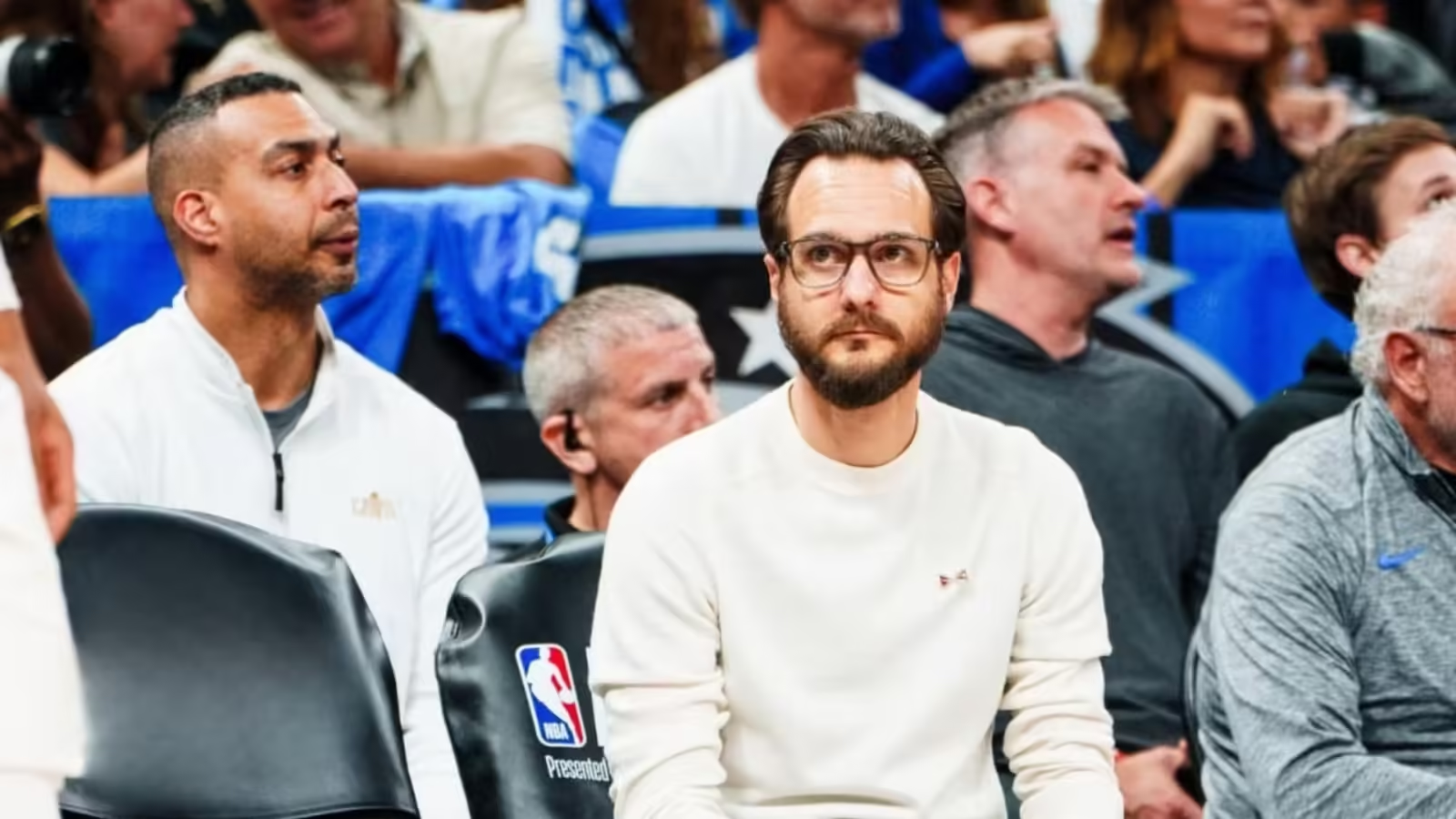

At heart, Steve Spiro – the Cavaliers Senior Director of Player Health / Head Athletic Trainer – is a sports fan.
And you can bet that there isn’t a single player on the Cavs roster who doesn’t know that the man who oversees their day-to-day health concerns isn’t a huge Boston Red Sox and Miami Dolphins fan.
Going into his 17th season with the Wine and Gold, Spiro’s journey, from a kid growing up in Cape Cod straight to the seat directly next to Kenny Atkinson on the Cleveland bench, has been a charmed one.
After completing his undergrad degree at Temple University in Philadelphia, Spiro earned his master’s at the U. of Miami, arriving in Coral Gables the year after the Hurricanes won the National Championship. His first assignment as a grad student was women’s volleyball, but he soon found himself on the sidelines at the unforgettable 2003 Fiesta Bowl against Ohio State.
In 2004 – the same year the big league club broke the Curse of the Bambino – Spiro moved on to an internship with the Red Sox Triple-A affiliate in Pawtucket before returning to Temple, where he joined the men’s basketball staff under legendary head coach, John Chaney. And during Spiro’s six-year stay with his alma mater – the last four alongside Fran Dunphy — the Owls reached the Elite 8 on two occasions.
That’s when fate finally brought Spiro to the North Coast.
The summer of 2010 is one that Cavalier fans remember well. On July 8 of that summer, following Cleveland’s capitulation to the Celtics in six games, LeBron James made his Decision to take his talents to South Beach. And with his talents, Numeral 23 took his longtime personal trainer, Mike Mancias – creating an opening on the Cavs training staff. A mutual A-10 friend from the University of Dayton recommended Steve Spiro for the job. And the rest, as they say, is history.
As Cavs.com begins its series to shine a light on the people behind the team that make everything go, today we start with the top dog of the team’s training staff …
Is this job, this career path as a trainer, something you’ve always wanted?
Steve Spiro: I think, if anything, going through high school, you’re unsure what you want to do. You want it to be meaningful; you want to have that answer and not keep searching for it.
I knew I wanted to be in sports. And I was that kid who, eating cereal and reading the newspaper before going to school, I always had the sports section open. I went to bed every night with a sports radio talk on. If the Red Sox were playing, I fell asleep listening to Red Sox games or Celtics games or Bruins games. My dad would wake up in the night and come shut the radio off.
Growing up, I played basketball, played baseball, ran cross country. Played out in the yard with buddies. So, sports was really all I knew, and I loved it. My dad was a physician’s assistant. So, I worked in medicine in the family practice, studying, seeing what he does, knowing how important medicine is in sports.
It was kind of like a perfect storm for me to continue to stay involved and be around the game, see the competition and have a hand in it.
What’s your exact job description and what’s your role with the team that you oversee?
Spiro: I was elevated to the position of Head Athletic Trainer before the 2013-14 season. And the job entails someone who helps with collaboration, that helps communication and that drives player care and the initiatives that we do with our guys.
And within our medical group, there’s tenure. Gio (Physical Therapist George Sibel) has been here for 21 years. (Strength and Conditioning Coach) Derek Millinder has been here the same amount of time as me, and I’m going into my 17th year.
And even now, you know, (Associate Head Athletic Trainer) Albert Padilla, and (Associate Strength and Conditioning Coach) Ed Subel on Derek’s side, they’re on year nine. So, we have a lot of continuity in our group at this stage. And everybody works. Everybody has their shovel, we’re all helping, we’re all helping dig and our hands are dirty. So, for my job, it’s letting really, really good people work. I’m not here to micro-manage our group, but hopefully I can be the voice for them when it’s needed.
I try to collaborate with everybody to bring this group together, and that obviously goes for our doctors at the Cleveland Clinic – Dr. Rosneck and Dr. Figler – and how incredibly important they are. And I can’t tell you how much I value their integration into what we do.
They’re obviously Cleveland Clinic doctors, but they’re ours and they’re woven into the fabric of what we’re doing and they help drive decisions and bounce ideas off of us and we get their thoughts and opinions to help us take care of our guys.
So, that’s kind of my job in a nutshell, and obviously a big part of it is managing the layers of communication.
The NBA has grown during my time. Performance teams and medical teams have grown. Coaching staffs have grown, front office staffs have grown. And so, the ability to communicate as best you can is critical – speaking with agents, speaking in the front office, speaking to coaches, making sure that everybody’s aware of what the plan is with these guys as it relates to injury, injury prevention and just overall player care.
It’s not perfect, of course, because there’s just so many layers that are involved. But that’s kind of my job, to get that information out there while still being hands on with our guys because that’s really what I want to do. The training room is kind of like your barbershop. You want to create an environment where guys can be their authentic self and feel welcome, where they can come in and let their hair down, so to speak. That just drives really good care for our guys, because they know at the end of the day, our group is here for their best interests.
Do you have the final say on whether a guy is able to play or return to the game? How does that chain of command work?
Spiro: I guess the short answer to that is yes, but obviously it’s so nuanced.
It varies, depending upon player situation, time and score, or however you want to break it down. I am definitely one piece, one opinion in the moment, in-game. I think I’m looked to as that person, whether somebody has an acute injury in game or whatever the situation is. Are we removing them from the bench? Are we going back into the locker room? Are we getting our docs involved and then helping them with their decision.
But the frontline stuff, yeah, of course, that’s the job of the athletic trainer and mine, specifically. Obviously, when you have somebody that’s out for an extended time, returning from an injury on a return-to-play basis, obviously more guys are all brought into the mix, medical and performance staff are brought into the mix and to try to get a decision to be a unanimous if a player is healthy. But it’s not always that cut and dried.
And I think a big decisionmaker in that situation is the player himself. And that’s why we value the relationships with our guys so much. When there’s a positive relationship between medical staff, performance staff, and the player, it really helps.
They want to be out there when the ball is in the air. But we also have to make sure they way there, through all the different tools and methods and testing that we have to get them back to 100 percent.
A number of years ago, there was one, two athletic trainers and maybe a strength coach and the head coach, there was a lot fewer people to be able to make the best determination with the information available. But nowadays, you have so many different professionals that help move the needle for the player. And it’s our job to connect everyone to make the final decision.
They can be some hard very hard conversations. In-game, nobody wants to talk to me, right? Like, you know when you go down and check on Player A, you’re getting yelled at.
At the end of the day, you know what they want. But, again, it’s your read as a clinician and your read on your relationship with him to know: ‘OK, this guy is alright.’ Or ‘I can watch him a little bit longer before I have to intervene.’ Or there’s the other way. You have to say: ‘No, man, we’re going in the back. I don’t like it for this reason and you’re not going back in.’ There’s a lot of emotion. Of course there is.
How are you best able to do your job? You do your job early with your athletes, to get them to know who you are and what you’re about and what your motivations are for them. And I just think that’s really helpful in those high-stakes moments. If you have their best interests at heart, they understand that. They may not like a decision, but they know once things calm down a little bit, that the only thing I care about is their well-being.
Your job on gameday can go from early morning to late night – from before shootaround to several hours after the game. How exactly does your gameday unfold?
Spiro: I think just like the players’ gameday, it’s routine-based.
And when you get into that routine – taking care of the guys and what guys have available to them and what you’re doing to help solve today’s problems. The more consistent you are, the more effective you’ll be. But there’s plenty of times when that routine gets thrown out the window because of a specific situation, say an injury, and maybe you’re not sure if a guy’s playing and they’re questionable that night.
And what you’re trying to do is either get him ready or, again, communicate to everybody that he’s not.
Sometimes, the day is stable, where you know who’s gonna go that night and things are in place and there’s no surprises. Sometimes not.
And that’s also kind of a fun part of a job, that no day is really the same. I mean, you can wake up to a couple text messages that a player’s been up all night sick, or something happened that impacts what you thought were the decisions for that day, and things get changed.
On the road, you’re at the hotel, you’re trying to see as many guys you can, or see guys pre-shootaround. Obviously, there’s work that’s done beforehand in the weightroom with our strength coaches. So, who do you need to check in with? Who has something lingering or something going on that needs some attention?
There are obviously your treatments in the morning, there’s morning shootaround, there’s communication with players and coaches and once shootaround’s over, you hope to be in a pretty stable spot.
And then there are times where it’s a gametime decision. And truly, you don’t want too many of those. Like, my mantra is: How you are during shooting and how you’re going through shootaround in the morning is probably how you’re going to feel at night. There’s probably not going to be a lot of drastic changes one way or another.
But there are times when a guy says: ‘I want to try it out tonight; I want to see how I’m feeling pregame.’ And there are instances that have to step in and say: ‘No, you’re not. Let’s live to fight another day.’
And then you have to respect the guys’ routines too.
You know, in the afternoon guys like their naps and they want their time, and that’s OK. Obviously, you’re getting to the gym early, you’re getting everything set up, you’re prepping with the guys.
And for me, it’s having my finger on that pulse of: Hey, this guy’s questionable. People need to know whether they’re going or not going that night, making sure every party is informed as to what’s going on. Because that’s going to be your real-time situation an hour-and-a-half, maybe even up to an hour before the game, where you go to the head coach or you go to front office guys and say, ‘Hey, this guy’s in’ or ‘Hey, this guy’s out.’ It’s very time-sensitive.
And sometimes, you gotta be the bad guy. You’re usually the deliverer of bad news, right?
When you walk into a room an hour before a game or an hour before practice, you’re usually bringing bad news. And that’s hard. We’re all human, and you want to be seen the other way. Because we kind of feel like we’re doing what we can to keep guys playing. But obviously there are times that it impedes upon a game and you’re the deliverer of bad news.
That’s a stress point. But you accept it and you love what you do and you keep working and it’s extremely gratifying.
You mentioned that you’re going into season 17 on the job. How much have things changed since you first started?
Spiro: I think the best way to say it – and I think I’ve said this recently – is, and I don’t want to be construed negatively, but everything is just “more.”
The job is more. There’s more responsibility, more pressure. There’s more staff. Even the rosters are more. I mean, we’ve got more players. And I don’t want the “more” word to be looked at as something negative. That’s just the reality, right? And with more of everything comes greater responsibility.
But really, that responsibility’s always been there. So, it’s a step in my career, recognizing how to best take care of the guys while staying up to date on best practices.
The NBA season, it used to be if you got married, odds are you got married in late July or August, right? Because that was inherently the time that it was a little bit of a reprieve on the calendar.
And again, I don’t want to make it sound negative, but now there’s no such thing as an ‘offseason.’ There’s just ‘next season.’ And you just roll from one thing to another, making sure that what you have in your possession to take care of your guys throughout – not just the 82 games plus playoffs, but even in the offseason. What are guys dealing with? How are you helping them in the offseason? If they’re not in town, you’re site- visiting them. You’re convincing them maybe to come back to Cleveland.
It’s always been 365-day job. But now there’s just more moving pieces. You know, the travel party, player contracts, the money. Everything is more, right?
And so, with that, I just think the pressure just continues to ratchet up, the pressure to get it right. And for me, specifically, our job on the medical side and the performance side is: Do we have the right number of bodies filling in these positions within our staff that best take care of our guys to be able to handle that “more.”
And I think we do everything we can – from our dieticians, our sports scientists, our strength and conditioning coaches, our physical therapists, our assistants, our team doctors, our network of doctors at the Clinic – to be ready for any situation that we face to best take care of our guys.
Source: www.nba.com