(Bloomberg) — A century after Walt Disney Co. transfixed moviegoers with a hand-drawn mouse appearing on a silver screen with synchronized sound, the world’s biggest entertainment company is now exploring a new frontier in animation: artificial intelligence. In December, the company will bring Ozzy Fox, a children’s series rendered by AI, to its flagship Disney+ streaming platform.Ozzy Fox, about an orange character who regularly bursts into song, is the product of a year-long collaboration with French startup Animaj, whose AI tools convert artists’ hand-drawn images and text instructions into three-dimensional animation. It’s just one example of a wider mission, led by Chief Executive Officer Josh D’Amaro, to bring the 103-year-old home of Disney princesses, Pixar and Star Wars into the AI era.Just one week into D’Amaro’s tenure as CEO, OpenAI shuttered its Sora text-to-video platform, scuttling a planned three-year partnership that would have seen Disney invest $1 billion into the startup and license more than 200 of its characters for use in AI-generated short videos. Since then, the company has charted its own course and is leaning on artificial intelligence to upgrade every one of its units from finance to film. At the same time, Disney has been looking to cut costs, moves that have resulted in regular rounds of layoffs as the company’s traditional TV channels struggle to retain viewers and advertisers.
Most Read from Bloomberg
D’Amaro’s embrace of AI marks a new approach for Disney. Under former CEO Bob Iger, Disney employed the carrot and the stick. It litigated against startups including Midjourney Inc. and MiniMax over alleged copyright infringement, after images featuring Mickey Mouse brandishing a machine gun or crude depictions of Disney princesses appeared on social media, while collaborating with one, OpenAI, which promised to act responsibly.
The false start of Disney’s collapsed deal with OpenAI and the threat of AI replacing artists speaks to Hollywood’s struggle to reconcile the promise of cheaper, faster filmmaking with fears that it could undermine the creative talent and intellectual property on which the industry depends. Those concerns fueled the crippling actors’ and writers’ strikes in 2023 and are simmering throughout an economic downturn in Los Angeles.
Few companies have more on the line than Disney. After more than $100 billion worth of acquisitions in the past two decades, from Marvel to Pixar, Star Wars owner Lucasfilm and The Simpsons owner 21st Century Fox, Disney has one of the industry’s richest troves of characters, stories and franchises. Disney hasn’t articulated an overall AI strategy, but teams across the company are experimenting with different applications, hinting at the potential for broad use of the technology. In September, the company named Karandeep Anand — a technology veteran who most recently lead an AI startup — as Disney’s first chief technology officer, in a broad signal of the role AI is likely to play in the entertainment giant’s future.Like other Hollywood studios, Disney began by introducing AI in parts of the business where it is least likely to encounter creative resistance.The company is building Disney Financial Insights — or D-Fi — an AI-enabled collaboration platform that can replace and automate manual budget reports, bringing visibility, approvals and insights into one place, people familiar with the plans said. It’s also testing AI-powered suggestions with some US subscribers to the flagship Disney+ streaming service. People can speak or choose from suggested prompts to describe what they want to watch, and the algorithm will promote relevant titles.Documents filed with the US Patent and Trade Office hint at bigger ambitions.In Disney’s parks division, a filing earlier this year describes a scenario where an AI-enabled character at the company’s resorts asks guests about their favorite memories to compare them with the character’s own programmed memories, in an exchange that mimics a meaningful conversation between humans.
Disney also patented a mechanism by which AI-enabled microphones can detect minor changes in the sounds of rides to signal to operators what maintenance is required to avoid a potential issue. Patents give an indication of the company’s thinking but don’t guarantee the ideas will come to life.
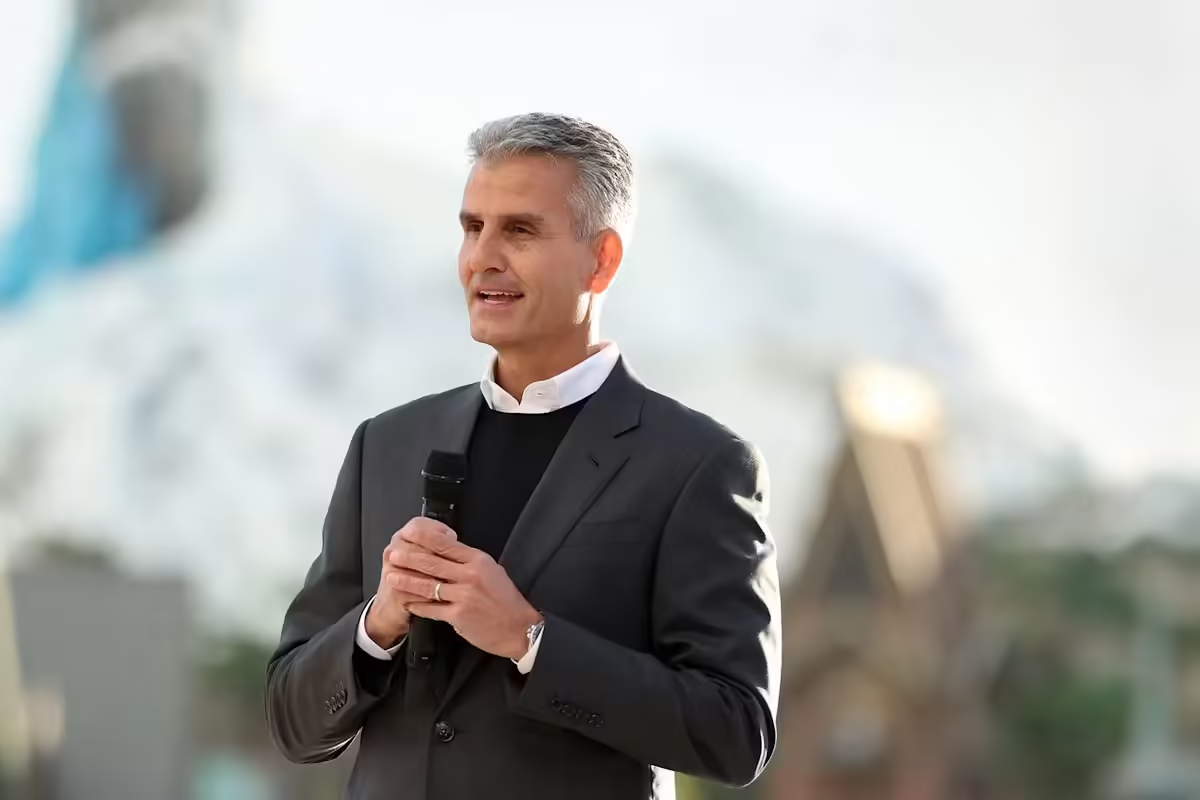
At a media event earlier this month at Disney’s headquarters in Burbank, California, the company showcased how the AI technology of five startups that participated in its annual Accelerator program could improve operations. There were autonomous robots built in the style of characters from the Pixar movie Cars to guide resort guests to parking spaces, and tools for disrupting traditional filmmaking with a hybrid production process that places an actor’s performance into an AI-generated environment.”We’re being very aggressive about exploring emerging technologies and seeing how they can support our creators and help us deliver even more engaging and even more personalized experiences all across the globe,” D’Amaro said at the function.In October, Dana Walden, Disney’s president and chief creative officer, and Alan Bergman, chairman of the entertainment studios, visited Amazon.com Inc.’s MGM studios in Los Angeles to see a demonstration of how the tech giant is using AI to accelerate live-action moviemaking and animation, according to people familiar with the matter. The two companies routinely meet, according to one of the people, who asked not to be named discussing information that’s not public.
The same month, Disney also disclosed that it’s acquiring some of the assets of Character.AI and hiring 60 employees. The chatbot startup filed for bankruptcy after a deluge of lawsuits related to negligence and wrongful deaths. The $20 million deal would give Disney expertise in conversational AI and help it build systems in-house, with more robust safety procedures, that could create new ways for consumers to interact with its characters. Disney could add conversations with characters as a feature on Disney+, though nothing is imminent, the people said.
Disney’s new CTO, Anand, is the former CEO of Character.AI. At Disney, he’ll oversee and centralize the company’s AI efforts. Jamie Voris, who previously oversaw adoption of AI at Disney at the Office of Technology Enablement, and Eddie Drake, who replaced Voris in his previous role of CTO at Walt Disney Studios in 2024, are retiring, according to people familiar with the matter. Neither Voris nor Drake responded to Bloomberg’s requests for comment.
Another way that Disney is expanding its use of AI while retaining control of its intellectual property is through its partnership with Adobe Inc. That relationship got an upgrade earlier this month in a new multi-year agreement that will give Disney early access to Adobe tools, including generative AI and video- and photo-editing software, to support creative endeavors across the company, from ESPN to Disney cruises.
Disney is more focused on controlling the use of their characters and preserving their exclusivity than getting paid by AI companies for training their models on the studio’s content, according to one senior executive familiar with its strategy.
Like Disney’s acquisition of Pixar Animation Studios in 2006, which revolutionized the company’s use of groundbreaking computer graphics and ushered in a new era of animation, D’Amaro sees AI investment as a logical evolution of the Hollywood model.”Technology itself is not the goal,” D’Amaro said at the Accelerator event. “It’s to put technology in the hands of our creators again to create these incredible and immersive stories.”
Most Read from Bloomberg Businessweek
©2026 Bloomberg L.P.
Source: finance.yahoo.com