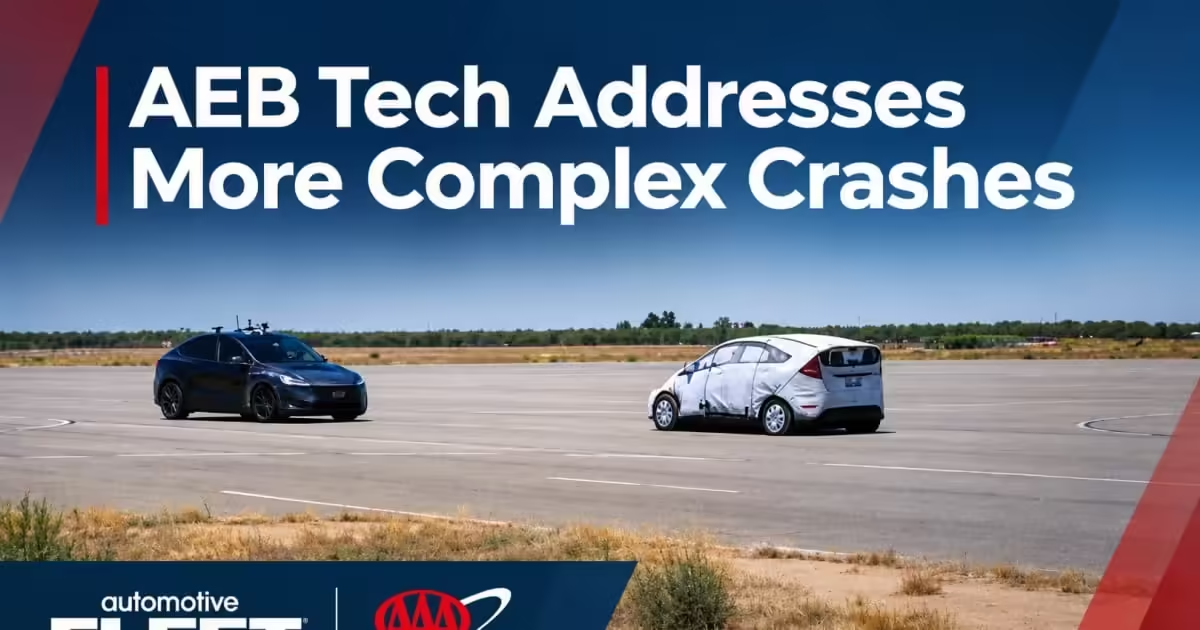

Testing of four 2026 model-year vehicles found that automatic emergency braking prevented collisions in standardized intersection scenarios, but three vehicles failed to avoid crashes when another vehicle turned into their path.
New research from AAA found that automatic emergency braking (AEB) systems designed to prevent intersection crashes perform consistently in standardized testing but may not respond effectively to other common collision scenarios.
AAA tested four 2026 model-year vehicles equipped with standard intersection AEB technology. All four avoided collisions during standardized left-turn tests. However, three of the four vehicles failed to prevent collisions when another vehicle turned into their path from a side road.
The findings raise questions about how fleet managers should evaluate advanced driver-assistance systems (ADAS) when selecting vehicles and developing driver safety programs.
“Intersections are some of the most dangerous places on the road,” said Greg Brannon, AAA’s director of automotive engineering and research. “AEB is making progress in the limited intersection scenarios it is tested to handle. Unfortunately, performance outside those scenarios is spotty.”
How AAA Tested Intersection AEB Systems
AAA partnered with the Automobile Club of Southern California’s Automotive Research Center to evaluate four 2026 model-year vehicles equipped with intersection AEB as standard equipment.
Researchers conducted 74 closed-course test runs under controlled daytime conditions, using a robotic soft vehicle to simulate another vehicle.
Testing included four intersection scenarios:
- Turn-into-path: A vehicle traveling at 30 mph encountered another vehicle turning right into its path from a perpendicular road at 5 mph.
- Standardized left turn: A test vehicle turned left at 9.3 mph across oncoming traffic traveling at 18.6 mph, following Euro NCAP testing procedures.
- Left turn without a turn signal: Researchers repeated the standardized left-turn test without activating the turn signal.
- Left turn with manual steering: A driver manually steered through the left turn with the turn signal activated, replacing robotic steering.
Where Did Intersection AEB Systems Fall Short?
AAA found that collision avoidance varied depending on the scenario.
The largest performance gap occurred during the turn-into-path scenario, when another vehicle entered the test vehicle’s path from a side road.
Three of the four tested vehicles struck the target during every run, while one successfully avoided all collisions.
Researchers also found that removing the turn signal affected one vehicle’s response during the left-turn scenario. That vehicle provided neither a forward collision warning nor automatic braking.
However, replacing robotic steering with manual steering did not affect collision avoidance in the standardized left-turn scenario. All four vehicles warned the driver, applied the brakes and avoided collisions.
Current AEB Testing Standards Leave Gaps
Historically, U.S. vehicle-to-vehicle AEB testing has focused primarily on rear-end collisions.
In 2020, Euro NCAP introduced intersection testing protocols that included left turns across oncoming traffic.
The National Highway Traffic Safety Administration developed a draft Intersection Safety Assist testing procedure in 2019 for research purposes, but a final standard has not been implemented.
According to AAA, existing protocols do not fully evaluate how intersection AEB systems respond to common U.S. crash configurations.
In previous research conducted in 2022, AAA evaluated four vehicles equipped with standard AEB systems that did not include manufacturer-identified intersection AEB functionality.
Those systems failed to provide collision warnings or automatic braking during any test runs involving two intersection crash scenarios.
What Do the Findings Mean for Fleet Safety?
For fleet managers evaluating vehicle safety technology, the findings highlight the importance of understanding what specific AEB systems are designed to detect and prevent.
Although the tested vehicles performed consistently during standardized left-turn scenarios, results varied when another vehicle entered the roadway from a perpendicular direction.
AAA recommends that automakers, researchers, regulators and safety organizations expand intersection AEB testing to include additional crash scenarios and real-world driving conditions.
The organization also advises drivers to treat intersection AEB as an additional safety feature rather than a replacement for attentive driving.
When entering intersections, AAA recommends that drivers consider “covering the brake” by positioning their right foot just above the brake pedal, with their heel on the floor, while remaining prepared to brake or steer if necessary.
For fleet safety programs, the results provide an opportunity to reinforce driver training around ADAS limitations, particularly in intersection scenarios where automatic braking may not activate.
AAA Testing Methodology
AAA conducted 74 closed-course test runs under controlled daytime conditions.
Five runs were planned for each vehicle and configuration. If a vehicle failed to provide either a forward collision warning or automatic braking during the first three runs, researchers stopped testing that configuration to reduce the risk of vehicle damage.
The findings reflect the performance of four 2026 model-year vehicles under the conditions tested and do not necessarily represent the capabilities of all intersection AEB systems.
Source: www.automotive-fleet.com