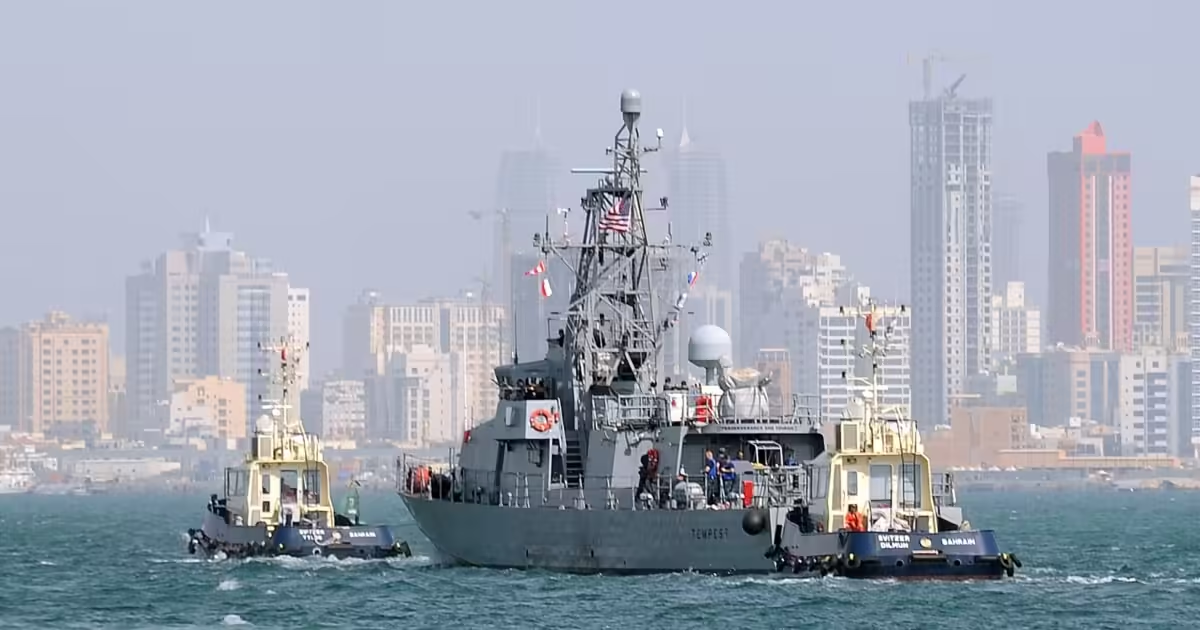

US Central Command (CENTCOM) has denied a claim by Iran’s Islamic Revolutionary Guards Corps (IRGC) that it destroyed a US military early-warning radar in Bahrain in retaliation for an overnight air strike on a port near the Strait of Hormuz.
“The IRGC launched two one-way attack drones toward Bahrain and both were shot down by US forces. There were no injuries or damage,” CENTCOM said.
The initial claim was carried by Iranian state media on November 13. An IRGC statement said its attack was “in response to the enemy’s air aggression against a telecommunications tower in Sirik.”
Earlier, the official Iranian news agency IRNA reported that Sirik, in Hormozgan Province, had been hit by an “enemy” strike. It didn’t name the attacker or give details of damage or casualties.
The IRGC statement also stopped short of directly blaming the United States for the alleged Sirik attack.
The CENTCOM statement made no reference to the claimed attack on Sirik, which sits on the Hormuz coast and hosts part of Iran’s radar and communications network monitoring the waterway. It has been hit repeatedly since the war began with US and Israeli strikes on February 28.
Tehran has previously reported attacks on telecommunications infrastructure in the town and has responded with strikes on US facilities in Bahrain, home to the US Navy’s Fifth Fleet.
The latest exchange comes a day after US President Donald Trump said Washington no longer needed an agreement with Tehran.
“We don’t need a deal with Iran. Those days have long since passed,” Trump wrote on Truth Social on November 12. “We’ve got their money, Hundreds of Billions of Dollars, and we’ve got their Strait!”
In the same post, Trump said he had asked Vice President JD Vance to “focus his complete and total attention” on what he called corruption and crime in Democratic-run cities and states. Vance had spent months leading US efforts to secure a cease-fire and revive nuclear talks with Iran.
The move came a day after The Wall Street Journal reported that Vance was considering face-to-face talks with a senior Iranian security official.
Shayan Samii, a US-based national security analyst, told RFE/RL’s Radio Farda that Trump appeared to be pursuing a policy of “neither war nor negotiation.”
“Trump is now trying to achieve through economic pressure what a military intervention would not bring him,” Samii said. “He has not taken military intervention off the table.” He added that sidelining Vance showed Trump had “put the war file in the hands of” Secretary of State Marco Rubio and Defense Secretary Pete Hegseth.
Samii said mixed messages from Tehran were also undermining its credibility.
“When [Foreign Minister Abbas] Araqchi says we will negotiate, but [security chief] Mohsen Rezaei says there will be no negotiations until America accepts our seven conditions,” he said, world leaders conclude there is “no reliable decision-maker” in the Islamic republic.
The conditions include ending the US naval blockade of Iran, releasing frozen Iranian assets, and halting fighting on all fronts. Rezaei has insisted that Washington accept Tehran’s demands before negotiations can resume or the Strait of Hormuz reopen.
Trump also warned that Iran “will not exist very long any longer” if it killed a senior US official. His remarks followed reports that Treasury Secretary Scott Bessent had been moved to a military base amid Iranian threats.
Asked about his quarters on CNBC News, Bessent said “F the Iranian leadership. I’m not going to be cowered. They have initiated death threats against me…the IRGC, they’re like a dangerous, cornered animal.”
Tension is also rising around Hormuz, which Iran has attempted to close since the early days of the war. On November 12, Iran’s army said two oil tankers caught fire after hitting naval mines in the eastern part of the strait, saying the vessels had entered a “prohibited and unsafe zone.”
There have been numerous reports of explosions on ships in recent weeks, either from drone attacks or from striking mines.
Separately, Iran’s Assembly of Experts, whose main task is appointing the supreme leader, said withdrawal from the Nuclear Nonproliferation Treaty had become an “unavoidable necessity” amid a growing debate in Iran about developing nuclear weapons.
Trump has repeatedly stated that preventing Iran getting nuclear weapons is his primary war aim.
Source: www.rferl.org