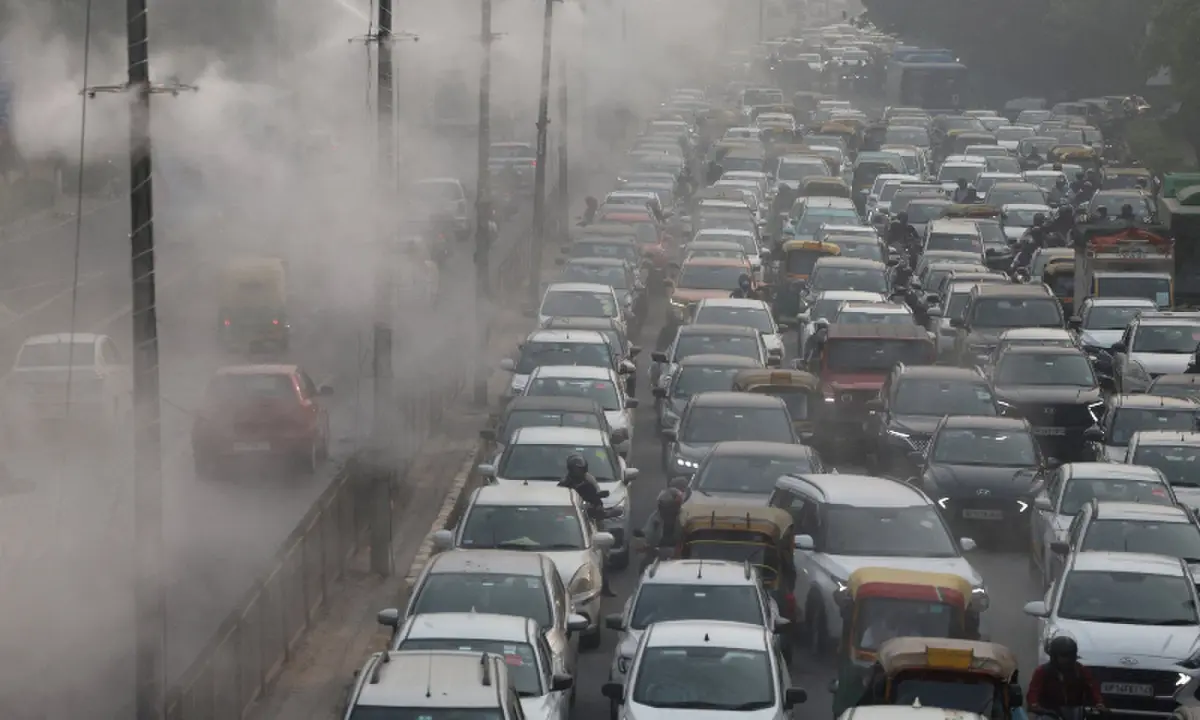

India’s capital, Delhi, overtook Lahore to become the world’s most polluted city on Friday, with air quality reaching hazardous levels and visibility dropping as smog blanketed the city of 20 million people.
Earlier, Delhi’s air quality index (AQI) stood at 334, categorised as “hazardous”, making it the most polluted major city globally, according to Swiss air quality monitoring group IQAirwhich measures pollution levels based on the concentration of pollutants. An AQI reading of up to 50 is considered good, indicating little or no health risk.
India’s official Central Pollution Control Board (CPCB), meanwhile, recorded a higher AQI of 403 in Delhi and classified the air quality as “severe”.
The difference between the Swiss and Indian readings is due to the different AQI scales and methodologies used to calculate and classify air pollution levels.
According to IQAir’s hourly readings, Delhi’s AQI had dropped to 208 by 11am PKT. At the time, Lahore was ranked seventh among the world’s most polluted major cities, with an AQI of 155.
In Delhi, cars and motorcycles emerged from dense smog, which also appeared to obscure street lights on the city’s main roads, videos from news agency YEARS showed.
Pollution is a seasonal problem in many parts of northern Pakistan and India, as the cold, heavy air of winter traps vehicle emissions, construction dust and smoke from agricultural burning.
Friday’s readings marked a drop in Lahore’s pollution levels after the city had ranked as the most polluted major city in the world for several days in a row.
Earlier this week, Lahore’s average PM2.5 concentration was eight times the World Health Organisation’s (WHO) guideline value, according to a report by the Pakistan Air Quality Initiative (PAQI).
The report, released on Tuesday, said the number of likely crop-residue fires in Punjab, Pakistan, remained almost unchanged from the corresponding period last year.
Lahore’s average PM2.5 concentration stood at 126 micrograms per cubic metre during the period, exceeding the 24-hour National Environmental Quality Standards (NEQS) on all 40 days for which valid data were available. The average was 11pc lower than in the corresponding period in 2025.
Satellite instruments detected 18,825 fires across Punjab, Pakistan, 89 per cent of which were classified as likely crop-residue burning. The highest daily count was recorded on Nov 1, with 1,102 detections.
The 24-hour National Environmental Quality Standards (NEQS) were exceeded on all 40 days for which valid data were available. The average concentration was 11pc lower than during the corresponding period in 2025.
However, the report cautioned that the association did not establish the precise contribution of crop-residue burning to urban pollution, as stagnant weather conditions and reduced atmospheric dispersion also contributed to the accumulation of pollutants.
EPA intensifies action
After Lahore’s air quality improved on Friday, Punjab Environment Protection Agency (EPA) spokesperson Sajjad Bashir outlined actions that he said had been intensified against major sources of pollution.
He said authorities had intensified action against polluting industries and brick kilns, agricultural residue burning, smoky vehicles and open burning of waste.
The spokesperson said comparative data for the period between Jan 1 and Nov 10 this year showed a “substantial increase” in inspections, regulatory action and financial penalties against polluting industries and brick kilns compared to the corresponding period last year.
Brick kiln inspections increased from 37,838 in 2025 to 80,594 during this period while authorities demolished 1,372 kilns during the current year against 1,223 last year. Moreover, 864 kilns were sealed for violations this year. Financial penalties, meanwhile, increased to Rs163.35 million compared to Rs156.05m in 2025, he added.
Industrial inspections rose from 38,098 in 2025 to 47,643 in 2026 for the period between Jan 1 and Nov 10 while 1,419 industrial units were sealed and fines totalling Rs216.98m were imposed, more than double the Rs101.41m imposed during the corresponding period in 2025.
The department also instensified action against prohibited plastic material, with confiscations rising to 438,159 kilogrammes from 378,630kg last year.
Fines imposed in cases involving prohibited plastic materials also increased to Rs34.21m from approximately Rs7.63m in 2025, according to the comparative figures.
Action against restaurant emissions was also part of the enforcement campaign, with 9,802 visits conducted during the current year. These resulted in the installation of 3,750 suction hoods and the sealing of 1,263 establishments, the data showed.
The department also continued action against construction-related pollution and fugitive dust through inspections, notices, sealing of premises and the installation of mist sprinklers.
Bashir said favourable weather had helped disperse pollutants, but added that the improvement could not be sustained through weather conditions alone.
He stressed the need for continued enforcement against industries, brick kilns, agricultural burning, smoky vehicles and open waste burning beyond the smog season to prevent pollution levels from rising again.
Source: www.dawn.com