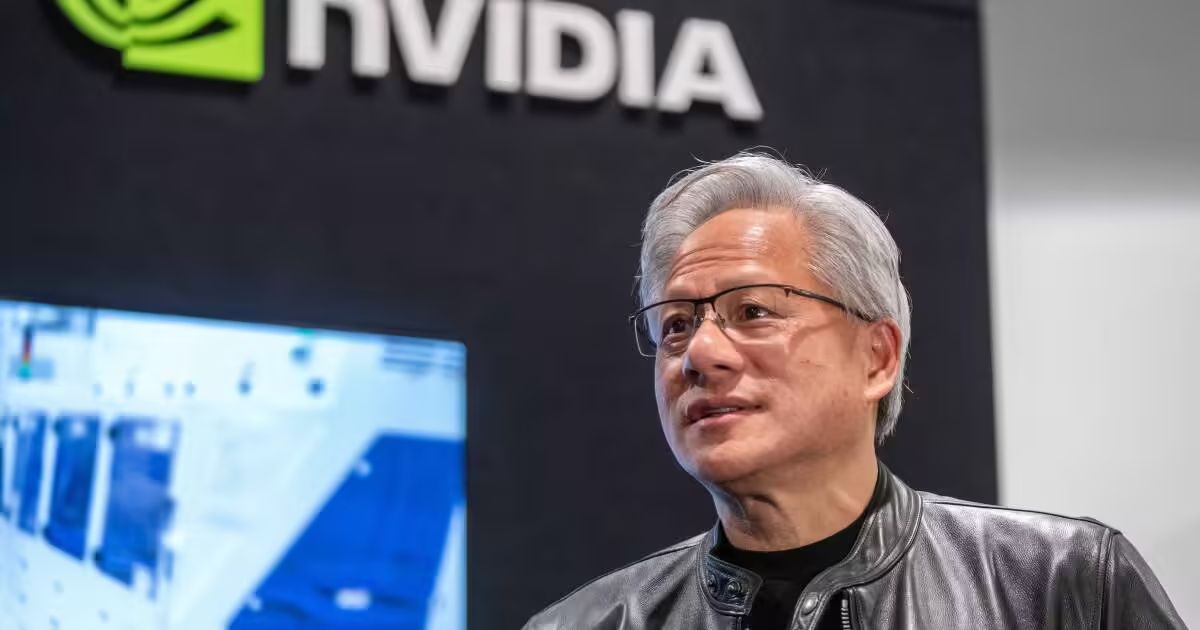

Nvidia’s stock value tumbled on Wall Street Thursday after CEO Jensen Huang resigned following news of his affairs with an alleged Chinese spy and a company employee.
Nvidia (Nasdaq: NVDA) shares began the day down 10%, but rebounded somewhat to end the day down 4.4%, shaving about $180 billion off the value of the company. It also dragged down other technology stocks, causing the Nasdaq 100 technology index to fall 1.1%. All this comes as the company’s board of directors scrambled to name his replacement.
Nvidia is based in Santa Clara, California, but has an office in Westford that reportedly employs dozens of engineers and other workers.
Kristina Minnick, a professor of finance at Bentley University, said the early drop in stock price of Nvidia was a big deal not only for Nvidia shareholders, but for the overall stock market.
“You don’t even have to have purchased a share of Nvidia, but if you own an S&P index fund, you’re exposed to Nvidia because of their market cap,” Minnick said.
As one of the most valuable companies in the world, Nvidia has an oversized influence on all the major stock market indexes, she said.
“A sharp decline can reduce retirement accounts even for people who were never directly Nvidia shareholders,” she added. “Corporate governance failures at companies this large can affect millions of Americans’ retirement savings, even if they were not directly invested in those companies.”
But Minnick cautions anyone with 401Ks to stay calm when it comes to their stock portfolios.
“I wouldn’t act too impulsively,” she said. “I mean, you know, my advice is pretty simple. Don’t panic. Don’t sell just because of this huge drop. It’s not like Nvidia has lost its technology. It hasn’t lost its engineers. It hasn’t lost its competitive advantage overnight.”
She said that what’s happening with the stock market is uncertainty about the leadership, and markets tend to react strongly to uncertainty. If you’re investing for retirement, and you should be thinking long-term and not reacting to daily headlines.
The U.S. federal government is investigating Huang’s affair with a Chinese businesswoman, who is suspected of acting a spy for Beijing. On Wednesday, a new report surfaced that Huang had another affair with a Nvidia vice president who worked in their healthcare unit and reported to him.
Huang co-founded the company three decades ago, and is closely identified with the company. That’s a big part of the company’s problem and why stocks tumbled.
Minnick said Huang’s actions are problematic, but the inaction of the board of directors throughout his reign as CEO has made matters worse and failed to protect shareholders.
“The two fundamental responsibilities are to hold management accountable for misconduct, but also to protect shareholder interests and preserve the long-term company value. Well, they failed on both of those,” she said.
Minnick said a board of directors “shouldn’t start developing a succession plan the day your CEO resigns, especially for a company that is worth trillions of dollars.”
Minnick, who focuses on corporate governance, said the board of directors breached two fundamental duties: duty of care and duty of loyalty.
She said duty of care means directors need to make informed decisions and oversee material corporate risks, which includes succession planning. Duty of loyalty means acting in good faith and to avoid putting your own personal interests ahead of the company’s interests.
“They didn’t have the succession planning. They didn’t anticipate that there’s a key person risk. Jensen is Nvidia, and they didn’t identify some sort of transition strategy in some— in case anything happened to him. And they didn’t have any plan to help protect organizational continuity,” she said.
On Thursday, the company named Colette Kress, Nvidia’s Chief Financial Officer, its interim chief executive.
Nvidia is known for inventing graphics processing units and these specialized chips work to power artificial intelligence (AI) and accelerate computing. Because of that, Huang’s actions could have greater implications not only in business and technology, but for the country as a whole.
“The story could be a lot deeper, particularly if due to the relationship that China had access to some of the higher power chips, which we were trying to prevent happening,” she said “because we’re essentially in an arms race when it comes to AI and whoever gains traction the fastest wins.”
Source: www.wgbh.org