
Olive oil, an integral part of what has become known in recent decades as the Mediterranean diet, has been valued as medicine since antiquity. Homer called it “liquid gold,” and Hippocrates even used it to treat his patients. Athletes in the ancient Olympic Games coated their bodies with it to protect them against the cold, rain, and sunburn. Modern science now explains why. Its benefits come from two components: monounsaturated fats, mainly oleic acid, and several active biophenols, such as oleocanthal and hydroxytyrosol, which have powerful anti-inflammatory and antioxidant effects.
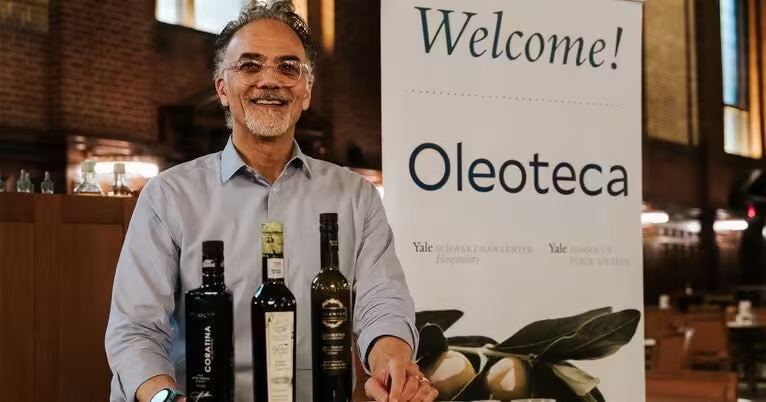
For Kyriakides, a deep respect for food as medicine has shaped his career. With a background in infectious diseases, his early research focused primarily on HIV/AIDS and its treatment. But in 2018, after completing his olive oil sommelier training, he became increasingly interested in understanding the relationship between olive oil and nutrition. By then, he and Vasiliou had already been discussing an olive oil sciences program at Yale (conversations that, in reality, began soon after Vasiliou arrived in 2014 to chair the Department of Environmental Health Sciences, a role he held until earlier this year).
In 2018, they coordinated the first International Yale Symposium on Olive Oil and Health. They’ve since organized seven, and the eighth will take place in Delphi, Greece, in April 2027.
Working with colleagues in Greece, Vasiliou’s lab studies olive oil’s bioactive compounds, using tools from cell biology and multi-omics to artificial intelligence, to understand how they may protect against inflammation, metabolic disease, and neurodegeneration, including Alzheimer’s disease. In the U.S. alone, consumption of olive oil has grown from 28,000 metric tons per year during the early 1970s to more than 400,000 metric tons annually by the 2020s.
But Vasiliou says the health benefits of the Mediterranean diet aren’t linked to molecular science alone. They’re rooted in a way of life: shared meals, seasonal and local food, and strong community ties. That’s why, along with partners in cities and municipalities across Greece and Italy, he and Kyriakides also co-organized Yale symposia on gastronomy and culture in Heraklion, Crete, and Naples. These social and cultural dimensions are part of the exposome, too, and they help explain why the Mediterranean diet works as a whole, not just as a list of ingredients.
A global hub of olive oil science
Together, Vasiliou and Kyriakides have proposed a dedicated Yale entity focused on the olive tree, its unique products, and their impact on human and planetary health. Tentatively called the Yale Program in Olive Science and Health, it currently operates as an initiative, but they’re seeking donors to establish it as a full center.
As an official center, they say, the initiative would convene scientists, clinicians, agronomists, economists, and policymakers around four goals: research, education and training, translation, and global partnerships. In terms of research, they’d study how olive oil and its bioactive compounds protect against human disease as well as investigate the olive sector’s role in climate resilience and sustainable agriculture. They’d also prepare students and young scientists to work across nutrition, public and environmental health, and sustainability.
The center would work to turn evidence into public health guidance, food policy, and quality and authenticity standards that benefit consumers and producers alike. They’d also build on their existing symposia and collaborations with researchers, universities, cities, and producers across Greece, Italy, Spain and the wider Mediterranean, the U.S., and Latin America. Ultimately, the center would position Yale as an international hub where the science of the olive tree meets public and planetary health, sustainability, and culture.
“Few products bring together human health, planetary health, and culture the way the olive tree does,” Vasiliou said. “Studying it scientifically is a way to honor where I come from while translating traditional wisdom into evidence that can benefit people everywhere.”
Source: news.yale.edu