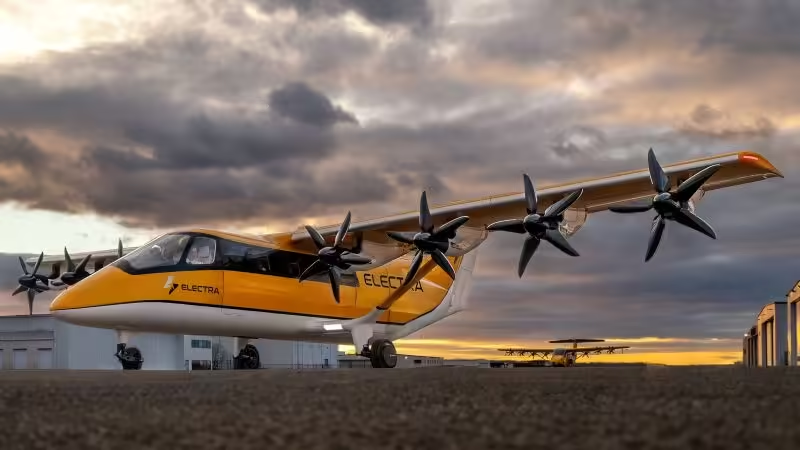

Too far to drive, too close to fly. It’s modern travel’s version of being caught between a rock and a hard place, seemingly inescapable until flying cars take off, and that’s probably not happening anytime soon. A solution to the conundrum may well be touching down before long, though — just not necessarily on a runway.
Requiring no more than 150 feet of ground to take off or land, a hybrid-electric aircraft being developed by Virginia-based advanced air mobility company Electra hopes to revolutionize regional travel by ushering in a new era of “direct aviation” that circumvents roads and airports alike.
For all the transnational connections that commercial aviation has forged, it is yet to carve out adequate routes for “annoying” regional journeys.
“Despite how large the airline business is, it just doesn’t solve the hardest problems in our daily lives,” Electra CEO Marc Allen told CNN.
“It’s great for getting across continents, we love it for that. It’s great for moving huge volumes of goods, but it’s not great for regional mobility,” he said. The kind of journeys that are “too long to drive conveniently, but too short to fly easily, and so you’re kind of stuck.”
Electra refers to “The Rule of Six” criteria that advanced aircraft should meet; quiet, access, payload, range, safety and affordability. According to Allen, no aircraft in history has ticked all the boxes he believes underpin the next generation of aviation.
Commercial airliners, for example, excel where helicopters fall short in terms of their ability to safely shuttle many tons of cargo and passengers alike over thousands of miles, but their access is confined to airport runways; the millions of dollars spent by the Federal Aviation Administration (FAA) annually on noise mitigation projects is a testament to airliners’ ineligibility in meeting requirements for quiet.
Yet advancements in distributed electric propulsion technology, whereby some or all of a plane’s combustion-based engines are swapped out for smaller electric motors spread across the airframe, have set the stage for what Electra said is the first aircraft capable of covering all bases: the Ultra Short.
Fitted with a turbogenerator and eight electric motors, Electra says its EL9 Ultra Short is capable of traveling 380 miles with a full payload of nine passengers or 3,000 pounds of cargo. Electric vertical take-off and landing aircraft (eVTOLs), by contrast, can generally fly 100 miles at most.
Batteries that power the motors for takeoff and landing are charged mid-flight via the electricity generated by a gas turbine engine that, while running on standard jet fuel, burns 40% less fuel than comparable aircraft, contributing to 70% lower operating costs than helicopters, according to Electra. The hybrid-electric architecture is designed to accommodate alternative energy sources, including hydrogenas the technology becomes commercially viable, potentially enabling zero-emissions flight.
The Ultra Short emits just 75 decibels on takeoff, about as loud as a vacuum cleaner, but its flagship attribute is that for which it takes its name. Capable of taking off at just 30 miles per hour, the aircraft would require 150 feet, less than 2% of New York’s John F. Kennedy International Airport’s shortest runway, to take off or land.
It is made possible by the eight propellers, which accelerate airflow over the wings to allow the aircraft to generate its own lift. The propellers are complemented by a system of flaps and droops, and wind tunnel testing has produced EL9 lift coefficient readings over 20, a “staggering” output up to eight times greater than the capabilities boasted by the most modern wings on large commercial aircraft, says Allen.
Though it cannot be considered an eVTOL because it doesn’t lift off and land vertically, like a helicopter, Allen says the EL9’s takeoff experience “feels like an elevator.” He added: “It’s very gentle, and it just climbs straight up.
“The aircraft accelerates and within about three to four seconds, you’re in the air. You look around and go, ‘Oh my goodness. I just got up like five or six stories.’”
That ability to squeeze into small spaces unlocks the potential for what Electra dubs “direct aviation”: point-to-point regional air travel that overthrows the “tyranny” of gridlocked roads and airport checkpoints.
Enabling these flights would be a “mesh network” of access points that the Ultra Short can zip between. Many of these already exist, explains Allen, in the form of heliports, fields, parking lots, and any other 150-foot stretches of flat surface fit for purpose.
Last month, a two-seater Ultra Short prototype landed and took off at a 300-foot floating barge used for helicopter parking in Lower Manhattan.
A trip from a Washington, D.C. mall parking lot to a New York City heliport could be done in an hour and 45 minutes using the Ultra Short, according to Electra research, more than twice as fast as current car or commercial flight routes.
Though promising a “life beyond runways,” the Ultra Short is not intended to replace traditional aviation infrastructure. Rather, Allen is confident the aircraft will not take business from airlines but rather expand it.
Connecting new access points — including those added at major airports — to existing air travel networks could offer airlines access to an entirely new base of customers, who could use Ultra Short to reach connecting flights to farther afield destinations.
The economic case for advanced air mobility strengthens with distance and occupancy, according to PricewaterhouseCoopers director Aleksander Buczkowski, who oversees the accounting firm’s Global Centre of Excellence in Drone and Geospatial Technologies and co-authored a 2025 report on the industry’s commercial outlook.
While short intra-city flights are difficult to justify against existing ground transport, air taxi companies targeting 100-to-200-kilometer journeys where existing connectivity is poor are better placed to attract customers willing to pay for the time saved, Buczkowski told CNN via email.
However, he added that, “The industry as a whole has been struggling with regulation and the certification of these new platforms, and that remains the major hurdle for every player.” Another challenge is “unit economics”: the cost of the aircraft and the level of utilization an operator can realistically achieve.
“Unless both come together, the service is either unaffordable for passengers or operates at a loss,” Buczkowski said.
“The question is whether a hybrid, fixed-wing design could be cheaper to operate than helicopters or eVTOLs, with the real test coming once the aircraft is certified and flying commercial routes.”
So when will the Ultra Short truly take flight?
Electra has already received upward of 2,200 EL9 pre-orders from more than 60 worldwide airline operators, translating to a $15 billion backlog, while sales discussions continue with various infrastructure partners and airline operators regarding the running of access points and flight services, respectively.
EL9 testing will begin in earnest with a series of runs at five Norwegian sites in late 2027. From there, it will likely take a year of flying before the aircraft reaches Type Inspection Authorization, a critical juncture that permits FAA engineers and test pilots to conduct official inspections and tests aboard the plane. Allen is aiming to launch commercial service in 2030.
Construction will begin next year on an $850 million facility spanning 88.5 acres in Springfield, Ohio. Contracted customers include the US Air Force, Army and Navy, with Allen believing that Electra’s aircraft has the potential to eventually replace the American military’s workhorse tactical transport helicopter, the Black Hawk.
Shifting theaters of operations could necessitate a change in vehicle, with the Ultra Short — already capable of carrying cargo quietly to remote locations — offering the added benefit of being able to charge an increasingly electronic arsenal of modern military gear, from drones to communications equipment.
“It’s a generator on the ground. You can run 15 houses off the power this airplane puts out,” Allen said.
With a $10 million price tag for commercial models, though, most civilian pilots will have to wait a little longer for a world in which they can step out of their front door and into their own Ultra Short personal plane.
“That’s one generation too early,” Allen added.
Source: www.cnn.com