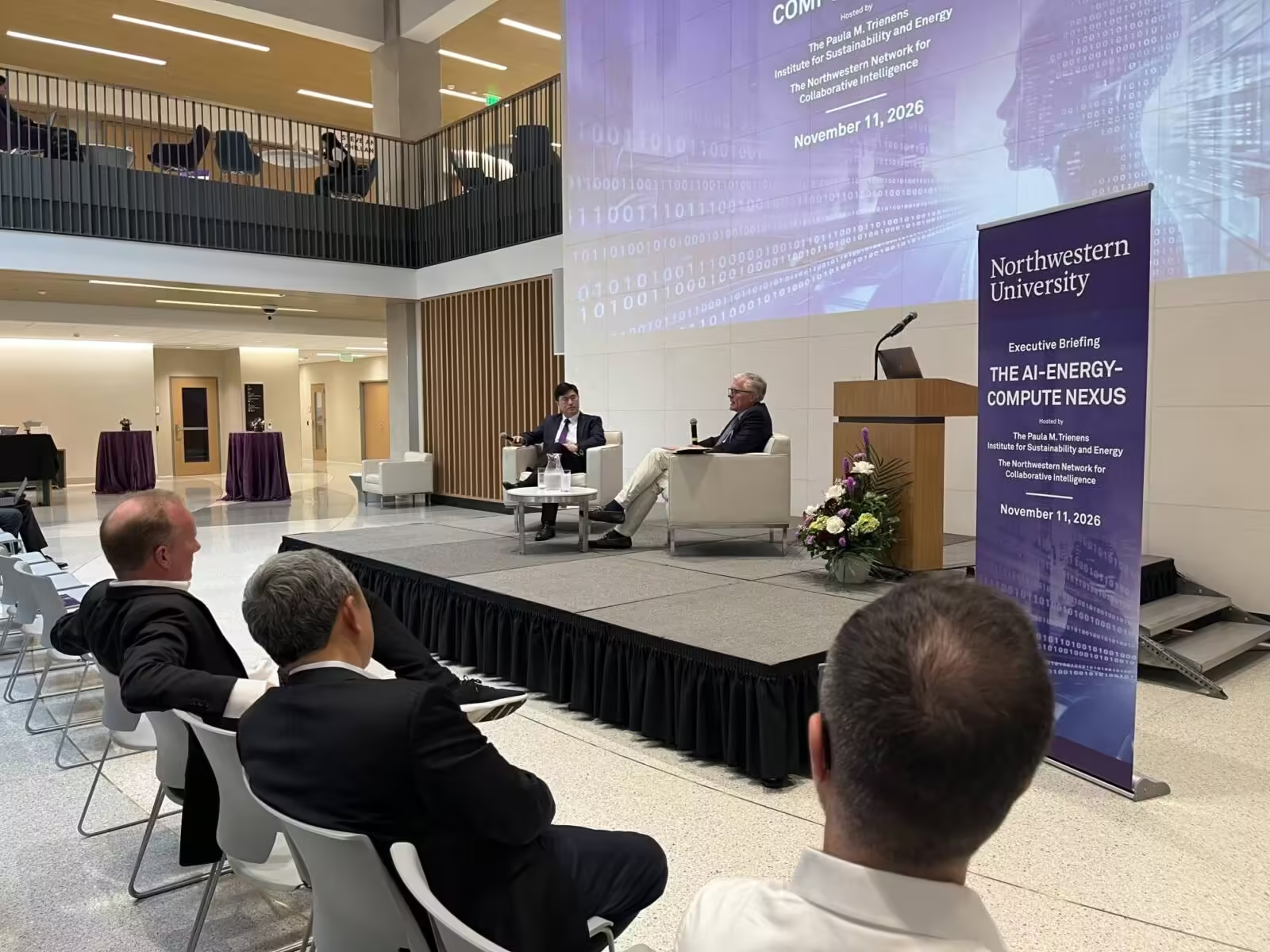

Experts and Northwestern President Mung Chiang explored the role of artificial intelligence in the development of energy technologies during a Wednesday executive briefing hosted by NU’s Paula M. Trienens Institute for Sustainability and Energy and the Network for Collaborative Intelligence.
Chiang and NU Trustee Jim DeNaut (Weinberg ’84), co-chair of the Trienens Institute Executive Council, opened the briefing with a conversation on AI and its effects in research.
“Eventually, the question is not whether machines can think, it’s whether human beings can still think,” Chiang said.
He said machines had surprised him recently, noting OpenAI’s proposed solution to the Navier-Stokes problem announced in September. The solution has not yet been widely accepted by the mathematics community.
The Navier-Stokes problem, an equation to prove how to mathematically describe fluid mechanics, is one of seven “Millennium Problems,” offering a $1 million prize for solving it.
Attendee Jason Cummings, who is the founder and CEO of AI literacy company Empowerment Strategies, said he appreciated Chiang’s desire to question what should be computed.
“Technology moves fast,” Cummings said. “There’s a tendency for people to be fascinated with everything that’s out there in the marketplace, but the reality is people should be less fascinated with the capabilities and they should be more focused on the depth of utility with the technology.”
Kellogg Prof. Dashun Wang kicked off the events’ presentations by focusing on AI use in science, comparing AI agents to “airplanes for the mind.”
He highlighted his study on innovation activities at the University, including from Feinberg Prof. Kathleen Green, whom he said had initially never filed a patent from her research.
In his study, using AI tools, Wang said he found companies had cited Green’s papers for multiple patents without her knowledge. After Wang’s team revealed this to Green, she quickly filed her first patent, he said.
“There appears to be a large amount of untapped innovation potential that now can be precisely pinpointed with all these airplanes for the mind that we now develop,” Wang said.
After Wang, McCormick Prof. Chris Wolverton spoke about using AI to discover new, lab-synthesized materials. He said scientists can use these materials in all parts of energy production, including in making new batteries.
The next speaker, chemistry Prof. Shana Kelley, talked about the role of AI in biology to discover the breakthroughs responsible for improving the quality of human life.
“What if we had computational tools that really allowed us to learn faster about biology?” Kelley said. “That allows us to look at what molecules do in silico before we went into the lab and did all of the long, difficult research.”
Robert Slone (Weinberg M.S. ’94, Doctorate ’97), the chief scientist and innovation officer of global safety company UL Solutions, spoke about UL’s testing of AI models.
Madeline Hinkamp and Muhammed Shuaibi, who both work at Meta, explored creating large language models for experimental chemistry research.
Steven Torrisi, the senior strategic alliance manager at NVIDIA, concluded the event’s presentations with a conversation on using AI for chemistry research, particularly at the atomic scale, through Graphics Processing Unit computing.
Chemistry Prof. Teri Odom said she attended the event to hear about NU’s AI-based innovations and its application to research and education.
Odom, whose research involves nanochemistry, said she hoped to learn about the possibilities of using machine learning, particularly in screening the shapes of nanostructures.
“I’m always interested in learning new things,” Odom said. “Northwestern offers opportunities for both students and faculty to do that, and so I wanted to take advantage of that.”
Lucas Kubovchik contributed reporting.
Email: [email protected]
X: @ninethkk
Related Stories:
— Rutgers professor challenges AI’s ‘inevitability’ during NU lecture
— McGill professor calls for practical use of AI in healthcare during NU event
— Trienens Institute seeks solutions amid renewable energy transition
Source: dailynorthwestern.com