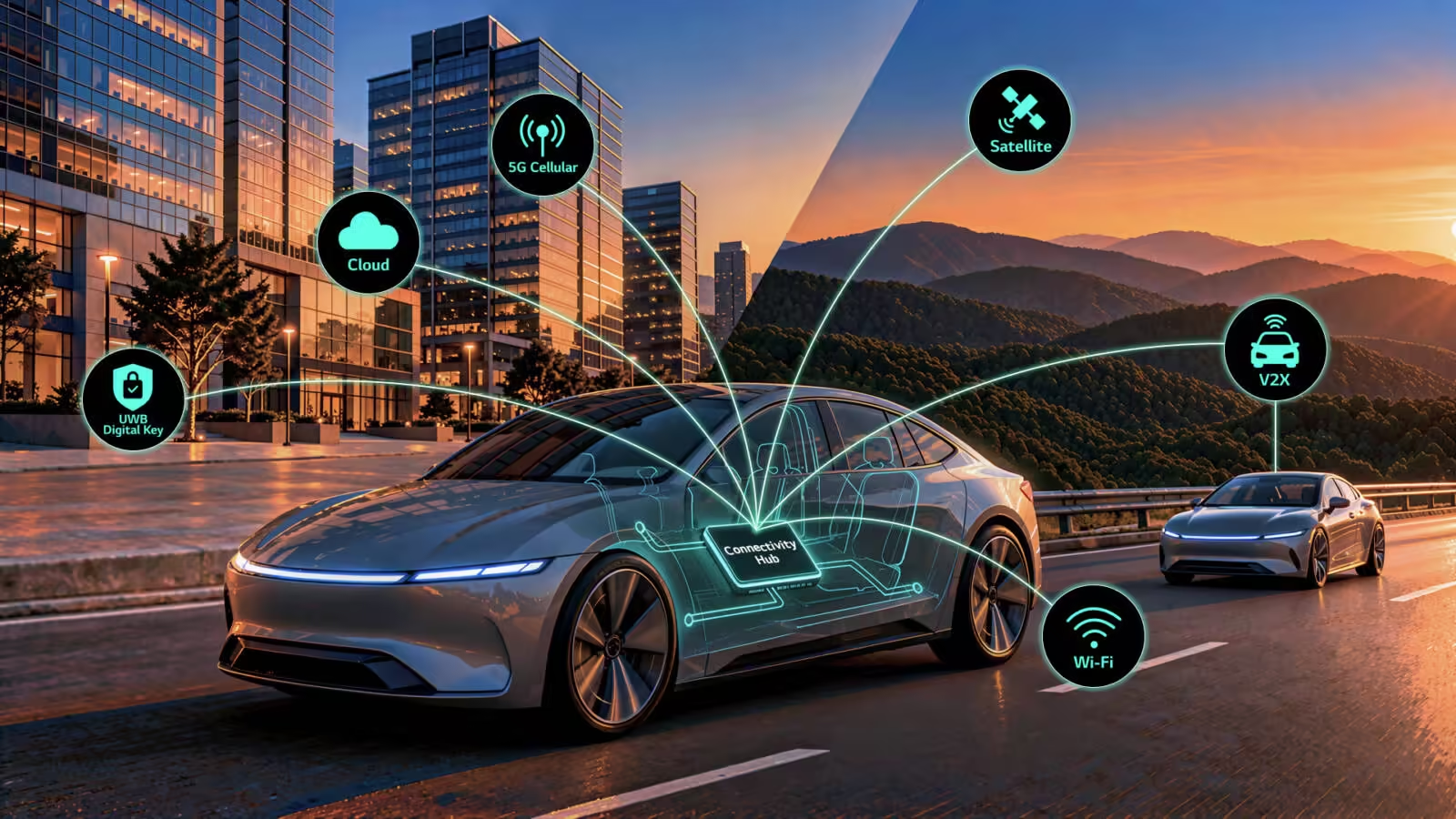

LG Electronics’ Hajong Sung explores how smart telematics can reshape vehicle connectivity architectures through intelligent consolidation, with software-defined antennas supporting greater flexibility in wireless performance management.
Modern vehicles rely on a growing range of wireless technologies, from cellular networks and satellite communications to vehicle-to-everything (V2X) connectivity and digital keys. Supporting these functions forces automakers into a difficult balancing act: increasing connectivity without adding unnecessary cost, weight, or architectural complexity.
Smart telematics brings these elements together by consolidating antennas, communication modules, and related functions into integrated connectivity hubs. Within this broader approach, software-defined antenna (SDA) technology provides greater flexibility in how vehicles manage wireless performance, potentially allowing automakers to optimize connectivity for different vehicle models and operating environments.
Both developments introduce engineering trade-offs. Greater integration brings challenges involving radio frequency (RF) interference, thermal management, and security isolation, while SDAs remain constrained by underlying hardware. Connectivity architectures must also meet evolving cybersecurity, software-update, and electromagnetic-compatibility requirements.
Automotive World spoke with Hajong Sung, Research Fellow and Team Leader, Connectivity Development at LG Electronics, about how telematics can integrate and manage expanding connectivity functions, where SDA adds flexibility, and how connectivity platforms can be designed to adapt throughout the vehicle lifecycle.
As smart telematics brings antennas and communication modules into a single unit, what benefits does this offer, and what engineering challenges does it create?
Integrating antennas and communication modules into a single unit delivers benefits across multiple dimensions. From a system perspective, it reduces RF cabling, wiring complexity, packaging volume, weight, and overall cost. It also minimizes cable losses between the modem and antennas, improving signal quality and communication performance. These benefits become increasingly important as vehicles add more antennas to support 5G, global navigation satellite systems (GNSS), Wi-Fi, V2X, and satellite services.
However, integration also creates new engineering challenges. Multiple radios operating in proximity increase the risk of RF coexistence issues, intermodulation, and receiver desensitization. Thermal management becomes more demanding because high-power communication devices and antennas share a confined enclosure. Antenna placement, metal structures, and mechanical packaging can also significantly affect RF performance.
Success depends less on individual component performance and more on how effectively the components are integrated into a cohesive whole.
The key is to design the system holistically, optimizing hardware architecture, antenna layout, shielding, filtering, thermal design, and intelligent radio coordination software together.
Success depends less on individual component performance and more on how effectively the components are integrated into a cohesive whole. Leveraging LG’s decades of mobile communications experience, we can co-design the antennas, mechanics, RF, and software into a single, unified platform.
With smart telematics, as vehicles add wireless functions such as 5G, V2X, ultra-wideband (UWB), and satellite connectivity, where does an SDA architecture give automakers genuine flexibility to add or update capabilities through software, and where does the underlying hardware still set the limits?
SDAs will evolve in stages. Today they handle simple frequency tuning, and over time they are expected to move toward the coordinated control of frequency, impedance, and the radiation pattern. As that happens, automakers will gain greater flexibility in four main areas.
The first is vehicle-specific optimization. Sedans, SUVs, and trucks each have different antenna mounting positions and metal body structures that can distort the signal. With SDA, automakers may be able to compensate for some of these differences through software-based impedance and radiation-pattern tuning, reducing the need for model-specific hardware redesign.
The second is supply chain efficiency. Automakers may be able to use a common hardware module across a wider range of markets and vehicle types, with software configuration supporting applicable regional frequency bands within the hardware’s designed tuning range. Each unit is then customized before shipment by setting the regional service bands in software.
The third is network expansion through antenna sharing. Terrestrial and non-terrestrial antennas can be combined into one. Software then switches between them seamlessly, helping the vehicle maintain coverage across a wider range of environments, including areas where terrestrial networks are unavailable, subject to satellite and network service availability.
The fourth is real-time adaptation to the driving environment. As the vehicle moves through urban canyons or tunnels, or changes direction, it can optimize its own antenna radiation characteristics to maximize reception. In future implementations, data-driven control algorithms could help adjust antenna characteristics in response to changing operating conditions, while software updates could further refine performance over time.
That flexibility still has physical boundaries. First, software can only adjust the antenna within the tuning range of its built-in tunable components, which is bounded by the minimum and maximum capacitance of the switching devices. Second, polarization is limited. Switching between two linear polarizations or two circular polarizations is achievable, but switching between linear and circular in one antenna remains technically difficult. Third, adding tunable components constrains antenna design. Engineers must minimize insertion loss in the switched matching network and keep the design within the maximum input voltage the switching components can withstand.
In short, software extends what the antenna can do over the vehicle’s lifetime, but only within the physical envelope that the tunable hardware is designed to support.
Software extends what the antenna can do over the vehicle’s lifetime, but only within the physical envelope that the tunable hardware is designed to support.
What is the architectural logic for combining telematics and digital key functions within a single connectivity hub, and how do you ensure that consolidation does not compromise the security or reliability of vehicle access?
The architectural logic is straightforward. Both telematics and digital key functions are connectivity-centric and rely on many common technologies, including wireless communication, positioning, security frameworks, cloud connectivity, and software update mechanisms.
By integrating these functions into a single connectivity hub, OEMs can reduce electronic control unit (ECU) count, simplify vehicle architecture, decrease wiring complexity, and improve software reuse. A centralized platform also enables better coordination among technologies such as Bluetooth Low Energy (BLE), UWB, near-field communication (NFC), and cellular communications.
However, consolidation should not compromise security or reliability. Digital key functions are fundamentally vehicle-access functions and therefore require strict security isolation.
The architecture should include:
- Hardware-rooted security
- Dedicated secure elements or hardware security modules (HSMs)
- Secure boot and authenticated software execution
- Isolated execution environments
- Independent safety and security monitoring paths
Even when telematics and digital key share hardware resources, security-critical vehicle access functions should remain logically isolated. In other words, consolidation should occur at the platform level, not at the expense of trust boundaries.
As OEMs move toward more centralized, software-defined vehicle architectures, how do you see the connectivity hub’s role evolving within smart telematics? Could it absorb additional functions over time, or are there practical limits to how much should be consolidated?
As vehicle architectures become more centralized and software-defined, the connectivity hub will evolve from a communications device into a core networking platform for the vehicle.
Historically, telematics was largely focused on emergency services and remote diagnostics. Today, it supports over-the-air (OTA) updates, cloud services, V2X, predictive maintenance, and connected applications. In the future, the connectivity hub may absorb additional functions such as digital key, connectivity orchestration, and communication management based on AI processing.
Nevertheless, consolidation has practical limits. Functions with vastly different timing requirements, safety classifications, thermal characteristics, or computational demands may remain separate. OEMs must balance the benefits of integration against the risks of creating a single point of failure.
The long-term direction is not unlimited consolidation, but intelligent consolidation, where functions are grouped according to common technology needs while maintaining appropriate isolation, scalability, and reliability.
As vehicles become increasingly dependent on continuous connectivity, which functions are most sensitive to temporary communication loss, and how should the vehicle architecture maintain safe, predictable operation when connectivity is interrupted?
Not all vehicle functions are equally sensitive to connectivity interruptions. Some functions, such as streaming and non-critical cloud services, may simply become unavailable when connectivity is lost. Others, including emergency communications, remote vehicle functions, connected fleet operations, and certain cooperative driving applications, require more robust continuity or fallback mechanisms. OTA updates and remote diagnostics should be designed to pause, recover, or resume safely after an interruption.
The most important principle is that safety-critical vehicle operation should not depend solely on external network connectivity. Vehicle systems should always be designed to degrade gracefully. Core driving, braking, steering, and safety-related functions must continue operating safely and predictably even when all external communications are unavailable.
Connectivity should enhance vehicle capabilities, not become a prerequisite for safe vehicle operation.
To achieve this, architectures should include:
- Local decision-making capability
- Functional independence from cloud connectivity
- Data buffering and synchronization mechanisms
- Multi-network redundancy where appropriate
- Robust fault-detection and recovery strategies
Connectivity should enhance vehicle capabilities, not become a prerequisite for safe vehicle operation.
Connectivity systems must increasingly meet requirements spanning cybersecurity, software update integrity, and electromagnetic compatibility. How does LG design connectivity architectures to meet these requirements without compromising performance, flexibility, or the ability to evolve over the vehicle lifecycle?
Modern connectivity systems must simultaneously satisfy cybersecurity, software update integrity, and electromagnetic compatibility requirements throughout the vehicle lifecycle. At LG, we view these regulations not as separate compliance activities but as architectural requirements that influence the entire system design from the beginning, helping OEMs address applicable regulatory requirements.
For cybersecurity under UN R155, we implement security-by-design principles, including secure boot, a hardware-based root of trust, authenticated communications, encryption, and continuous vulnerability management.
For UN R156, OTA architectures include end-to-end software integrity protection, secure update validation, rollback mechanisms, and recovery procedures to ensure updates can be deployed safely throughout the vehicle’s operational life.
For UN R10 electromagnetic compatibility requirements, RF architecture, antenna design, shielding, filtering, and coexistence management are engineered to minimize interference while maintaining communication performance.
Most importantly, the platform is designed for modularity and software flexibility. This allows the system to evolve over many years through software updates, support new communication technologies, and help OEMs address evolving cybersecurity and connectivity requirements.
Our objective is to ensure that performance, security, compliance, and future scalability are not competing goals, but complementary characteristics of a well-designed connectivity platform.
Sponsored Content: This article was produced on behalf of LG Electronics. While LG Electronics provided information and expert commentary, Automotive World retained responsibility for the final content.
Source: www.automotiveworld.com