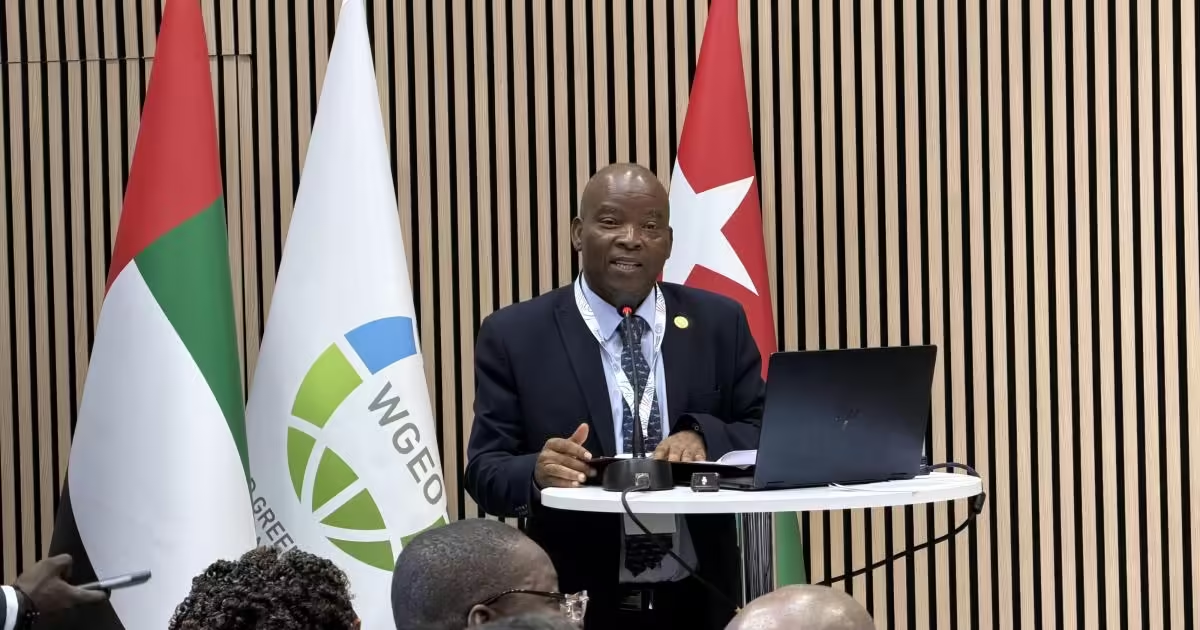

SPEECH BY
H.E. COMMISSIONER VILAKATI
AFRICAN UNION COMMISSION
ON BEHALF OF
H.E. MAHAMOUD ALI YOUSSOUF
CHAIRPERSON OF THE AFRICAN UNION COMMISSION
COP31 HIGH-LEVEL DIALOGUE ON FINANCING EARLY WARNINGS FOR EARLY ACTION IN AFRICA
THEME: ACCELERATING AFRICA’S EARLY WARNING SYSTEMS AND RESILIENCE TO MULTI-HAZARDS
12 NOVEMBER 2026 | 9:30–11:00 HOURS | AFRICA PAVILION, BLUE ZONE, ANTALYA, TÜRKİYE
- Your Excellency, President Daniel Francisco Chapo, President of the Republic of Mozambique and African Union Champion for Disaster Risk Management;
- Your Excellency, Dr. Abiy Ahmed Ali, Prime Minister of the Federal Democratic Republic of Ethiopia;
- Honourable Dr. Gilbert Siame, Minister of Green Economy of the Republic of Zambia and Chairperson of the African Ministerial Conference on Meteorology (AMCOMET);
- Your Excellency, Mr. Kamal Kishore, Special Representative of the United Nations Secretary-General for Disaster Risk Reduction and Head of UNDRR;
- Your Excellency, Mr. Claver Gatete, Executive Secretary of the United Nations Economic Commission for Africa (UNECA);
- Your Excellencies, Heads of African Union Organs and Institutions;
- Distinguished Representatives of the United Nations System, Regional Economic Communities, International and Regional Organisations;
- Distinguished Development and Financing Partners;
- Ladies and Gentlemen.
It is a great pleasure to join you at this important High-Level Dialogue on Financing Early Warnings for Early Action in Africa, convened at a critical moment for our continent and the global climate and disaster risk agenda.
Africa is increasingly exposed to interconnected and intensifying climate and disaster risks. From devastating floods and prolonged droughts to tropical cyclones, heatwaves and other natural hazards, these threats continue to endanger lives, undermine livelihoods, threaten food and water security, and reverse hard-won development gains across our Member States.
These growing risks remind us that disaster management cannot remain predominantly reactive. We must strengthen our investments in prevention, preparedness and anticipatory action. Our challenge is not simply to predict hazards; it is to ensure that forecasts translate into timely warnings, that warnings trigger effective early action, and that such action is supported by predictable and sustainable financing.
Excellencies, Ladies and Gentlemen,
Africa has made encouraging progress under the United Nations Secretary-General’s Early Warnings for All initiative. Forty-one African countries currently report having early warning systems, while the comprehensiveness of these systems has more than doubled since 2022.
We commend the leadership of the United Nations system, particularly UNDRR, the World Meteorological Organization (WMO), the International Telecommunication Union (ITU) and the International Federation of Red Cross and Red Crescent Societies (IFRC), alongside African Union Member States, Regional Economic Communities, technical institutions and development partners, for their continued efforts in advancing this important agenda.
At the continental level, the African Union has continued to advance the Africa Multi-Hazard Early Warning and Early Action System (AMHEWAS) as a strategic mechanism for strengthening Africa’s capacity to anticipate, prepare for and respond to multiple hazards.
Under the AMHEWAS Programme, seven Situation Rooms have been established, while more than 40 Member States have received support through capacity-building and training in early warning systems. Additional Member States are expected to benefit from the establishment of Situation Rooms in the coming years, subject to the availability of sustainable financing.
These achievements demonstrate the value of continental coordination and collective investment in strengthening early warning capacities.
However, significant gaps remain. Many countries continue to face inadequate forecasting infrastructure, fragmented institutional coordination, limited technological capacities, insufficient financing and persistent challenges in ensuring that warnings reach the last mile.
We must therefore ensure that early warning systems are not only technically robust but also inclusive, accessible, people-centred and responsive to the needs of all communities, particularly women, children, young people, persons with disabilities and other vulnerable groups.
Our ultimate objective must be to ensure that no one is left behind and that every community, regardless of its location or level of development, has access to timely, reliable and actionable early warning information.
The evolving El Niño-related climate risks and their potential implications for the coming agricultural and hydrological seasons further underscore the urgency of strengthening our preparedness and anticipatory action capacities, particularly in protecting agriculture, water resources, public health and livelihoods.
Excellencies, Ladies and Gentlemen,
The African Union welcomes the Addis Ababa Call to Action, which emerged from the Africa Early Warnings Forum held from 2 to 4 September 2026. This represents an important continental commitment to accelerating implementation, strengthening partnerships, closing last-mile protection gaps, mobilising sustainable financing and securing the future of early warning systems beyond 2027.
Our responsibility now is to translate these commitments into concrete actions, measurable results and sustained investments.
In this regard, the African Union is advancing AMHEWAS as an important continental mechanism for strengthening coordination, preparedness and anticipatory action. Through this initiative, we seek to connect continental, regional and national capacities, strengthen collaboration among Regional Climate Centres, Regional Specialised Meteorological Centres and national institutions, and improve the generation, exchange and utilisation of multi-hazard risk information.
AMHEWAS represents an important expression of Africa’s determination to strengthen its own continental capacities for multi-hazard early warning and early action. It provides a platform for enhancing coordination, facilitating the exchange of risk information and supporting Member States in translating forecasts into timely and informed decisions.
Our ambition is to ensure that forecasts and warnings are effectively connected to decision-making, contingency planning, disaster preparedness and early action.
To realise this ambition, we must continue investing in the operational capacity of AMHEWAS Situation Rooms, strengthening technical expertise, improving access to satellite and earth observation data, enhancing information-sharing arrangements and reinforcing collaboration with our regional and national institutions.
We must also strengthen the institutional and operational linkages between early warning systems and disaster risk financing mechanisms so that credible risk information can trigger timely financial resources and anticipatory interventions before disasters escalate.
AMHEWAS must continue to complement and reinforce the implementation of Early Warnings for All, while contributing to a sustainable, African-led approach to multi-hazard early warning and early action.
Excellencies, Ladies and Gentlemen,
Financing remains one of the most critical challenges facing early warning systems in Africa.
We cannot achieve universal early warning coverage through fragmented, short-term and project-dependent interventions. Nor can we build resilient societies if investments in early warning systems remain insufficient and disconnected from national development and financing frameworks.
We need predictable, diversified and sustainable financing that combines domestic resources, international climate finance, development financing, innovative risk-financing mechanisms and private-sector investment.
To address this challenge, I wish to highlight three financing priorities.
First, strengthening domestic investment.
African governments must progressively integrate early warning systems into national development plans, climate adaptation strategies, disaster risk reduction frameworks and public investment programmes.
Early warning systems must be recognised as an essential public good and a strategic investment in protecting lives, safeguarding livelihoods and preserving development gains.
We must move towards allocating adequate domestic resources for the establishment, operation and maintenance of early warning infrastructure, including national forecasting institutions, communication systems and institutional capacities.
Second, expanding access to international climate and development finance.
We call upon international climate finance institutions, multilateral development banks and development partners to scale up accessible, predictable and long-term financing for early warning infrastructure, forecasting technologies, institutional capacity and anticipatory action.
Africa must be able to access climate finance in a manner that is equitable, responsive to its priorities and proportionate to the scale of its climate and disaster risks.
We must also ensure that financing arrangements support not only the establishment of early warning systems but also their long-term operation, maintenance, technological upgrading and institutional sustainability.
Third, strengthening public-private partnerships and innovative financing.
The private sector has an important role to play in advancing technological innovation, expanding digital and communication infrastructure, strengthening data services and developing solutions that improve the reach, accessibility and effectiveness of early warning systems.
We should therefore promote partnerships that mobilise private-sector expertise, technology and investment while ensuring that early warning information remains accessible, affordable and available as a public good.
These three priorities must be pursued collectively to build a financing architecture that is sustainable, inclusive and responsive to Africa’s needs.
Excellencies, Ladies and Gentlemen,
As we approach the 2027 horizon of the Early Warnings for All initiative, Africa must begin shaping a sustainable post-2027 framework.
The end of the current implementation period must not mean the end of our commitment or investment.
Rather, it should mark a transition towards stronger national institutions, sustainable financing arrangements, technological innovation and greater accountability for results.
Africa needs an African-led and nationally owned framework that builds on the progress achieved under Early Warnings for All, consolidates existing partnerships and ensures the long-term sustainability of early warning systems across the continent.
This framework must be anchored in national priorities, supported by regional cooperation and strengthened through continental coordination.
The African Union Commission will continue working with Member States, Regional Economic Communities, the United Nations system, technical institutions and development partners to advance this agenda and ensure that Africa’s priorities are sustained beyond 2027.
Our post-2027 vision must move us away from time-bound projects and fragmented interventions towards strong institutions, predictable financing, integrated systems and operationally effective early warning and early action capacities.
In this regard, I wish to urge our development partners and financing institutions to match their commitments with predictable, accessible and long-term financing, moving beyond fragmented project-based support.
I also call upon the international community to support Africa’s post-2027 agenda through equitable access to climate finance, technology transfer, institutional strengthening and capacity development.
Africa must not only remain a beneficiary of global early warning initiatives; it must be an active leader in shaping the policies, partnerships and financing arrangements that will determine their future.
Excellencies, Ladies and Gentlemen,
As I conclude, allow me to reiterate that the true measure of our success will not simply be the number of early warning systems established, Situation Rooms operationalised or forecasts generated.
It will be measured by the number of lives protected, livelihoods safeguarded, communities reached, disasters anticipated and economic losses avoided.
Through the Addis Ababa Call to Action, AMHEWAS and our collective commitment to Early Warnings for All, Africa has an important opportunity to establish a sustainable, coordinated and African-led approach to multi-hazard early warning and early action.
Let us therefore match our political commitments with the necessary financial resources, strengthen our partnerships and accelerate implementation.
Let us move from forecasting hazards to financing action; from managing disasters to preventing their impacts; and from fragmented interventions to a coordinated and resilient Africa.
Together, we can build a continent where every community is informed, every institution is prepared and every warning creates an opportunity for early action.
I thank you.
Source: au.int