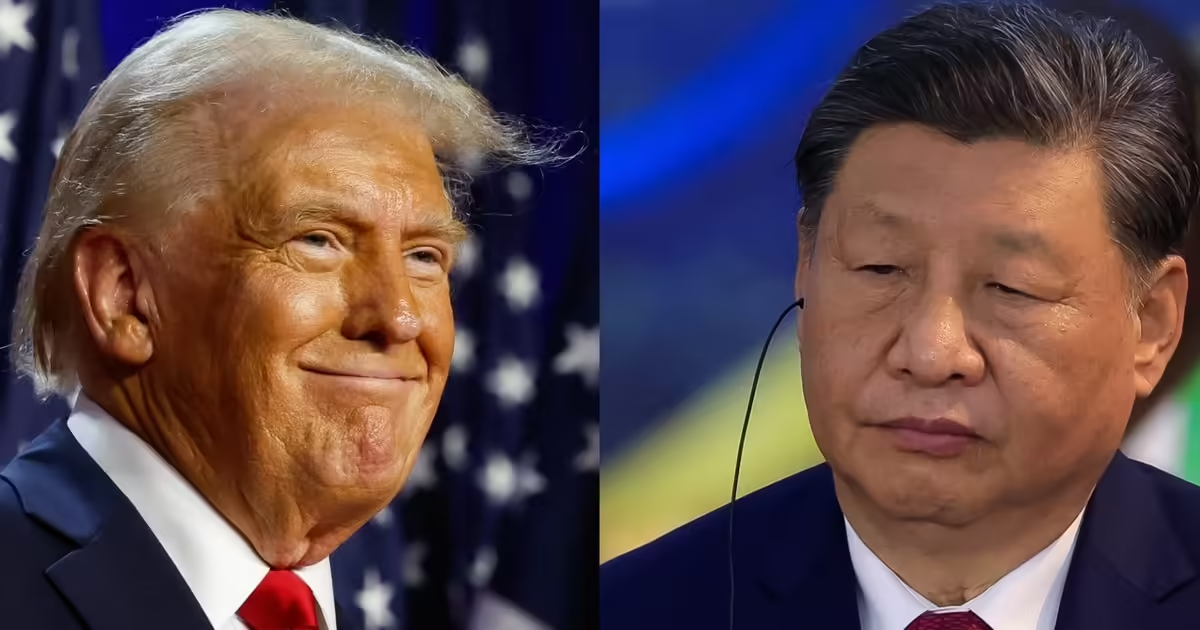

The two leaders are expected to meet sometime this month on the sidelines of the Asia-Pacific Economic Cooperation (APEC) summit in Shenzhen, China, at a time when manufacturers outside China are struggling to secure minerals needed for electric vehicles, defence equipment, electronics and other advanced technologies.
China’s relative dominance in the rare earth market creates unique supply-and-demand conditions, as its decisions have far-reaching consequences.
Consequently, the abundance of these minerals in China, compared to other regions, gives it pricing advantages on the global stage.
Yttrium, for example, a mineral used in electronics and industrial turbines, sells for about $1.15 million per tonne in Europe, compared with just $9,144 in China, according to Argus Media price data reported by Bloomberg.
Dysprosium is about 20 times more expensive outside China, while terbium costs around eight times more.
These price differences reflect China’s enormous influence over the rare earth supply chain, particularly its processing capacity.
However, for now, China dominates the rare earth market and has, for the last few months, been lenient with some of its policies concerning the rare elements.
China halts rare earth export restrictions
Beijing’s export restrictions, suggested over a year ago, have made it harder for foreign manufacturers to obtain certain materials, giving the world’s second-largest economy considerable influence over industries that depend on them.
The measures cover five rare earth elements, including holmium, erbium, thulium, europium and ytterbium, alongside certain processing technologies and equipment.
However, the extension does not remove all the restrictions, as controls introduced in April 2025 on seven other elements, including yttrium, dysprosium and terbium, remain in place.
That distinction matters because some of the minerals facing the sharpest price pressures are still subject to export controls.
Africa’s opportunity is becoming harder to ignore
Recent rare earth developments across Africa
As Washington and other major economies look for ways to reduce their dependence on Chinese supplies, Africa is attracting growing attention as a potential alternative source of rare earths.
The US is already putting money behind that ambition.
In August, Reuters reported that the US International Development Finance Corporation (DFC) had committed $62.8 million to rare earth projects in Malawi, Angola, Madagascar and South Africa.
South Africa’s Phalaborwa project accounts for approximately $50 million of that funding.
However, none of the four projects had entered production at the time of the report, highlighting the gap between securing investment and establishing a reliable supply chain.
Nigeria is also trying to move beyond exporting raw minerals.
A $400 million rare earth and critical metals processing plant is under development in Uke, Nasarawa State.
The facility, being developed by Hasetins Commodities Limited, is expected to add 12,000 tonnes of annual processing capacity and raise the company’s total capacity to 18,000 tonnes when fully operational.
Gabon has another major project in the pipeline.
The country is seeking to revive its long-delayed Mabounié niobium and rare earth deposit through a proposed $2 billion development involving Emirati-backed New Energy Metals and Chinese engineering group ENFI.
The project is expected to include several processing facilities in Gabon, rather than simply extracting and exporting the minerals.
Construction is set to begin in 2027, although the development has yet to reach production.
Africa’s rare earth challenge goes beyond finding minerals
Africa’s growing role in the rare earth race does not mean it can quickly replace China.
Mining projects take years to develop, while processing requires specialised technology, infrastructure, reliable power and substantial financing.
There are also commercial risks.
Reuters reported that private investors remain hesitant to finance African rare earth projects partly because of their higher risk profile and concerns that Chinese market intervention could undermine prices and project economics.
They want to attract investment from the US and other countries seeking alternatives to China, but they also need to ensure that new projects create local industrial capacity rather than simply turning the continent into another source of raw materials.
Trump and Xi’s upcoming meeting could offer some clarity on the direction of global rare earth trade.
But even if the two leaders reach an agreement, the push to diversify supply chains is unlikely to disappear.
For African countries with promising deposits, the opportunity is not simply to sell more minerals.
It is to establish a place in the processing and manufacturing industries that will determine who benefits most from the world’s growing demand for critical materials.
Source: africa.businessinsider.com