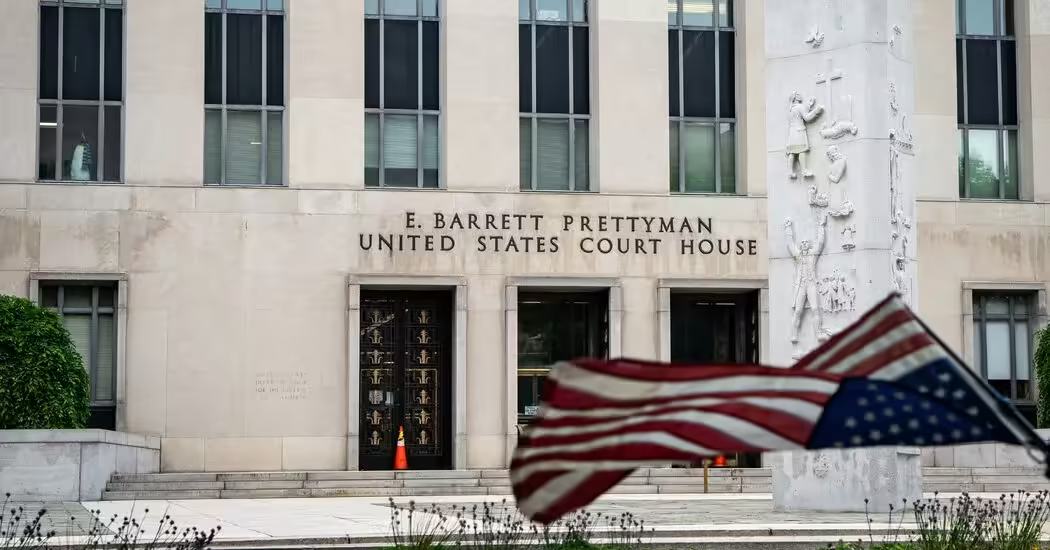

There was a time not too long ago when a federal prosecutor could spend a long career in the courtroom and never once fail to get a grand jury to sign off on an indictment.
But that time is over, especially in President Trump’s Washington.
In the past two weeks alone, prosecutors there have failed to secure indictments in at least three cases — an extraordinary acceleration of the troubles that the Justice Department, and the U.S. attorney’s office in Washington in particular, has had with grand juries for nearly two years.
The latest failure came on Friday, when prosecutors were unable, for the second time in recent days, to obtain an indictment against someone the authorities claimed had voted in two jurisdictions in the 2024 election, according to two people with knowledge of the matter.
The grand jury rejections have typically come in cases based on questionable evidence that prosecutors have nonetheless sought to jam through the courts, often because they involve public figures whom Mr. Trump has perceived to be his enemies. But they have also touched on some of the president’s other obsessions, including his contentious immigration crackdown and his efforts to prove that widespread voter fraud exists.
Things have gotten bad enough that a federal magistrate judge who once worked as a prosecutor in the U.S. attorney’s office publicly called out the Justice Department’s failures last week. It was “self-evident,” he said, that his former colleagues had become so petrified of grand jurors in Washington that they had started using unorthodox methods to get around them in an effort to bring charges.
The problems for prosecutors have increasingly extended beyond grand juries, as U.S. attorney’s offices in Washington and elsewhere have faced a forceful pushback from the federal bench.
Judges have thrown out cases and cut short other matters in the early stages of investigationat times, accusing prosecutors of abusing the criminal justice system.
“It’s important to understand how unusual all of this is,” said Greg Rosen, a former prosecutor in the U.S. attorney’s office. “By their very nature, grand juries hear only the government’s side. And when they keep saying no, and judges across the spectrum start saying it on the record, the problem isn’t the grand jury.”
A spokesman for the U.S. attorney in Washington, Jeanine Pirro, declined to comment, though she has defended her approach in the past. “I’m willing to take a not guilty,” she said in March. “I’m willing to take a no true bill because I’ll take all the crimes and put them in.”
Grand juries are a fundamental aspect of the federal criminal justice system, established by the Constitution to serve as a check on the executive branch’s power to charge people with crimes. Prosecutors have to persuade the panels only that there is probable cause that a crime has been a committed, a low bar that led courthouse wits in the past to remark that even a ham sandwich could be indicted.
There were differing accounts of why prosecutors had brought the case that failed on Friday.
One person briefed on the matter said the prosecutors were responding to pressure from political appointees, including Ms. Pirro, a longtime ally of the president. The appointees were seeking to satisfy Mr. Trump’s demands to bring cases involving potential voter fraud as the midterm elections neared, the person said.
Another person familiar with the matter said that prosecutors were just following through on information the office had been provided by the District of Columbia Board of Elections, which had sent the U.S. attorney’s office the names of people the board found had voted twice.
The failure to secure that indictment came only one week after a grand jury in a similar case declined to indict another person who prosecutors claimed had voted twice in 2024.
Until recently, grand jury failures — known in legal parlance as no true bills — were a rarity. That is because prosecutors have traditionally asked the panels to return indictments only in cases where they felt confident they could not just obtain convictions but also sustain them on appeal.
There was one high-profile no true bill during Mr. Trump’s first term in the White House. It involved Andrew G. McCabe, a former deputy director of the F.B.I. who was scrutinized by the U.S. attorney’s office over whether he had lied to bureau investigators about interactions he had with the news media.
But during Mr. Trump’s second term, there has been a remarkable — and embarrassing — deluge of no true bills, especially in Federal District Court in Washington, where prosecutors have been handed the task of carrying out many of the president’s revenge prosecutions. It has gotten to the point where the district’s chief judge, James E. Boasberg, has instructed grand jury foremen and forewomen to alert the court if they reject an indictment, so the court can keep track.
The problems really started two summers ago with Mr. Trump’s surge of federal troops and agents to the streets of Washington in an effort to crack down on local crime. In what appeared to be a citizens’ revolt against the movegrand jurors rejected indictments against a series of defendants who were caught up in the crackdown — including, most memorably, a man who threw a sandwich at an immigration officer.
The most notable no true bill came in February when a grand jury in Washington rejected efforts to indict six Democratic lawmakers who had posted a video that enraged Mr. Trump by reminding active-duty members of the military and intelligence community of their obligations to disobey illegal orders.
The botched attempt to prosecute the lawmakers — including two senators, Mark Kelly of Arizona and Elissa Slotkin of Michigan — for what amounted to political dissent was what critics have called an egregious misuse of the grand jury system even for a Justice Department that has repeatedly trampled prosecutorial norms in its efforts to satisfy the president’s demands for vengeance.
Federal prosecutors across the country — particularly in major cities like Chicago and Los Angeles — have confronted similar problems with grand jurors. In those cities, grand juries have rejected cases against individuals accused of assaulting federal agents working on immigration matters for the Trump administration. And prosecutors in Virginia have also faltered when seeking indictments — including twice in the same week against Letitia Jamesthe New York State attorney general who oversaw a civil fraud case against Mr. Trump.
But in Washington, the public’s distrust of the Justice Department under the president has manifested itself in new and remarkable ways.
According to “The Department of Revenge: How Trump Took Control of American Justice,” a book by the New York Times reporter Devlin Barrett, a local community group started teaching monthly classes on jury nullification, which is when jurors vote to acquit a defendant because they disagree with how the case was brought, among other reasons.
There is no way of knowing how much — or even if — the classes have affected grand jurors. But the list of grand jury failures in the city has included no true bills in the cases of both ordinary residents and prominent opponents of the president. Among them is Cassidy Hutchinsonthe former White House aide who gave testimony to the House select committee that investigated Mr. Trump’s role in the Jan. 6, 2021, attack on the Capitol. (Ms. Cassidy’s case was investigated by the Justice Department’s civil rights division, not Ms. Pirro’s office.)
Still, prosecutors in Ms. Pirro’s office have taken notice of the cascade of failures and have grown gun-shy of grand jurors, recognizing that they will likely be unable to push politicized cases past the panels for the foreseeable future, according to people familiar with the matter.
The office has gone out of its way to avoid grand juries in recent weeks, using unusual methods to bring charges. Last month, for instance, prosecutors charged two former F.B.I. officials with lying to Congress by using a criminal complaint, a tool that is normally employed in urgent situations when there are concerns that someone might flee or destroy important evidence.
Days after it was issued, Magistrate Judge Zia M. Faruqui threw out the complaint, saying that the prosecutors who filed it had failed to meet even the low standard of showing probable cause. Judge Faruqui also chastised the prosecutors for making an end run around the grand jury.
“It is self-evident that the U.S. attorney’s office is avoiding taking this case to the grand jury,” he said in an excoriating address from the bench, “and that is understandable given their poor record there lately, but it is also unbelievable.”
Source: www.nytimes.com