
When one thinks about the key supporters of MAHA, they likely don’t envision Black people, and rightfully so. A 2025 poll from KFF and The Washington Post found that only 30% of Black Americans support the MAHA movement, compared with 43% of white Americans.
But the data belie a stark reality: On an issue-to-issue basis, Black people are strikingly aligned with MAHA, at least in terms of their concerns around the movement’s tentpole issues. I’ve been studying why, or rather how, this came to be.
According to a May poll from Global Strategy Group, 47% of Black people, compared with 35% of white people, strongly agree with the statements “I am concerned about environmental toxins and pesticides” and “I am concerned about ultra-processed foods and artificial ingredients in our food” — key MAHA flashpoints.
The same poll found that 51% of Black people, a staunch Democratic voting bloc, either strongly or somewhat agreed with the statement “I am skeptical of vaccines,” compared to 58% of Republicans and 28% of Democrats. Moreover, the poll found that 26% of Black people strongly or somewhat support eliminating fluoride from public drinking water, a not-so-secret desire of health secretary Robert F. Kennedy Jr. This figure nearly mirrors the 28% of Republicans who also want the additive nixed from our water supply, while
18% of Democrats felt the same.
This crossover makes some sense. MAHA is perhaps the sole part of the Trump administration’s sprawling attempt to remake American society that can be said to be, at least on the surface, apolitical. Its broad agenda amplifies everyday public health issues like food quality and safety while elevating thorny but universally relevant topics like Big Pharma’s role in the overmedicalization of Americans.
This explains why a number of people on the left who would seem to be politically opposed to MAHA sometimes begrudgingly, and sometimes warmly, endorse it. In recent months, Rep. Alexandria Ocasio-Cortez (D-N.Y.), who appears to have 2028 ambitions, has glowingly discussed her conversations with MAHA activists and characterizes the MAHA cause as nonpartisan. Uber-progressive physician and Michigan Sen.-elect Abdul El-Sayed actively campaigned on some of MAHA’s hallmark principles.
Many in clinical medicine have also come out in support of MAHA, or at least components of it. In The Atlantic, emergency physician Craig Spencer encouraged public health practitioners to swallow their pride in service of the lightning-in-a-bottle moment for reform that MAHA was serving up, aligning with a number of respected public health influencers who’ve encouraged the same kind of acquiescence.
To some, including me, this sudden embrace of MAHA and pandering to the movement’s voters looks like acute Stockholm syndrome. And that’s largely because its intentions are often assumed a priori to be politically neutral, and its origins are rarely questioned.
A January tweet from California Gov. Gavin Newsom’s press office noted that “MAHA started in California,” highlighting the likely 2028 Democratic presidential contender’s statewide ban on ultra-processed foods in 2025. In early October, Democrat Rep. Chellie Pingree (Maine), who made MAHA a centerpiece of her successful reelection campaign, tweeted that she’d “been fighting for a food system that puts people and farmers first long before the ‘MAHA movement.’”
But Black scholars and activists played the biggest role in bringing to light the systemic fissures in our health care and food systems that MAHA — and some left-leaning opportunists — now assume a gatekeeper role over.
Throughout the 1960s and 1970s, Black activists around the country began to lead coordinated efforts to address the harms caused by industrial pollution in the U.S. and tackle the industrialization of the food system.
In 1969, Fannie Lou Hamer, a Black organizer, pioneered land cooperatives in Mississippi to usher in food sovereignty, aiming to curb her Black contemporaries’ increasing reliance on large, sprawling food production systems. Hamer foresaw what would become a reality in the 21st century: a loss of community control over food production and the proliferation of ultra-processed, unhealthy foodstuffs, a talking point deeply embedded in Kennedy Jr.’s Eat Real Food initiative.
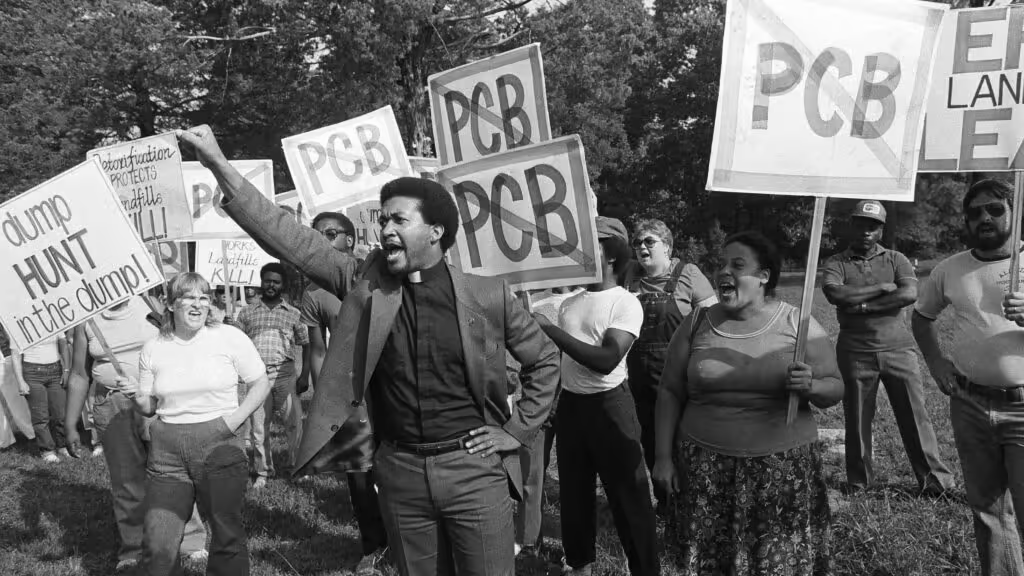
In 1978, Black residents in Warren County, N.C., began organizing to protest a landfill that was poised to store some 60,000 tons of cancer-causing PCBs (polychlorinated biphenyls) in their rural, low-income community. Over the next several years, as legal motions to stop the state government-endorsed plan were quashed, hundreds of Black demonstrators would be arrested in nonviolent protests against the site. It wasn’t until two decades later that the protesters’ persistence would pay off: An $18 million site detoxification process was initiated in 2002 and completed in 2004.
It’s evident Kennedy, a trained environmental lawyer, learned a great deal from cases like these. When running as a presidential candidate in 2024, Kennedy made several direct appeals for addressing environmental injustice, the racially inequitable distribution of environmental harms in minority communities. For instance, during a visit to Loyola Marymount College while on the campaign trail, Kennedy discussed the legacy of polluting facilities and noted, “We’ll have a cleaner environment if rich people and white people have to bear the equal burdens for people who are poor among the minorities.”
This was a racial justice battle cry, virtually right out of “Dumping in Dixie,” a seminal environmental justice text authored by the godfather of the movement, Robert Bullard.
This past “woke” iteration of Kennedy is deeply at odds with the present version, considering the term “environmental justice” is now essentially forbidden in research grant applications submitted to the National Institutes of Health, and that the NIH has substantially curbed funding for studies focused on racial disparities.
Ultimately, MAHA’s template is a retread, warmed over and confusedly repackaged for the anti-science and contrarian crowd keen on bringing the culture wars as deep as possible into public health.
To this end, Kennedy’s subtle homages to Black activism have been undercut by his public commentary and policy, which in addition to distorting and cherry-picking aspects of evidence-based science, is imbued with MAGA’s distinctive brand of political grievance and racial myopia.
Even as Kennedy and his MAHA consorts have cribbed from the Black activist playbook, they’ve actively undermined and misrepresented Black identity and culture. Part of this has been accomplished by playing into the fears that many Black people harbor against doctors and the medical establishment, including by using disinformation to gin up concerns about vaccines in Black communities, a population already highly skeptical of immunizations. Going back to the Tuskegee experiments, where Black men’s treatment for their syphilis was withheld, Black populations have held significant distrust for clinicians and medical research.
In a Kennedy-produced documentary, “Medical Racism: The New Apartheid,” a piece of unabashed agitprop released in 2021, the current health secretary recruited Nation of Islam Minister Tony Muhammad to help peddle the fantastical claim that vaccine-makers are nefariously targeting Black kids as a means of widening racial disparities.
And this tactic isn’t new. Republicans and anti-abortion activists have long sought to curry the support of Black people by claiming abortion is a subversive tool being used by white liberals and medical elites to facilitate Black genocide.
On a podcast before the 2024 election, Kennedy argued that Black people have a stronger immune response to certain antigens than other races, thereby warranting a change in their vaccine scheduling, a scientifically debunked notion that he nevertheless doubled down on during his Senate confirmation hearing.
He has also been a vocal cheerleader for a controversial study to assess the effects of hepatitis B vaccine dose timing on a cohort of infants in the small West African country of Guinea-Bissau, where local officials recently raided the offices of an RFK-Jr.-allied research group supporting the study.
The most positive reflections on MAHA have largely centered around the trope of the genteel “MAHA mom,” a racially coded term painting white mothers as singularly focused, doting caregivers who just want their kids to be healthy. Contrast this with Kennedy’s thoughts on Black parents. In a 2024 podcast, he advocated “reparenting” Black kids with ADHD, a population he said was “just standard put on Adderall, SSRIs, benzos, which are known to induce violence.”
It’s no surprise that prominent Black politicians haven’t accepted the Faustian bargain that MAHA represents and rallied around MAHA as their white peers have. Kennedy’s vision of and prescription for Black America is antiquated and dangerous. The spoils MAHA may otherwise offer — if we’re willing to whitewash its ethos — are no consolation.
With the midterms serving up a colossal defeat for MAGA, it stands to reason that MAHA’s day of reckoning may not be too far off. Calls for RFK. Jr’s impeachment are already bubbling among Democratic party leaders, a group that no longer needs to actively curry favor with MAHA proponents.
Only time will tell if the movement and its baggage can thrive without a titanic political force like MAGA behind it. Public health will be better off if it doesn’t.
Jerel Ezell is an epidemiologist and assistant professor at the University of Chicago Medical Center.
Source: www.statnews.com