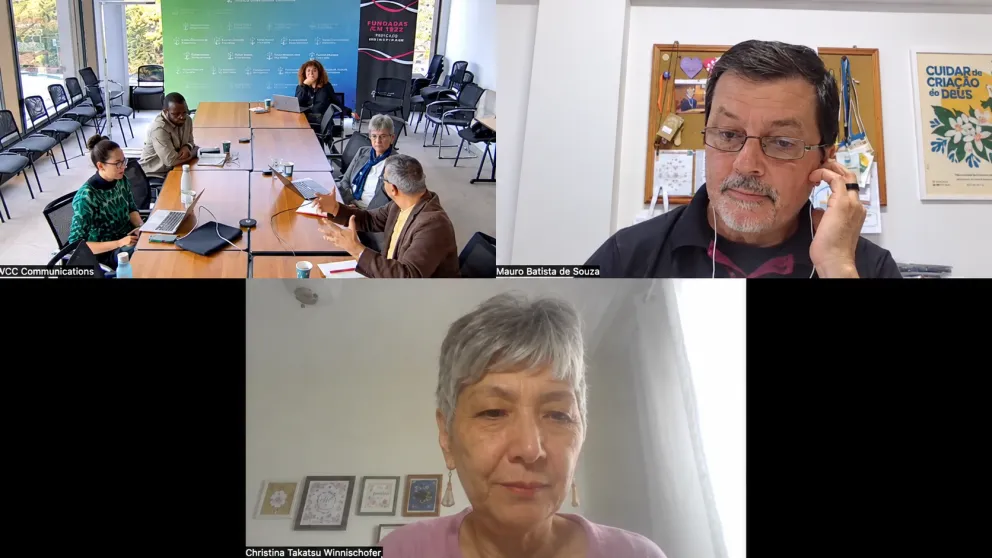

The World Association for Christian Communication (WACC) and Article 19 Brazil were at the forefront of the exchange of experiences and ideas on how we might link and act together in small and large ways to ensure AI development respects and integrates human rights.
WACC deputy general secretary Sara Speicher moderated the discussion, and opened by explaining how the roundtable is part of a Digital Rights Exchange programme organized by Forus and ECNL. The Digital Rights Exchange is being held as part of the Civil Society Alliances for Digital Empowerment project, co-funded by the European Union.
“We also decided to hold this exchange in collaboration with the WCC because churches and ecumenical organizations have real moral and communications authority,” she said.
Raquel da Cruz Lima, coordinator of the Law and Policy Program at Article 19 Brazil and South America, reflected on how money, power, and scale driving the development and implementation of artificial intelligence may make many of us question whether we have the power to impact its direction at all. But she assured those gathered that they do have the power—especially when they speak and act collectively.
“When we talk about freedom of expression, we emphasize its social and collective dimensions,” she said. “It is our ability to hear voices, to create relationships, to engage in partnerships to produce knowledge together, and to participate in public life.”
The discussion noted how, when we combine secular and faith-based efforts, we can make a difference.
Rev. Dr Mauro Batista de Souza, president elect of the Evangelical Church of the Lutheran Confession in Brazil, and a member of the WCC central committee, reflected that churches are offering an increasingly important perspective to discussions on AI, whether those discussions are taking place at a local church or an international forum.
“Technology must remain at the service of life, and not the other way around,” he said. “We must be sure AI does not deepen existing inequalities or create new forms of exclusion.”
Those gathered weighed the question: How might artificial intelligence – and indeed all our digital platforms – look and act if it was designed with human rights at its core?
Christina Takatsu Winnischofer, general secretary of the Episcopal Anglican Church of Brazil, gave an overview of many facets related to AI about which the church is concerned. “In our environmental justice group, there is a concern with data centers,” she said. “There has also been a discussion within the whole church on exactly what information is shared, and the bias that is already built into the programs that are there.”
After responding to questions, the speakers all agreed that the conversation must continue on grassroots, regional, and international levels.
Watch the recording of this event
Our Common Future: Advocating for Digital Rights and AI Accountability
Source: www.oikoumene.org