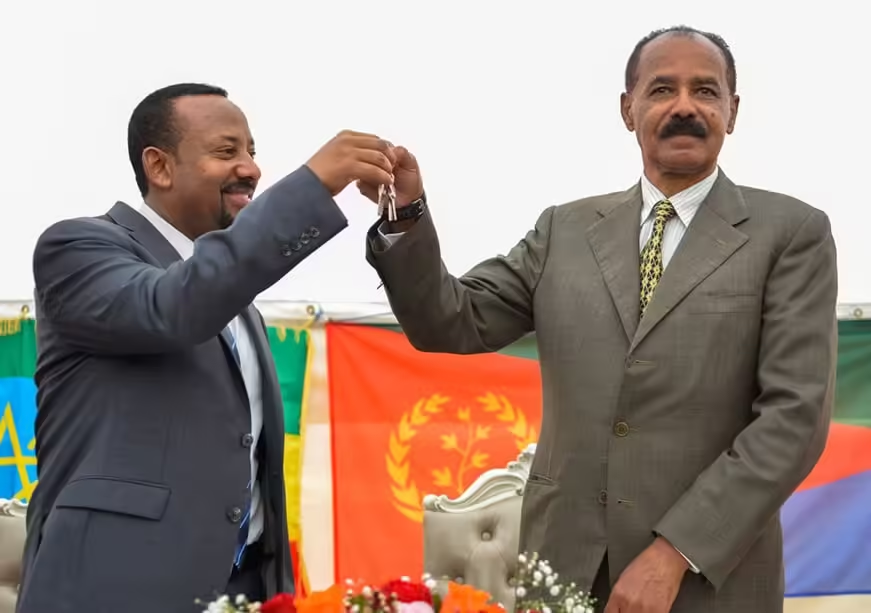

Image Source: Getty Images
On 18 September 2026, the United States quietly allowed the national emergency declared in Executive Order 14046 to lapse, ending the sanctions that the Biden administration had imposed in 2021 on Eritrea’s military, its ruling party, and other entities over Asmara’s role in Ethiopia’s devastating Tigray War and the resulting humanitarian crisis in northern Ethiopia. The move does not lift all US restrictions on Eritrea, but it raises questions about Washington’s priorities in an increasingly unstable Horn of Africa, where maritime security and strategic competition are closely intertwined and are reshaping regional alignments.
Situated in Ethiopia’s extreme north, the Tigray region borders Eritrea to the north and Sudan to the west. In November 2020, a devastating conflict broke out there, pitting Ethiopia’s federal government (FDRE) and its armed forces, the Ethiopian National Defence Force (ENDF), against the Tigray People’s Liberation Front (TPLF). Eritrean troops intervened alongside Ethiopian federal forces and were accused of committing serious atrocities in the region. In November 2021, the Biden administration imposed sanctions on Eritrean military entities, President Isaias Afwerki’s ruling People’s Front for Democracy and Justice (PFDJ), and other individuals and organisations linked to the conflict.
In November 2022, the FDRE and the TPLF signed the Pretoria Agreement, committing to an immediate and permanent cessation of hostilities. Despite the agreement, the situation remained tense. In October 2026, Prime Minister Abiy Ahmed’s office unilaterally announced the formation of a new federal caretaker administration in Tigray, promising elections by April 2027 and effectively sidelining the power-sharing arrangements.
With tensions across the Middle East and the Red Sea threatening international shipping, Eritrea’s strategic location has acquired renewed importance. Its long coastline, its proximity to Yemen, and its access to the southern Red Sea offer potential advantages to Washington. Securing Eritrea’s cooperation, or at least preventing it from aligning with competing regional actors, has been an important consideration for the US.
The sanctions remained in place through annual renewals of the presidential declaration of national emergency, including under the Trump administration. The regional context adds strategic weight to the decision. With tensions across the Middle East and the Red Sea threatening international shipping, Eritrea’s strategic location has acquired renewed importance. Its long coastline, its proximity to Yemen, and its access to the southern Red Sea offer potential advantages to Washington. Securing Eritrea’s cooperation, or at least preventing it from aligning with competing regional actors, has been an important consideration for the US.
Eritrea’s Strategic Value
Eritrea remains one of the world’s most authoritarian states. It has not held a national election since independence in 1993, and it maintains an extensive system of national service that, although limited by law to 18 months of conscription, is in practice extended indefinitely for a significant proportion of conscripts. Its political economy is closely tied to the ruling party, which exercises absolute control over the state, the security apparatus, and major economic activities.
Mineral extraction, including gold, silver, copper, zinc, and potash, has provided an important source of revenue and attracted foreign investment. These resources also help the regime sustain its military establishment and consolidate political control. The national service system, meanwhile, has long been criticised for coercive labour practices and restrictions on individual freedom. Amnesty International has documented forced labour, torture, arbitrary detention, and severe restrictions on independent media. Eritrea’s strategic importance, therefore, sits alongside a deeply troubling domestic record.
Even so, its location could make Eritrea an attractive partner for the United States amid heightened maritime insecurity in the Red Sea. Its southern port of Assab lies close to the Bab el-Mandeb Strait, a critical passage connecting the Red Sea to the Gulf of Aden and the wider Indian Ocean.
The situation in Yemen adds another layer of complexity. Houthi rebels have repeatedly threatened shipping through the Red Sea. At the same time, the group’s conflict with Yemen’s internationally recognised government and its regional opponents has complicated efforts to secure the waterway, raising the strategic relevance of countries on the opposite African coast, including Eritrea. The lapse of US sanctions could, therefore, create diplomatic space for greater engagement between Washington and Asmara.
Saudi Arabia also has an interest in Eritrea’s regional posture. The two countries have maintained relations shaped by Red Sea security and the wider balance of power in the Horn of Africa. Engagement between Eritrean and Saudi officials could offer Asmara additional diplomatic leverage as regional tensions intensify. For a country facing severe economic constraints and with few international partners, closer ties with influential regional powers could yield political as well as economic dividends.
Eritrea’s difficult relationship with Ethiopia gives Cairo a potential regional partner, even if cooperation between the two does not automatically translate into a coordinated strategy against Addis Ababa.
Egypt presents another important consideration. Cairo and Asmara share concerns about Ethiopia’s regional ambitions, although their interests are not identical. Egypt’s dispute with Addis Ababa over the Grand Ethiopian Renaissance Dam (GERD) has made the balance of power in the Nile basin a central concern for Egyptian policymakers. Eritrea’s difficult relationship with Ethiopia gives Cairo a potential regional partner, even if cooperation between the two does not automatically translate into a coordinated strategy against Addis Ababa.
Washington’s Balancing Act
Although Saudi Arabia and Egypt may welcome greater US diplomatic flexibility towards Eritrea, Washington is unlikely to abandon its relationship with Ethiopia. The two countries have longstanding security ties, and Ethiopia remains a major regional actor whose cooperation is vital to US interests in the Horn of Africa. The lapse of the national emergency declared in Executive Order 14046, which addressed the crisis in northern Ethiopia, ended the entire Ethiopia-related sanctions programme, though every party delisted was Eritrean. Simultaneously, the State Department formally removed Ethiopia from the list of countries to which US defence exports are barred under the International Traffic in Arms Regulations (ITAR). Together with the prospect of closer security engagement with Addis Ababa, these steps suggest that Washington is seeking to keep its options open rather than choose a side.
The timing of the lapse is particularly sensitive. Relations between Ethiopia and Eritrea have deteriorated amid mutual accusations, including Addis Ababa’s allegations that Asmara is backing armed groups fighting the federal government. The unresolved legacy of the Tigray War, competing regional ambitions, and uncertainty over the future political order have heightened the risk of renewed confrontation. Any escalation could destabilise a region already scarred by conflict, displacement, and humanitarian emergencies.
The distinction between strategic engagement and political endorsement matters. Washington may have legitimate reasons to seek a more workable relationship with Asmara, particularly given the importance of Red Sea security. But if such engagement strengthens the ruling elite without creating incentives for better governance or respect for human rights, its benefits will remain narrowly concentrated.
Conclusion
Removing the sanctions will not offer any material relief to ordinary Eritreans. The measures targeted elements of the ruling party’s financial and military apparatus, as well as senior officials associated with the regime, so their lapse is more likely to benefit those influential political and economic actors. In a system characterised by political repression, restricted economic opportunities, and indefinite national service, social conditions cannot improve without domestic reform.
Ultimately, Trump’s Eritrean gamble reflects a broader shift in US policy, as Washington seeks strategic advantage without publicly attaching conditions on political reform, human rights, or an end to indefinite national service, citing only the advancement of US regional interests.
Ultimately, Trump’s Eritrean gamble reflects a broader shift in US policy, as Washington seeks strategic advantage without publicly attaching conditions on political reform, human rights, or an end to indefinite national service, citing only the advancement of US regional interests. At the same time, it appears wary of aggravating the regional rivalries that could further destabilise an already volatile Horn of Africa. Eritrea’s strategic location and its ties with Egypt and Saudi Arabia make it an important regional player, one that Washington is keen to engage.
The lapse of the sanctions may be a pragmatic opening, but it is not a strategy in itself. Unless Washington can reconcile its maritime security goals with regional stability, and ground its approach in a credible understanding of Eritrea’s domestic politics, its rapprochement with Asmara risks becoming a partnership of necessity without a clear long-term vision.
Samir Bhattacharya is a Fellow at Observer Research Foundation.
The views expressed above belong to the author(s). ORF research and analyses now available on Telegram! Click here to access our curated content — blogs, longforms and interviews.
Source: www.orfonline.org