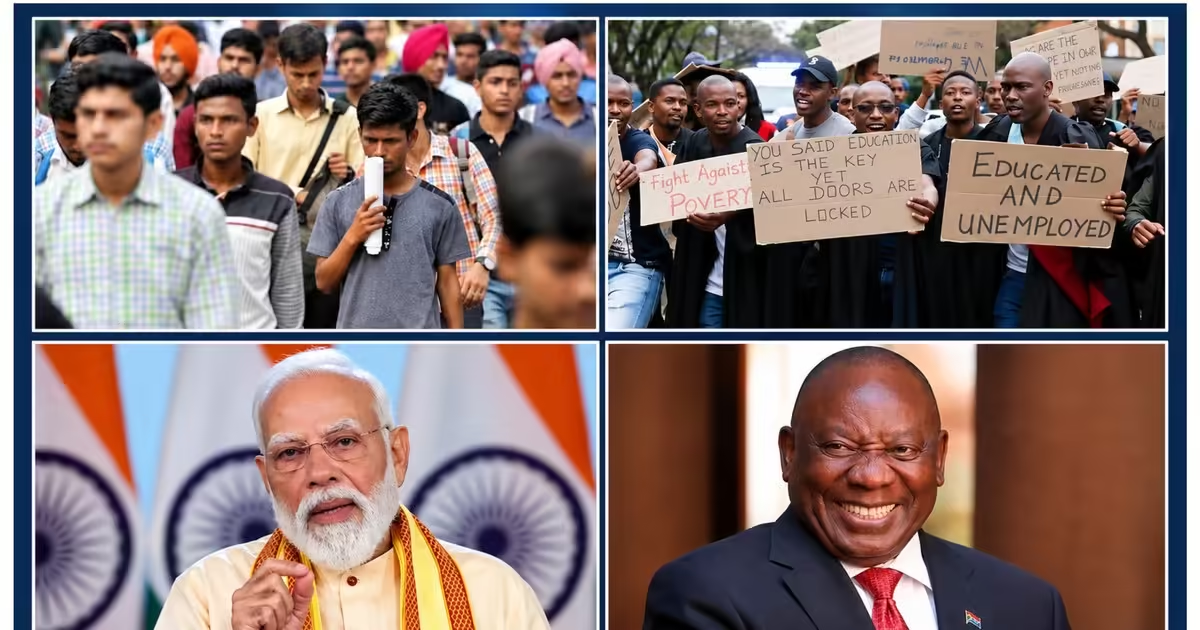

The latest figures reveal contrasting employment trends, with India recording gains in rural employment and agriculture, while South Africa continued to lose farming jobs despite efforts to revive the sector.
According to Statistics South Africa (Stats SA), unemployment rose from 33.6% in the second quarter to 33.7% in the third quarter, leaving 8.6 million people unemployed and 16.8 million in work.
Although the economy added 101,000 jobs, the number of unemployed people increased by 97,000 as the labour force grew by 198,000.
India, with a population of 1.48 billion compared with South Africa’s 65.5 million, recorded an improvement over the same period.
Figures from India’s Ministry of Statistics and Programme Implementation showed that unemployment fell from 5.4% to 5.1%, while labour force participation increased from 54.6% to 55.5%.
India’s rural employment rises as South Africa loses agricultural jobs
India’s declining unemployment rate was supported by improving employment conditions in rural areas, where agriculture remains a major source of income for millions of households.
Rural unemployment fell from 4.8% to 4.3%, while the proportion of rural residents in employment increased from 54.2% to 55.6%. Labour force participation also rose from 56.9% to 58.1%, reflecting stronger activity in the rural labour market.
Agriculture accounted for a growing share of rural employment, rising by 3.8 percentage points to 56.7%, while self-employment increased from 61.4% to 62.7%.
South Africa, meanwhile, lost 34,000 agricultural jobs and another 68,000 positions in private households.
The country’s largest employment gains came from finance, which added 111,000 jobs, followed by manufacturing with 33,000, mining with 31,000 and community and social services with 20,000.
Although President Cyril Ramaphosa recognised agriculture’s potential to create jobs in a sector where commercial farmland remains largely white-owned, his October 2026 plan to release 2.5 million hectares to black farmers came after the third-quarter job losses, which could take years to reverse.
South Africa’s job growth fails to keep pace with expanding workforce
Beyond agriculture, South Africa’s employment figures show that the economy is not creating enough jobs to accommodate its growing workforce.
Formal employment increased by 268,000 during the quarter, but the informal sector lost 98,000 jobs, while private households shed another 68,000 positions.
As a result, employment gains across several industries were not enough to prevent the overall unemployment rate from rising.
The situation is more serious when people who have stopped looking for work are considered.
Stats SA reported that the number of discouraged jobseekers increased by 70,000 to 3.7 million, as more people gave up searching for employment because they believed jobs were unavailable.
South Africa’s expanded unemployment rate, which also includes people who want work but are not actively searching or are otherwise part of the potential labour force, rose from 43.8% to 44%.
Different employment challenges in India and South Africa
Despite India’s lower unemployment rate, the country continues to face challenges involving informal work, low earnings and job security, particularly among people who depend on agriculture and self-employment.
The Indian government has introduced employment incentives to encourage businesses to recruit workers and help young people secure formal jobs.
During the launch of an employment initiative in June 2026, Prime Minister Narendra Modi said, “The Government’s focus has been on linking employment with security, dignity, and social protection.”
However, the increase in agricultural employment does not necessarily mean higher incomes or better working conditions, as many workers still depend on seasonal and informal jobs.
Although the two countries use different methods to measure unemployment, India’s rural employment gains show the potential of agriculture to support job creation, an opportunity South Africa has yet to fully tap into as it struggles to create enough jobs for its growing workforce.
Source: africa.businessinsider.com