

Chile – like any other nation – has speeches that mark the collective ideology of its compatriots. One of them is that it is an economy based on small and medium-sized businesses (SMEs), which would be the ones driving the national economy.
However, the figures derived from Operation Income 2026, based on commercial information for the year 2025, show a different reality: Chile is a country of SMEs in terms of their number, but not in terms of their level of turnover nor in the amount of employment they generate.
Recently released by the Internal Revenue Service (SII), the records are based on the information that taxpayers, through the traditional form 22 and other sworn statements, report to the supervisory body each year.
This translates into a true x-ray of the situation of the national economy at a micro level.
Specifically, in 2025 taxpayers declared to the SII that there are 1,658,684 companies in the country, which implied a growth of 4.4% compared to the previous period. This is the largest expansion recorded since 2022.
If the situation is compared to the beginning of the 2010s, the total number of firms has increased by 76.6% in the country.
Another of the relevant lines that people declared in Operation Income was the total billing made by their companies last year, calculated in development units (UF). And as is the trend, it represents several times the total volume of the country’s Gross Domestic Product (GDP).
In this way, last year total sales were recorded in the country for 34,944 million UF, an advance of 1.5% compared to the year 2024. This implies a slowdown if contrasted with the 5% advance that occurred in the aforementioned year.
The level of turnover in the domestic market is such that it exceeded the total GDP several times: US$ 1,523 billion in income, which contrasted with a total Product that amounted to just over US$ 350,000 million last year.
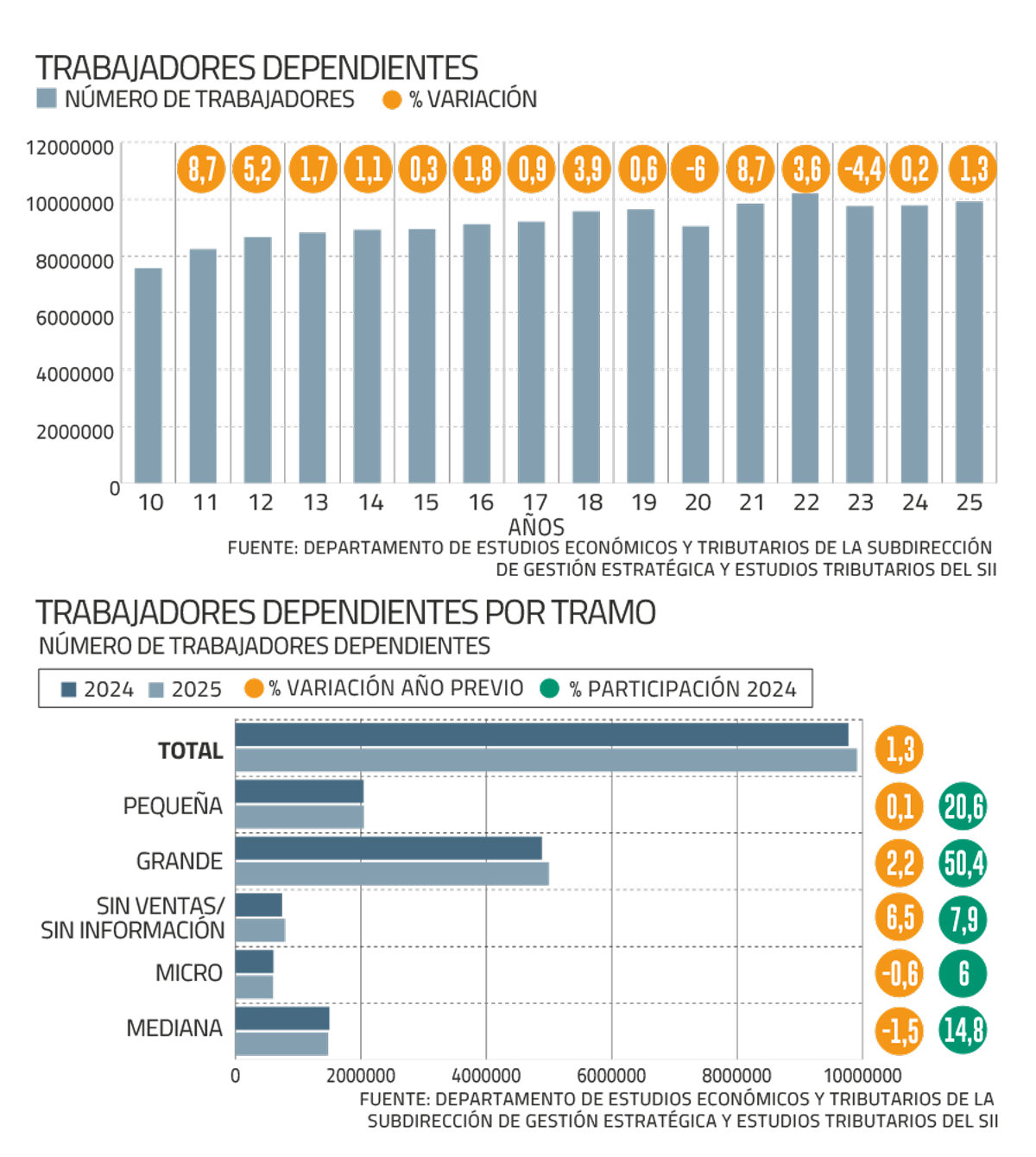
Finally, the tax representatives and advisors of the companies reported to Internal Revenue that, as a whole, these companies employed 9.9 million workers last year, an increase of 1.3% compared to 2024, which is equivalent to an acceleration if contrasted with the advance of just 0.2% that was registered in said year compared to 2023.
In this way, the total number of dependent workers approached the 10 million it reached in 2022, according to SII records.
The majority of employed workers performed functions in large companies (50.4%), followed by small (20.6%) and medium-sized companies (14.8%). Thus, MSMEs weighed 41.5%.
What each item weighs
The data also allows us to prepare an x-ray of the participation of each type of company in the total. Thus, Internal Taxes defines five sections to classify companies, based on their annual sales in UF.
A company without sales corresponds to taxpayers whose declared tax information does not allow determining an estimated amount of them; The micro company is the one that invoices between 0.01 UF and 2,400 UF per year; a small one, which generates ordinary income of between 2,400.01 UF to 25,000 UF each year; a medium one, with turnover between 25,000.01 UF to 100,000 UF; and a large one is the one that sells more than 100,000.01 UF per year.
Based on this criterion, 58.9% of the firms in Chile fell into the microenterprise category. That is, 978,433 taxpayers.
Legal entities that do not declare sales were located further back, with more than 352 thousand, 21.2% of the universe. Small businesses, meanwhile, accounted for 16.2% of the total (269 thousand taxpayers) and large businesses totaled only 18,650, 1.1% of the total.
Last year, total sales in the country amounted to 34,944 million UF, a growth of 1.5% compared to the year 2024. This implies a slowdown when contrasted with the 5% advance that occurred in the aforementioned year.
Now, adding the micro, small and medium-sized business segment, these represented 77.6% of the total companies in the country.
What was the panorama like 15 years ago? Micro, small and medium-sized firms accounted for 82.4% of the total.
When analyzing the sales situation by company size, a curious situation arises: large companies took the main share, with 87.6% of the country’s turnover last year. Small companies followed far behind, with just 5.6%, and medium-sized companies completed the podium, with 5.2%.
The sum of micro, small and medium-sized companies resulted in them representing only 12.3% of sales at the country level.
Adding the micro, small and medium-sized business segment, these represented 77.6% of the total companies in the country. What was the panorama like 15 years ago? Micro, small and medium-sized firms accounted for 82.4% of the total.
15 years ago, large companies invoiced 84.4% of total sales, and micro, small and medium-sized companies 15.5%.
Now, going to the number of workers employed, the majority performed functions in large companies, with 50.4% of the total, followed by small ones with 20.6% and medium-sized ones, with 14.8%. Thus, the sum of the micro, small and medium segment amounted to 41.5%.
In 2010, the proportion was like this: 45.5% of workers worked in micro, small and medium-sized companies, while 47.8% worked in large corporations.
The information comes from forms 22 and 29 that year after year people and company representatives declare to the SII, in addition to sworn declarations No. 1887, 1879, 1827, 1847, 1923, 1924, 1926 and 1943, where items such as salary payments, investments, labor taxes and shares in companies, among others, are reported.
Source: www.df.cl