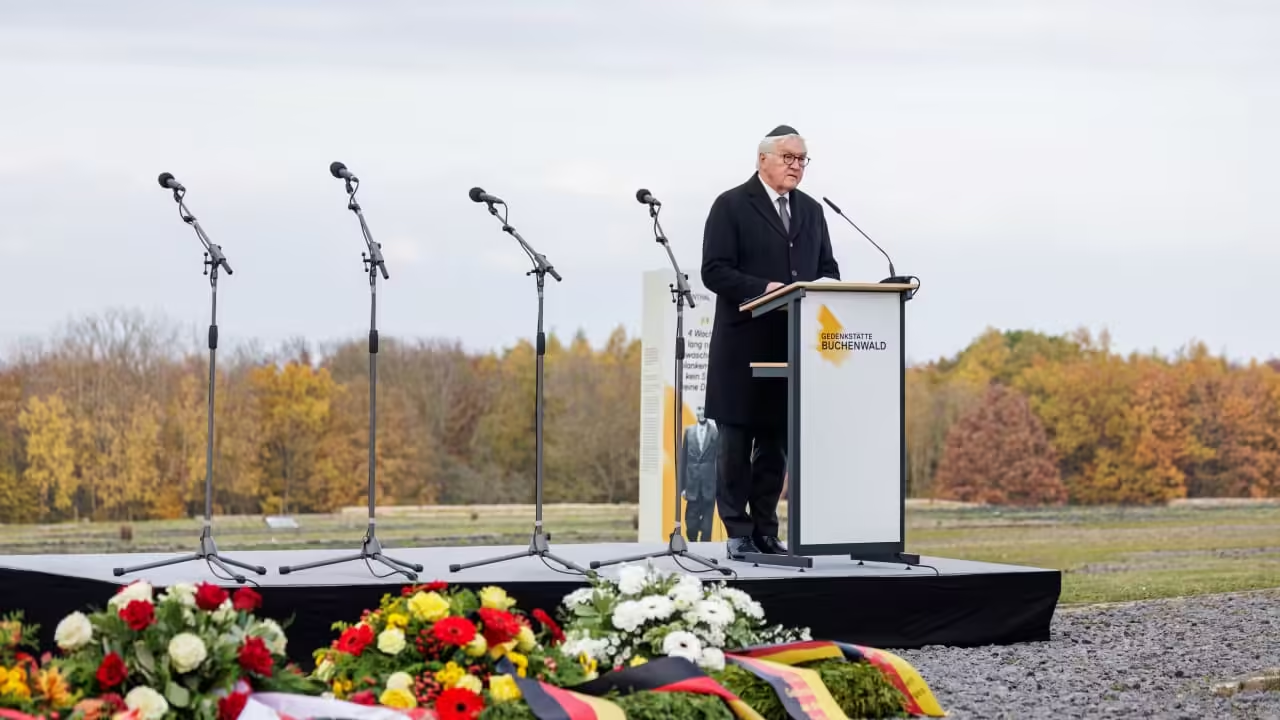

On November 9, 2026, the leaders of several European countries invoked the memory of Kristallnacht to warn against the resurgence of antisemitism, defend Jewish life, and reaffirm their countries’ historical responsibilities to ensure ‘Never Again.’
German Chancellor Friedrich Merz emphasized historical responsibility, President Frank-Walter Steinmeier acknowledged attacks on Jews, Dutch Prime Minister Rob Jetten urged Jews to stay, and Norwegian Prime Minister Jonas Gahr Støre warned against importing international conflicts. Each stressed the importance of remembering, 88 years on.
Yet the speeches raise a question that goes beyond remembrance: How closely do the promises made at Kristallnacht commemorations reflect the experiences of Jews living in these countries today? And do the leaders’ rhetoric correlate with or contradict the reality on the ground?
The Netherlands
During his speech in Amsterdam, Jetten spoke of how “the horror of Kristallnacht as an antisemitic outburst of violence is not unique from a historical point of view.”
He compared the 1938 pogrom with the terrorist attack of October 7, stressing that even all these years later, “anti-Jewish feelings are once again rekindled by social divisions in our country.”
“There is no excuse whatsoever for threats and violence against synagogues, against Jewish schools and restaurants, or against Dutch Jews who do not want to hide their identity,” he said.
He also directly addressed members of the Jewish community who are considering leaving the Netherlands, asking them, “Don’t give in to it; this is your home.”
Jetten then listed all of the actions taken by the Dutch government to protect Jews, such as making extra money available for the security of Jewish buildings and institutions, supporting visible Jewish life at the national level in consultation with the Jewish community and the National Coordinator for Combating Antisemitism, and on a personal level, his own decision to hand a mezuzah on his front door as a way [“To show that I want to be prime minister of a country in which Jewish life is visible.”]
Nevertheless, the reality on the ground in the Netherlands is that antisemitism is still increasing. Police registered 867 antisemitic incidents in 2025, compared with 880 in 2024. Of those 867 antisemitic incidents, more than 400 of which were directed at (perceived) Jewish individuals and institutions.
Dutch Jews disproportionately affected by discrimination despite small population
The Dutch National Coordinator for Combating Antisemitism, Eddo Verdoner, noted that Jews make up less than 0.3% of the country’s population, yet antisemitism accounts for 26% of all specific discrimination incidents registered by the Public Prosecutor’s Office.
“The Netherlands is the first in line to do whatever is necessary to make life more complicated for Jewish people in the Netherlands, for tourists coming from Israel,” Jigal Markuszower, President of the Jewish Communities in The Netherlands, told The Jerusalem Post last month.
And while Jetten asks Dutch Jews to feel secure and welcome in the Netherlands, he did not acknowledge whether actions of his own government risk contributing to an environment in which Jewish citizens feel increasingly isolated and unsafe.
Just recently, the Netherlands introduced a ban on importing, purchasing and selling goods originating from Israeli settlements in the West Bank. Importantly, this was not merely a political declaration. The restrictions also apply to goods brought into the Netherlands for personal use, including souvenirs and gifts.
Jetten’s government developed the measure and formally announced it in July 2026.
Just three days before his Kristallnacht speech, on November 6, Jetten defended the measures and said his government was encouraging other European countries to adopt similar restrictions. The prime minister also confirmed that the Netherlands was pursuing additional measures against Israel at the European level, including pressing for a reassessment of the EU-Israel Association Agreement.
While not inherently contradictory, it does ask the question of how Jetten reconciles his government’s increasingly confrontational diplomatic relationship with Israel with his commitment to ensuring Jewish citizens feel welcome in the Netherlands.
Separately, Dutch universities have been continually restricting cooperation with Israeli institutions.
For example, the University of Amsterdam announced in October 2025 that it would not enter into new institutional educational or research partnerships with Israeli institutions. It also decided not to extend its Tel Aviv University exchange agreement. Similar decisions have since been made by TU Delft, Leiden University, and Radboud.
These are university decisions, not national government decrees. But in terms of the climate created, the exclusion of Israeli academic institutions from partnerships can create an academic environment where Israeli or Jewish students and researchers in the Netherlands feel marginalized.
In his Kristallnacht speech, the prime minister acknowledged that Jewish citizens are experiencing insecurity in his country. But it is unclear whether his government has adequately assessed the domestic consequences of its own actions and the actions of its institutions.
Norway’s PM warns of rising antisemitism and harassment of Jewish children
The same scrutiny can be applied to Norway, and to the policies of Støre’s government.
Støre used his November 9 Kristallnacht speech to warn that antisemitism is increasing in Norway, Jewish children face harassment, and society must prevent international conflicts from influencing how it treats its own citizens.
Støre asked the question of ‘could it happen again?’ and acknowledged that antisemitism still exists in Norway, “and is increasing.”
He also recognized that, in modern times, “we don’t need a shop window or a living room window to break crystal; we have the internet, comment sections, social media, or bullying that Jewish children and young people face at school.”
Støre then proceeded to stress that if Jews are affected in Norway, “everyone is.”
He also said, “In 1938, Europe was still living in peace. Norway was neutral, but I am quite sure that the Jews who lived here – they saw signs in the times that not everyone else saw. Because pogroms had happened before – and they lived with it in their stories.”
There was a certain irony to this part of his speech, given the number of Norwegian Jews who had told The Jerusalem Post of their warnings to governments that have not been heard.
Just last year, much to the chagrin of the local Jewish community, Det Mosaiske Trossamfunn (DMT), Støre attended an anti-Zionist Kristallnacht event co-organized by the Palestine Committee of Norway and the local branch of Jewish Voices for Peace.
DMT encouraged Store not to attend, but he went ahead with his plans anyway.
There was also an irony in Støre warning against letting international conflicts affect relations with Norwegians, while becoming so involved in the conflict in question.
On June 19, 2026, Norway’s Foreign Ministry published a proposal to prohibit trade involving Israeli settlements. The proposed restrictions include importing settlement products, exporting goods to settlements, certain property transactions, and commercial services connected to settlement construction.
In August 2025, Norges Bank Investment Management announced it would sell holdings in Israeli companies outside the fund’s benchmark index.
Furthermore, Norway formally recognized Palestinian statehood on May 28, 2024. Many of these actions were taken against the direct wishes of the Jewish community.
In fact, Norway’s own 2025–2030 action plan against antisemitism contains a finding that makes the connection between Israel and Norwegian antisemitism especially relevant.
30% of respondents said Israel’s warfare in Gaza had made them feel more negatively toward Jews in general, according to the 2024 survey cited in Norway’s government action plan.
That finding does not establish that Norwegian government policy caused antisemitism. It does, however, demonstrate that hostility related to the Israeli-Palestinian conflict can extend to Jews as a group.
The same government document acknowledges that Jewish children have been pressured to answer for Israeli military actions, that some Jewish families have received threats, and that many Jews avoid displaying religious symbols publicly.
Given that the government recognizes this connection, how does it ensure its own rhetoric and policies do not reinforce the conflation of Israeli actions with Jewish identity?
Germany takes a different approach to Israel amid rising antisemitism
Germany presents a different case from Norway and the Netherlands.
Chancellor Friedrich Merz has opposed broad sanctions against Israel, defended academic cooperation with Israeli institutions and repeatedly reaffirmed Germany’s historical responsibility toward the Jewish state. President Frank-Walter Steinmeier has similarly condemned antisemitism across political and ideological divides.
However, Germany has also restricted certain arms exports to Israel, supported targeted measures against certain settlers and faced increasing pressure to boycott Israeli institutions.
Additionally, antisemitism remains at historically elevated levels despite Germany’s extensive Holocaust education programs, legal protections and official commitments.
This raises the central question of whether Germany’s political commitment to Jewish life and Israel is translating into meaningful protection for Jews, and whether its own policies and institutions sometimes undermine that commitment.
In his speech in Munich’s Ohel Jakob synagogue, Merz acknowledged that Jewish institutions still require armed police and extraordinary security measures. He also framed Israel’s existence as a refuge for Jews facing persecution and as part of Germany’s historical responsibility, adding, “We stand unwaveringly by Israel’s side.”
Steinmeier, speaking outside Buchenwald, expressed shame that Jews are once again being threatened and attacked on German streets.
Perhaps most strikingly, Merz conceded that an open, visible Jewish existence in Germany is still not fully possible. Their remarks came after Germany recorded 8,725 antisemitic incidents in 2025, nearly 24 each day.
However, unlike the other two countries, Germany has explicitly rejected general sanctions against Israel, citing Germany’s particular historical responsibility. German academic institutions, unlike Dutch universities, have publicly resisted demands to boycott Israel.
For example, on April 22, 2026, Freie Universität Berlin reaffirmed its opposition to academic boycotts of Israeli universities and researchers. This makes Germany an important counterpoint to the Netherlands.
However, the questions to pursue are not simply whether academic boycotts have been adopted, but whether campaigns advocating them have affected Jewish and Israeli students, and the government and universities’ opposition to boycotts should be acknowledged alongside documented cases in which Jewish or Israeli individuals have nevertheless faced exclusion.
Additionally, the increase in antisemitism comes despite Germany’s continued investment in Holocaust remembrance. Both Steinmeier and Merz praised Germany’s extensive culture of Holocaust remembrance. In August 2026, the federal government announced an additional €10 million for memorial institutions and related projects.
It seems possible that Germany has become better at commemorating Jewish suffering than at preventing contemporary hostility toward Jews.
Commitment to Never Again
While the speeches delivered across Europe on Kristallnacht demonstrate that leaders recognize the threat of antisemitism, recognition alone does not guarantee that Jewish communities feel safe, nor does commemorating the persecution of Jews in the past necessarily translate into protecting them in the present.
The distinction between the three countries is notable. While Germany has largely resisted calls for sweeping boycotts of Israel, the Netherlands and Norway have pursued increasingly restrictive measures. Yes – such policies are not inherently antisemitic, but they raise questions about whether governments have adequately considered their potential consequences for Jewish citizens, particularly when hostility toward Israel can spill over into hostility toward Jews.
Norway’s own research illustrates that concern, with 30% of respondents reporting that Israel’s war in Gaza had negatively affected their attitudes toward Jews.
In Germany, meanwhile, the persistence of antisemitism despite extensive Holocaust education and political commitments suggests that remembrance, however important, is insufficient on its own.
None of this establishes that European governments are responsible for the antisemitism their leaders spoke of yesterday. It does, however, place a responsibility on them to examine whether their decisions and language are consistent with the principles they invoke each November.
88 years after Kristallnacht, the measure of Europe’s commitment to “Never Again” lies not only in what its leaders say about the Jews who suffered in 1938, but also in whether Jews living in Europe today can openly and safely practice their faith, express their identities and participate in public life without fear.
Source: www.jpost.com