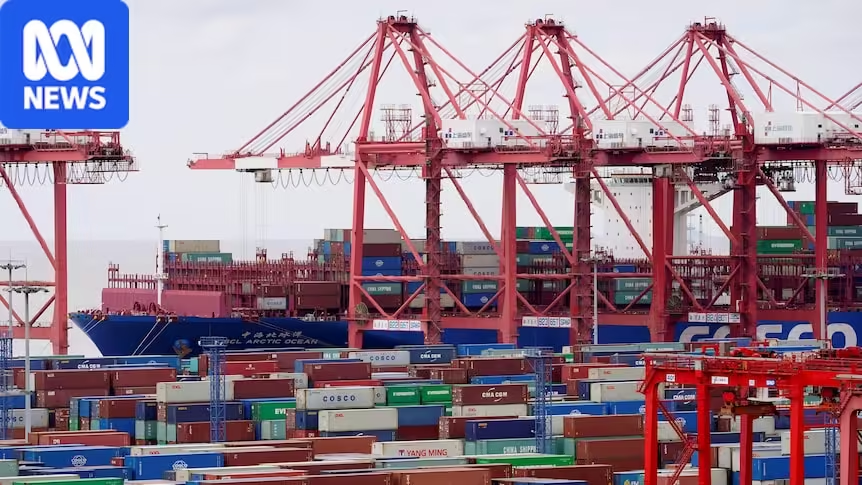

China’s trade surplus ballooned to more than $US1 trillion ($1.4 trillion) in the 10 months to October, official data shows, with the country reaching the milestone even earlier than 2025’s record-breaking sum.
The figures come ahead of talks between China President Xi Jinping and his US counterpart Donald Trump at the Asia-Pacific Economic Cooperation (APEC) summit in China next week, when trade tensions will likely loom large.
Exports from the world’s second-largest economy have surged in recent months, driven in part by soaring global demand for AI-related products including computer chips, data centre servers and networking equipment.
The trade boom has offered Beijing a key economic lifeline as domestic activity is weighed down by longstanding woes in the once-roaring property sector.
Exports jumped 35.2 per cent year-on-year to $US412.3 billion last month, according to the General Administration of Customs (GAC), while imports expanded 41.6 per cent to $US307.1 billion.
The figures brought China’s total trade surplus during the first 10 months to a towering $US1.04 trillion, according to the GAC.
Trade has been a key issue for Xi Jinping and Donald Trump in recent years. (Reuters: Kylie Cooper)
“Exporters have been the key driving force behind China’s economy this year,” Zhiwei Zhang, president and chief economist at Pinpoint Asset Management, wrote.
“I expect they will continue to perform well in the foreseeable future,” he said, adding that he did not think China’s macro policy stance would change significantly for the rest of the year.
The country is well on track to surpass the record $US1.2 trillion surplus hit last year, when the $US1 trillion mark was reached in November.
However, the export boom has fuelled tensions with several key trading partners, who complain that floods of lower-cost Chinese goods are doing huge damage to their local industries.
Chinese exports to US grow
In unwelcome news to Washington, the latest figures show Chinese exports to the United States surged 32.9 per cent last month.
Mr Xi and Mr Trump have navigated a shaky truce to a fierce trade war since their meeting in October last year, agreeing recently to extend the arrangement ahead of talks that were held in Washington in September.
They are expected to hold another head-to-head at the APEC gathering, which runs from November 18 to 19 in Shenzhen and could also see the pair meeting with Russian President Vladimir Putin for trilateral talks.
On Friday, top Chinese and US officials held what readouts suggested were tetchy talks ahead of the summit.
The Americans stressed “the importance of China fully and immediately implementing its commitments” and highlighted “concerns about recent Chinese actions”, according to the US Treasury Department.
Chinese Vice Premier He Lifeng expressed “serious concerns over recent economic and trade restrictive measures imposed by the United States”, according to a state media report.
Trade frictions with EU continue
China’s trade surplus with the European Union has also rankled Brussels.
Tuesday’s data showed China’s surplus with the 27-nation bloc had swelled to $US310.7 billion in January-October, topping the $US241.6 billion recorded during the same period last year.
Talks last month in Beijing between EU trade chief Maros Sefcovic and Chinese counterpart Wang Wentao ended with an agreement to limit exports of hybrid vehicles to Europe.
“Trade frictions with the EU have continued to broaden in recent weeks,” wrote Nguyen Hoang Nam of Capital Economics.
Steps taken recently by Brussels to stem the flow of imports, including 2-euro fees on all packages entering the bloc, “so far cover only a small portion of China’s exports and are unlikely to have much impact on the economy”, Mr Nguyen said.
Analysts say Beijing is relying heavily on exports to achieve its official growth target for this year of 4.5-5.0 per cent, its lowest goal in decades.
Domestic consumption has been sluggish for several years, with data on Monday showing inflation was still well short of the official target of about 2 per cent.
AFP
Source: www.abc.net.au