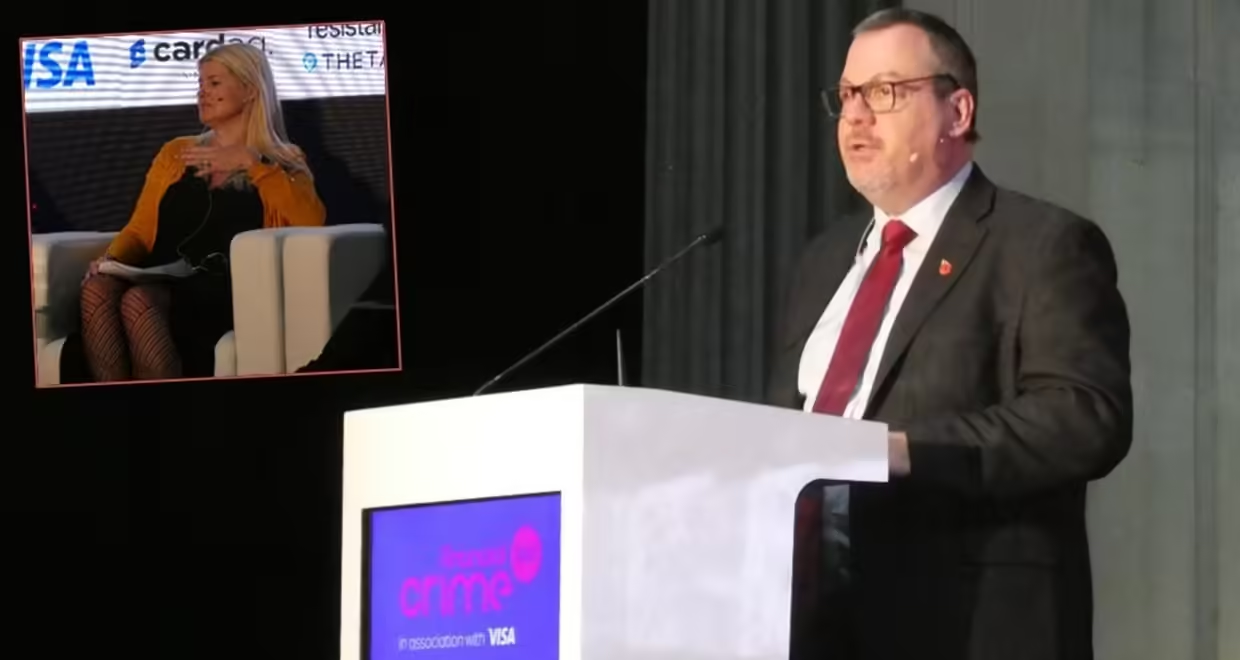

A senior figure at the UK Financial Conduct Authority (FCA) has warned that the threat of financial crime is intensifying and urged those seeking to tackle the problem to “turn information into action”.
Matthew Long, the financial watchdog’s director of payments and digital assets, delivered the opening keynote at the Financial Crime 360 event, setting out the growing threat and challenges facing regulators, law enforcement and the private sector.
He cited figures including £1.28 billion (about $1.71bn) stolen through payment fraud in the UK in 2025 and an estimated £100 billion (about $134bn) laundered through the UK, within the UK or via UK corporate structures each year. “These figures give an idea of the challenge, but they don’t really capture the full societal cost,” he told the audience.
“The threat isn’t standing still,” he said in a 15-minute address titled ‘The next 12 months in fraud and financial crime regulation in the UK: what to expect?’. “I honestly think the last six weeks have been the most significant change that I’ve seen in threat and pace since I used to work in law enforcement.”
“I don’t think I’ve been on a stage recently where a week or so before there’s been a billion-pound incident that illustrates my point, and that is the nature,” he said, apparently referring to the $6.3bn hack on crypto exchange Binance that made global headlines just days before the 2 November event.
“So, turning to the question: the next 12 months in fraud and financial crime regulation… that is quite straightforward. There’ll be more crime, there’ll be things we’ve not seen before, and the pace will be unbelievable,” Long – who began his career as a detective in Kent Police – told the largely private-sector audience in the City of London.
RELATED ARTICLE Fraud recovery to prevention: unlocking the potential of data and technology – write-up from a roundtable at our sister title Global Government Forum’s Public Service Data.AI 2026 on 15 October in London
‘Sometimes about taking risks’
Long praised the private sector for efforts to combat financial crime – he spoke of “great firms doing great things” – but aired concerns of weaknesses in their anti-fraud armoury.
“No single institution can tackle financial crime alone,” he said.
“Criminals collaborate exceptionally well,” he said. “I’ve personally seen board meetings by criminals as good as your [audience members’] board meetings – even minute-d.”
“We’ve got to collaborate across the board. Financial crime is a system problem. It needs a system response, and every single one of us in this room can do something about it,” he urged. “Firms are the vital line of defence. We expect you to be well equipped and playing that role.”
“Criminals do not respect organisations’ boundaries,” he continued. “That is why collaboration is so important. It’s about actually doing something. It’s sometimes about taking risks. It’s about having a proper discussion.
Already [at the conference]I’ve had two conversations here [where people said to me]‘well, I can’t share my data because…’ – [but] there are ways that we can do this.”
“We are increasingly working across the system, bringing together regulators, government, law enforcement, industry, with a common goal: to turn intelligence, to turn information into action,” he said.
RELATED ARTICLE Defence think-tank launches toolkit to fight ‘rapidly escalating threat’ of payment scams – a news story (12 August 2026) on RUSI’s publication of a ‘practical’ system-level framework for policymakers, regulators and practitioners to design and implement anti-fraud strategies (the focus being on authorised push payment fraud – widely referred to in the financial and payments sectors as APP scams)
Criminals’ ‘frightening’ technology use
Long gave examples of FCA activity including work with the National Economic Crime Centre (NECC) to plan and coordinate “robust” action against the operators of illegal crypto ATMs; leadership in international standard-setting bodies, “getting hundreds of regulators together to promote consistent global standards and reduced regulatory arbitrage”; and work with the Home Office and HM Treasury, among other bodies including the private sector, to agree priorities.
“We build a clearer picture and then a clearer picture gives us the opportunity for action,” he said. “But I don’t just want a picture – I want to see it and do something about it. The intelligence you [audience] hold and the willingness to share it can make a real difference.”
He also emphasised the importance of a regulatory framework that keeps pace with technology. “We’ve got to create a regulatory landscape that actually gives us a response to market change,” he said.
The way that technology is being harnessed “is and can be frightening”, he warned, mentioning artificial intelligence (AI). Here he highlighted that the FCA had recently (19 October) published guidance (‘AI in financial services: good practice and areas for improvement’) intended to help firms.
Long also mentioned the forthcoming cryptoasset regulatory regime, expected to come into force on 25 October 2027. This will bring a broader range of digital-asset activities under FCA supervision and impose requirements covering consumer protection, market integrity and operational resilience. “Authorisation [of firms] is not automatic,” he said. “We’ve set a high bar and firms that want to operate in the UK will need to demonstrate that [they] meet the standards of authorised firms.”
RELATED ARTICLE UK government publishes new fraud strategy as cases hit record level – a news story (17 March 2026) as the UK’s (delayed) new fraud strategy is published
ECCTA and intelligence sharing
The FCA was also represented during a panel discussion titled ‘New UK Fraud Strategy: Finally Leading The Way To True Industry Intelligence Sharing?’.
The UK government published its long-awaited 93-page strategy (‘Fraud Strategy 2026-2029’) in March, as cases hit a record level. This included the establishment of an Online Crime Centre to bring together specialists from government, police, intelligence agencies, banks, mobile networks and major tech firms to collaborate on ‘interventions that eliminate online fraud at scale’.
FCA head of department Beth Harris told the audience that she has “high hopes” for the Online Crime Centre but urged that “there’s plenty that we can all be doing now”, encouraging companies to act on “key triggers” more assertively. “There’s more that firms could be doing ‘industry to industry’,” she said.
The Economic Crime and Corporate Transparency Act 2023 (ECCTA) was referenced more than once during the discussion. “I did a lot of conferences about a year ago [where] we spoke quite a lot about [intelligence] sharing under the Economic Crime and Corporate Transparency Act, and I still feel that people have still got the same reservations,” Harris said.
On this theme – intelligence sharing and apparent misconceptions – her sentiment was similar to Long’s. “Lots of people say that “under GDPR we can’t do this”. Under ECCTA, people can share, and it’s really quite clear,” she said.
Source: www.globalgovernmentfinance.com