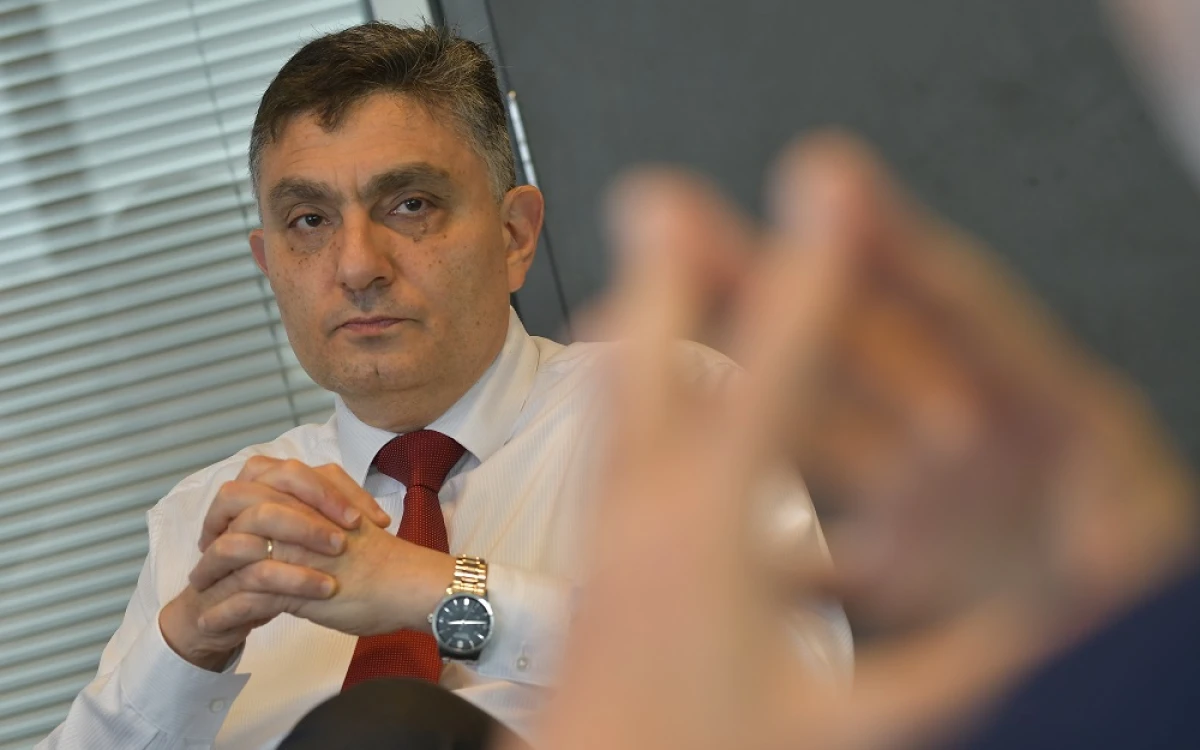

The economist, former director of the Planning and Budget Office (OPP) and former Minister of Economy and Finance, Isaac Alfiehe questioned the instance of Social Dialogue promoted by the government of Yamandú Orsi for the reform of the pension system. Interviewed by Javier de Haedo on the podcast Nominal of the Catholic University (UCU)Alfie maintained that one of the main problems with the proposals that have been promoted in this matter is the absence of true social dialogue. In his opinion, an instance that should serve to build agreements ended up becoming a mechanism to impose a majority vision. “Deep down there was no social dialogue: it was a majority thing that imposed its vision,” he stated during the interview.
The former leader raised his objections to the project promoted by the Executive Branch, particularly due to the changes in the conditions of access to retirement and the possibility of reducing the retirement age to 60 years. Their main question is that the proposal could create incentives for people to retire earlier, even when continuing to work could be more convenient for the system and for their own benefits.
As he explained, the economic incentive to postpone retirement would not be substantially different from what already exists in current legislation. Although he recognized that the new scheme could offer a somewhat greater incentive, he considered that the central problem is the sufficiency of the benefits and the costs involved in bringing forward retirements. “You will pay sooner, even if you pay less, and you will stop receiving contributions from the person. You are going to stop receiving those contributions plus the employer contribution,” he said.
The economist also questioned the methodology used to evaluate the impact of the reform. In particular, he referred to the calculation of the net present value of the benefits, which, he indicated, would be carried out with a discount rate of zero. To illustrate his argument, he stated that current consumption decisions versus future consumption must consider a positive discount rate.
In his opinion, if a real rate of around 5% were applied, the result of the calculation would change and early retirement could be more economically convenient for some of the workers.
Photo: UCU.
In this scenario, he warned that those who would have the greatest chance of taking advantage of the option to retire earlier would be people with relatively higher incomes, who have already reached the average of the best 20 years of contributions and have less room to improve their future retirement if they continue working. On the other hand, those with more fragmented work trajectories could face greater difficulties in accessing the contributory requirements.
Another point that he questioned was the elimination of the non-deductible minimum for certain additional income of those who receive the solidarity supplement. He explained that current regulations establish a threshold below which certain complementary income—such as rental income or interest—does not affect the benefit. The modification, he maintained, could generate a very high burden on the income of people who built savings to complement their retirement.
“They are going to charge you a tax of 33% above personal income tax. They are going to take 50% of your savings”he warned. And he added that the middle class should not be penalized in that way: “It is the one that supports society everywhere, the one that pays taxes, the one that works.”
An economy in need of reform
Beyond the forecast discussion, Alfie made a critical assessment of Uruguayan economic performance since the return of democracy. Although he recognized important advances in macroeconomic stability, institutionality and structural reforms, he considered that the country has not managed to sustain a sufficient growth rate in recent years.
In his opinion, the growth recorded between 1985 and 2014 made it possible to finance the model of coexistence and social protection characteristic of Uruguay. However, the situation changed after 2015.
“After 2015, unbankable. Absolutely unbankable,” he stated when referring to the possibility of sustaining public spending with the growth levels of the last decade.
In that sense, he questioned whether Uruguay has normalized a fiscal deficit close to 4% of the Gross Domestic Product (GDP) for a prolonged period. He also proposed that the measurement of public debt should consider all liabilities, including those of the Banco Central.
To reverse this situation, he considered reforms necessary to boost human capital, improve education and transform State management. In particular, he called for progress in spending evaluation mechanisms, debureaucratization and changes in public administration.
As a reference, he mentioned the tax reforms implemented in the United States during the 1990s, which established restrictions on spending growth and required new public programs to be justified through concrete results and benefits.
Criticisms of monetary policy and salary negotiation
The former Minister of Economy and former director of the OPP, also questioned the design of Uruguayan monetary and exchange policy. In his opinion, the use of the interest rate as the main instrument has limitations in a partially dollarized economy, where credit in national currency represents a small portion of economic activity.
“You are using an instrument that, in essence, is practically managing the exchange rate with the interest rate,” he explained. He considered that the main transmission channel of monetary policy in Uruguay is the exchange rate and not credit, as happens in less dollarized economies. This generates, in his opinion, an additional problem: when the peso appreciates, demand does not necessarily contract, but can shift towards imported goods, travel and other consumption abroad.

Photo: leonardo mainé / El País.
Regarding the inflation goal of 4.5%, he considered that it would not be prudent to reduce it in the short term, due to the salary and budgetary commitments built on that reference. He also pointed out rigidities in the operation of the Salary Tips. However, he clarified that the main problems in the labor market are not in the rights linked to licenses or forms of dismissal, but in the organization of work.
“It is a matter of organizing it differently and organizing it with modern flexibility,” he stated. In particular, he pointed to the seniority of the job categories and the difficulties in adapting working conditions to productive transformations.
Source: www.elpais.com.uy