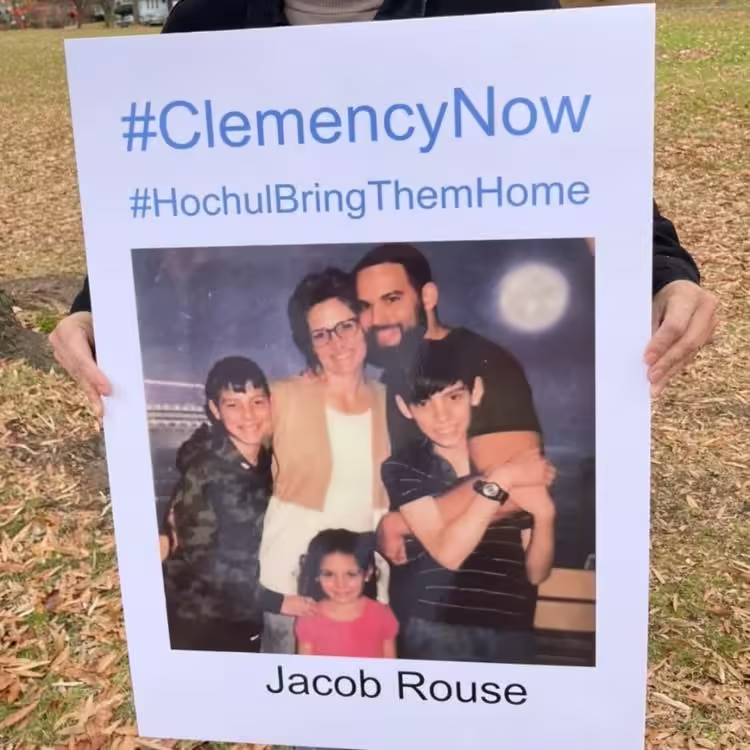

Jacob Rouse has spent two decades in Attica for a murder he didn’t commit. After years of rehabilitation, his appeal for clemency shines a light on what reformers call the “outdated and unjust law” that put him in jail.
By Aanika Eragam / Investigative Reporting Lab at Yale
Jacob Rouse and his wife Samantha. Photo provided by the family.
This story was published in collaboration with the Investigative Reporting Lab at Yale.
On the evening of March 9, 2006, 18-year-old Jacob Rouse parked his Ford Taurus on Magnolia Street in Rochester. Three of his friends — Antwon Owens, Brandon West, and Lucious Peters — exited the car and disappeared down the street. Hoping to make some quick cash, they spotted someone they thought was a local drug dealer to rob. Rouse stayed behind, prepared to drive the getaway car.
Rouse fidgeted as the evening grew darker. His girlfriend was waiting up for him at her house, and he had classes at the local community college in the morning. He was studying international business, while working part-time at an auto parts store to help his mother pay the bills. She’d raised him on her own in the city, in a one-bedroom apartment over a hair salon that didn’t always have electricity.
That night, a familiar noise sounded, one that had punctuated his childhood in Rochester, but never with this much clarity: Pop! Pop! Pop!
“As soon as I heard that first gunshot, my heart just dropped,” Rouse recalled.
His three friends suddenly reappeared, shouting at him to drive. Rouse reversed the car, raced down the road, and swung onto a side street.
Nearby, a Mazda had just drifted off a driveway, rolled over the curb, and crashed into a house across the street. The driver was Herschel Scriven, a youth pastor. He’d been out that night watching The Lion King with his church choir. The group was headed to Applebee’s. Scriven was backing out of the driveway when his car almost hit West, one of Rouse’s friends. Angered, Owens and West fired their guns at him.
Scriven died a few days later, just before his 23rd birthday.
A few weeks later, Rouse was sitting in a barber shop, trying to “zone out” for a haircut. Scriven’s death seemed to be all people were talking about in Rochester, and Rouse was paralyzed with regret. The barber brought it up with him, too.
“Yo, you heard about the minister that got killed?”
Rouse froze. Yes. He’d heard about it.
“Man,” the barber said, “the people that did that, they’re going to hell.’”
By April, Rouse was in custody.
Police sat him inside an interrogation room, where investigators told him they had wiretapped Peters’ phone and he had implicated Rouse. Rouse later learned this wasn’t true. At a pretrial hearing, Rouse and his attorney considered a plea deal, for which he would have to testify against his accomplices to get a shorter sentence.
“If I testified, my family could be harmed,” Rouse told me.
He opted to go to trial, though he never could quite wrap his head around the charge that had been levied against him: second-degree felony murder.
He was convicted. At his sentencing, Scriven’s father, Pastor Harry L. Scriven, Jr., told the court that Rouse should receive the maximum sentence: “I know that is not gonna bring my son back, but I believe justice should prevail.” Rouse was sentenced to 22 years to life in prison.
“To murder someone is to pull the trigger or to do whatever action is required to take that life,” Rouse told me. “I was responsible for my role that night that, you know, I drove these people here, I drove them back, I helped plan a robbery. But to say that I murdered somebody? It blew me away.”
Now, after 20 years of incarceration, Rouse faces a critical juncture. He is holding out hope that this November, Gov. Kathy Hochul will finally grant his application for clemency, which has been pending for six years. He is eager to return home to his eight-year-old daughter, his two stepsons — one with a life-threatening genetic condition — and his wife, who has terminal cancer.
Rouse’s future — and that of hundreds of other individuals imprisoned for felony murder in New York — also hangs in the legislative balance. This coming session, state representatives plan to reintroduce legislation that would repeal the state’s felony-murder law and make those previously convicted eligible for resentencing. At 39 years old, Rouse could be released.
“The reality is that felony murder is an outdated and unjust law that disproportionately incarcerates Black and Brown New Yorkers, sometimes even more harshly than the person who actually committed the murder,” State Senator Julia Salazar, a Democratic representative from Queens who sponsors the repeal bill, said in a statement.
“It’s shameful that we continue to allow so many New Yorkers to unnecessarily languish behind bars for a crime they did not actually commit.”
“The reality is, it’s an old law”
Rouse was shocked when he first learned how the felony murder doctrine works.
Typically, a murder charge requires killing intentionally, or killing with extreme indifference to human life, according to Guyora Binder, a professor at the University at Buffalo School of Law. But felony murder — a distinct legal framework — requires neither intent to kill nor reckless indifference. Instead, it holds that if a person participates in certain serious felonies — often including robbery, rape, arson, or burglary — and a death occurs in the course of the crime, that person and any accomplices can be charged with murder.
New York’s felony murder law imposes liability even on people who neither intended nor anticipated that anyone would be killed or who, like Rouse, were not present at the scene of the murder. Today, nearly every state has a version of the rule. The law was codified in New York in 1828.
“The reality is, it’s an old law,” said Alisha Kohn, co-founder and co-executive director of the Prisoners’ Brain Trust, an organization that spotlighted Rouse in its campaign to end felony murder. “And it is used as a catch-all so our district attorneys don’t have to do the work to actually find evidence against a person.”
The minimum sentence for felony murder in New York is 15 years with the potential for life imprisonment.
Binder’s research has found that in New York, Black Americans, like Rouse, are roughly 20 times more likely to be arrested for and convicted of felony murder. Looking particularly at disparities between those convicted as accomplices versus those personally responsible for causing death, Binder said that the “worst features of felony murder liability are distributed almost exclusively to people of color,” a pattern that has persisted across the country.
Between 2008 and 2021, at least 11 adults and two juveniles were convicted of felony murder in Erie County, according to data obtained by Binder’s team. All but one of those convicted were Black.
Subscribe to our free weekly newsletters
In Albany, legislators have drawn on Binder’s research to draft the bill that would repeal New York’s felony murder rule, allowing those previously convicted under the statute to have their sentences voided and resentenced. Salazar first introduced a version of the bill to the Senate in the 2023-2024 legislative session. While other bills in New York have sought to amend the law — raising the minimum sentencing age or narrowing the scope of felony murder liability — the current measure seeks to abolish the statute entirely.
Though the use of the felony murder doctrine is widespread across the United States, many states have begun to reform and curtail its scope, with recent legislative changes curbing its use in California, Minnesota, Colorado, Illinois, and Massachusetts. Proponents of the measure in New York hope to see it succeed this coming session.
“I initially introduced legislation on felony murder because New York’s Penal Law should align with international norms regarding proportional sentencing and reforms being undertaken in other jurisdictions in the United States,” Assemblyman Robert Carroll, a Democrat representing parts of Brooklyn, who has sponsored the bill in the Assembly, said in a statement.
During Rouse’s sentencing, his attorney Daniel Mastrella argued that his case did not qualify as felony murder. Rouse had set out that night to commit a felony — robbery, Mastrella said. But that plan was averted. The suspected dealer had disappeared around a hedge, Rouse said, and his three friends gave up pursuit. None of the defendants were charged with robbery.
The shots that Owens and West fired were not part of that attempted felony, Mastrella argued; they were fired independently as retaliation for Scriven’s car almost hitting West.
But in September 2006, a jury unanimously voted to convict Rouse of second-degree murder. Rouse was sent to Attica Correctional Facility, which seemed to him like a “fortress from medieval times.” In 1971, during an infamous riot, more than 1,000 incarcerated men seized control of the prison for four days, in protest of their living conditions.
“I didn’t even know the history at the time,” Rouse said. “But you could feel it on the walls, that it was a violent and wretched place.”

Attica Correctional Facility. Photo: Jayu, CC BY-SA 2.0, via Wikimedia Commons.
Meanwhile West, who had fired shots, was not prosecuted for murder; he was a juvenile at the time of the crime. West eventually took a plea deal for lesser charges of second-degree criminal possession of a weapon and menacing. Peters was convicted of second-degree murder and sentenced to 25 years to life. Owens was convicted of first-degree murder and sentenced to life imprisonment without the possibility of parole, which was later reduced to 25 years to life.
“He’s done so much. What is the hang-up?”
The clemency petition that Rouse’s legal team submitted in 2020 has grown to more than 400 pages. It contains his transcripts from Genesee Community College, where he made the dean’s list every semester and earned an associate’s degree in 2015, graduating as valedictorian of his class. It includes letters of support from family members, former teachers and even a prison superintendent. And it highlights the fact that he has never received a disciplinary ticket during his 15 years of incarceration, a fact his lawyers describe as “remarkable.”
Rouse’s team hopes that these factors — as well as the fact that he is serving a sentence for a murder he did not commit — will help tilt the scale toward clemency.
“Truth of the matter is, there’s nothing else he can do,” said Steve Zeidman, co-director of the Second Look Project New York, an organization dedicated to mitigating lengthy prison sentences. “He’s got so much support. He’s done so much. What is the hang-up?”
Rouse’s clemency application is one among more than a thousand in a state where approval is exceedingly rare. While the number of clemency applications has increased significantly in recent years, grants “remain historically low,” according to a 2020 report from the Peter L. Zimroth Center on the Administration of Criminal Law at NYU School of Law. Between 1967 and 1973, roughly 11 percent of applicants received clemency, according to the report; from 2007 and 2018, that rate fell to a fraction of one percent.
When Hochul took office in 2021, clemency grants picked up. She has issued 145 grants of clemency, as of August. The vast majority of those actions were pardons for those who had already served the length of their sentences; 20 were commutations.
Over the course of his time in prison, Rouse has lost contact with some of his family members. But in 2014, he unexpectedly met his future wife.

Rouse, Lewis and and their three children. Photo provided by the family.
Samantha Lewis arrived at Attica to visit her brother, who insisted on introducing her to Rouse, who had been a friend in his first year of incarceration. Rouse was immediately captivated. They started exchanging letters and soon fell in love. Within a year, they were married. They share three children, two from her previous marriage, and one from a conjugal visit — Sophia, who was born in 2018. This past spring, they marked their 11th anniversary.
Recent years have brought compounding challenges. In 2019, Samantha was diagnosed with Hodgkin’s lymphoma and successfully treated in 2021. In September 2023, she was diagnosed with breast cancer, which has now progressed to a terminal stage.
“I’m planning for potential death, right? And what happens to my baby girl?” she said. “She has a perfectly capable, loving father that is ready and willing to provide for her and nurture her. It’s devastating that he continues to be incarcerated.”
Rouse hasn’t seen the boys in two years, or his daughter since late August. After November, his likelihood of being granted clemency may decrease, as his eligibility for parole nears. He would not become eligible until May, by which time he fears his life’s “great accomplishment” — his wife — may no longer be alive.
“I was 18 when I caused this case,” Rouse said. “I couldn’t imagine what it was like to come home.”
posted 10 hours ago – November 10, 2026
Source: investigativepost.org