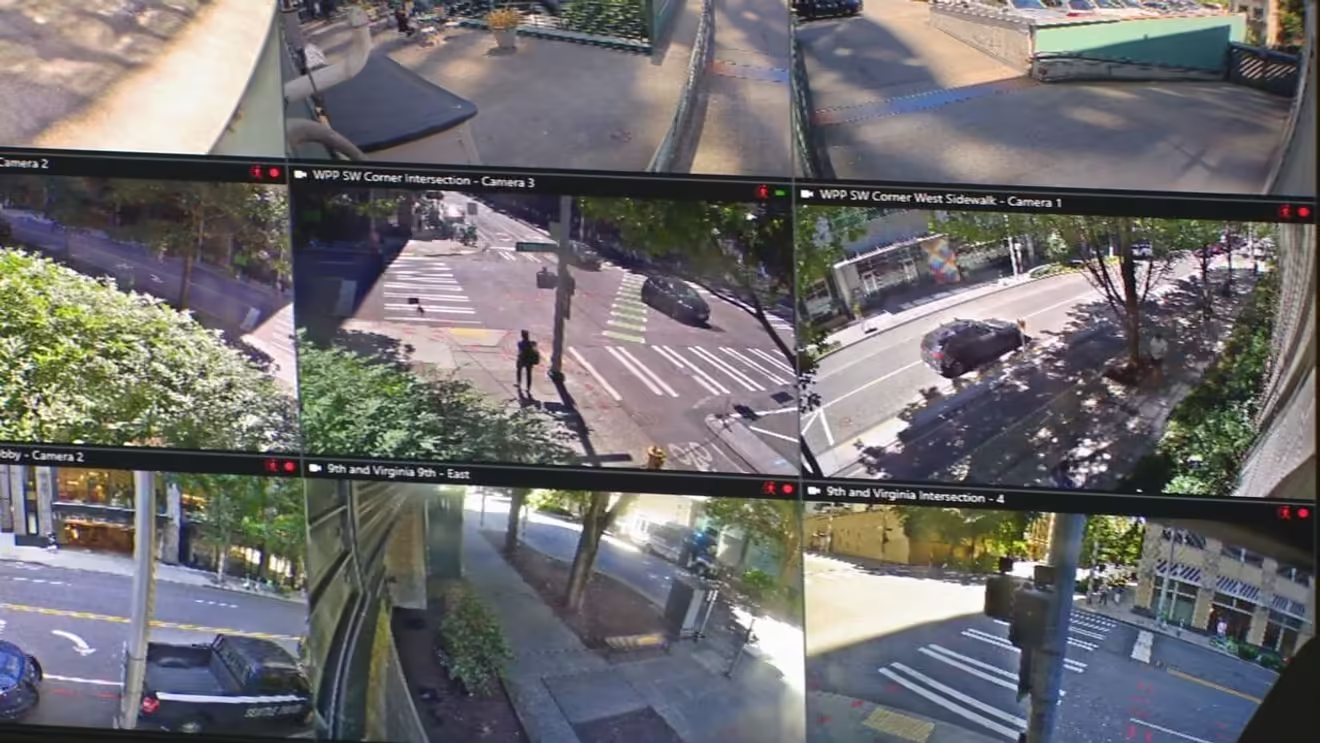

SEATTLE — Following the long-awaited results of a privacy audit into the city of Seattle’s Real Time Crime Center (RTCC), Mayor Katie Wilson has announced that the city’s surveillance camera program will be expanding.
Wilson said she is authorizing the Seattle Police Department to move forward with the expansion in SODO, Capitol Hill, and CID
Additionally, the existing cameras in the Stadium District will be turned back on immediately. The city will initiate purchasing and installing cameras in the other districts, which could take months.
The mayor made the announcement during a Tuesday morning press conference.
Wilson stressed that she is aware of community concerns regarding privacy and possible use by the federal government to allegedly target immigrants and minorities, and stated that officials are taking steps to mediate those concerns as the program expands.
Wilson faced pressure from critics of the system who argue it unnecessarily surveils people who have done nothing wrong, and police who have credited the system with solving several high-profile crimes at a time when the Seattle Police Department is critically understaffed.
RELATED | SPD surveillance review finds safeguards working, gaps remaining as Wilson weighs future
The audit was conducted by the New York University School of Law Policing Project. While the audit did not take a position on the RTCC program, it laid out examples of the benefits of the system as well as gaps in city policy for how it is used.
The RTCC opened in 2025 and has expanded to several hundred public and private cameras located across the city.
“A promised benefit is that more offenders will be identified, and there is some recent evidence to support this,” the executive summary of the audit states. “Additionally, the fact that more offenders may be apprehended, along with the existence of the networked surveillance technologies like cameras that feed into the RTCCs, may serve to deter further offenses.7 If all goes as proponents of RTCCs suggest, the end result might be less crime. The research on RTCCs remains limited, however, and does not yet present a consistent picture.”
Policing-Project-Seattle-RTCC-Governance-AuditPDF preview
The audit conducted site visits to the RTCC in May and September, and reviewed instances of the system being used in investigations and emergency response calls.
“Our review does not evaluate whether or not the RTCC should expand its current operations or continue to exist at all,” the audit states. “The long-standing position of the Policing Project is that the decision whether, and how, to use the surveillance technology ultimately is a matter for local democratic processes to decide. Still, such deliberation requires transparency regarding what technologies are used, and an assessment of whether the appropriate guardrails are in place.”
Wilson faced pressure from groups like the Community Not Cameras Coalition, which have asked her to turn off the RTCC’s camera network.
“This audit shows exactly what we’ve been concerned about,” said Ryan Talen, a member of the coalition. “This data is not safe. ICE, Stephen Miller, Donald Trump have access to it through the court system. We cannot give them that access; we can’t put our immigrant neighbors at risk. It’s not worth it.”
The audit noted ICE and federal authorities do not have a direct feed access to the RTCC, but could still request the data through a court order or public records request. In October, the city implemented a policy requiring any requests from immigration authorities to be sent directly to the Mayor’s office for review.
City and state law prohibit the use of local resources for immigration enforcement.
RELATED | SPD surveillance review finds safeguards working, gaps remaining as Wilson weighs future
In September, the city’s Office of Inspector General (OIG) released its review of the RTCC system. That report reflected similar concerns about a lack of written policies for how some aspects of the RTCC system are used.
Councilmember Rob Saka has called for $ 1 million in the upcoming budget to expand the RTCC system into Seattle Centerwhich was the site of a mass shooting at the Bite of Seattle event in July.
Source: komonews.com