
President Donald Trump may have declared the U.S.-Iran war “effectively over,” but its lingering impact risks adding further fuel to another devastating conflict with the potential to spill over into an all-out regional confrontation.
Across the Red Sea from the ongoing confrontation between Saudi Arabia and Yemen’s Iran-backed Ansar Allah movement, also known as the Houthis, two Horn of Africa nations appear to be on the brink of a major escalation.
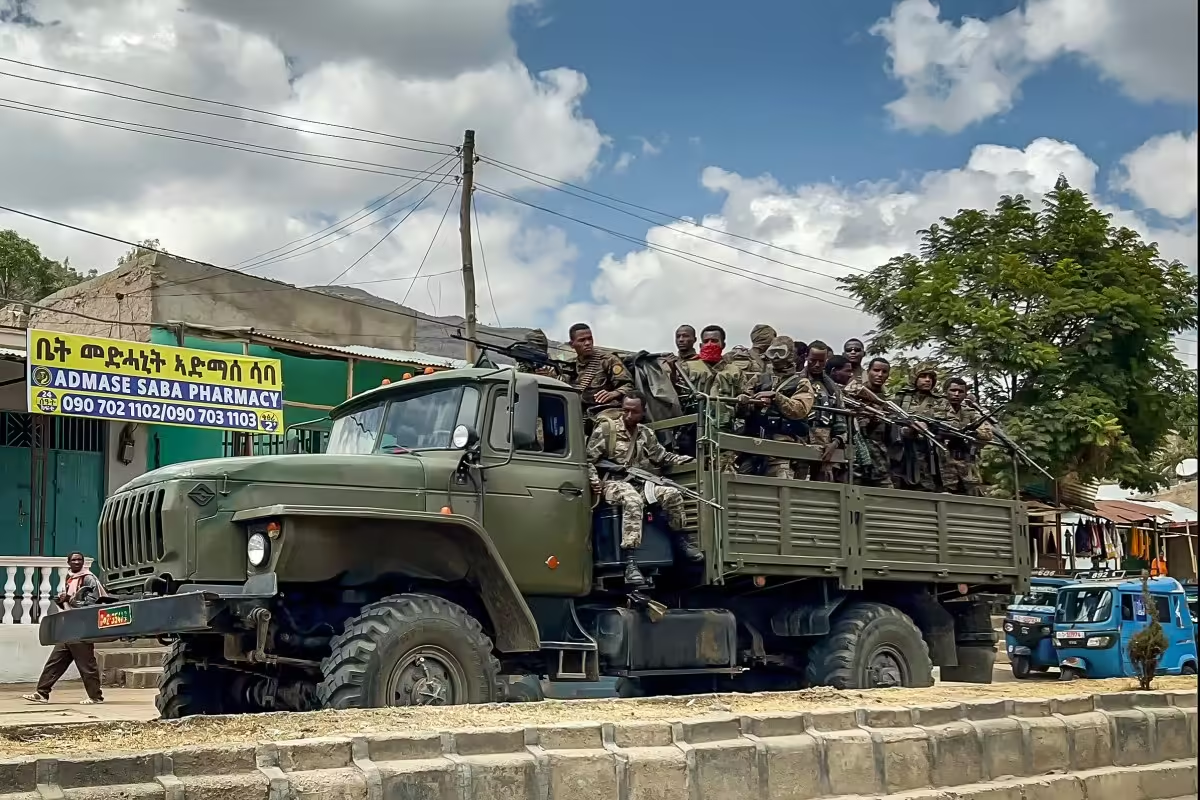
Ethiopia has accused neighboring Eritrea of aiding a rebel alliance that in September launched a large-scale offensive in the restive Tigray region, threatening a new round of a 2020-2022 war that marked one of the deadliest conflicts of the 21st century.
Read More on World
Eritrea fought alongside Ethiopia during the last Tigray conflict but the two have a complex history. That includes a 1998-2000 war fought five years after Eritrea secured its independence, taking with it strategic Red Sea access that the world’s largest landlocked nation seeks to reclaim to this day.
Meanwhile, Ethiopia has also been at the center of several other feuds eroding ties with regional countries, including Egypt, Somalia and Sudan, where a bloody civil war between rival factions now threatens to collide with the brewing Horn of Africa crisis.
“The war in Ethiopia risks overlapping with the regional war in Sudan and triggering a new war between Ethiopia and Eritrea,” Alan Boswell, the International Crisis Group’s project director for the Horn of Africa, told Newsweek. “The regional powers already sucked into the war in Sudan could soon find themselves entangled in yet another war in the Horn of Africa near the Red Sea.”
The Red Sea and its maritime route to the Suez Canal have only grown in strategic importance since the disruption to Strait of Hormuz traffic as a result of the U.S.-Iran war.
“The rivalries and the disorder in the Middle East are increasingly spilling over into the Horn of Africa,” Boswell said. “Conflicts on both sides of the Red Sea are now flowing back and forth into each other.”
Ethiopia’s Conflict Explained
Ethiopia has long grappled with tensions involving influential armed movements organized along ethnic and regional lines. The most powerful of these groups is the Tigray People’s Liberation Front (TPLF), which helped lead the overthrow of the country’s communist government in 1991.
The TPLF dominated Ethiopia’s ruling coalition for nearly three decades, until Abiy Ahmed became prime minister in 2018, following a period of widespread protests and political upheaval.
Ahmed moved to mend ties with Eritrea, drawing backlash from the TPLF. Tensions devolved into armed clashes and a brutal war that killed hundreds of thousands of people and displaced millions until a 2022 peace agreement.
Yet grievances persisted, with Ethiopian forces conducting drone strikes in the Tigray region and, last year, revoking the TPLF’s registration as a political entity. Deadly clashes erupted in January and February of this year, and in September, the TPLF aligned with six other parties to establish the Ethiopian Peoples’ Forces Alliance for Survival with the stated aim of overthrowing Ahmed’s government.
The rebel coalition comprises the TPLF, the Amhara Fano National Movement, the Oromo Liberation Army, the Ogaden National Liberation Front, the Afar National Unity Revolutionary Front, the Benishangul People’s Liberation Movement and, by some accounts, the Gumuz People’s Democratic Movement, though its membership is disputed.

Once bitter enemies, Eritrea and the TPLF have increasingly aligned against Abiy’s government since 2025, driven in part by Eritrean concerns over Ethiopia’s increasingly forceful demands for sovereign access to the Red Sea.
Egypt, which is feuding with Ethiopia over its massive Nile River dam project, and Sudan, which alleges Ethiopian support for the Rapid Support Forces paramilitary group fighting to seize control of the state from the Sudanese Armed Forces since 2023, have also been accused by Ethiopia of supporting the rebel coalition in Tigray.
A fourth country in the region, Somalia, is at odds with Ethiopia as well over its 2024 agreement with the breakaway Somaliland region, which contemplated granting Ethiopia access to the Red Sea coastline in exchange for potential recognition of Somaliland’s independence.
Turkey managed to oversee a deal to ease the tensions. Yet reports emerged last month of Egypt preparing to deploy troops to Somalia pursuant to an agreement reached between the two countries that same year.
“The conflict in northern Ethiopia lies at the intersection of several fault lines involving neighboring states, the greater Horn of Africa, and all countries with stakes in the Red Sea,” Liam Karr, Africa team lead for the American Enterprise Institute’s Critical Threats Project, told Newsweek.
“Ethiopia has insisted—at times belligerently—that regaining sea access is an existential issue and sought to better harness its portion of the Nile River, which has raised tensions between Ethiopia and littoral countries in the Red Sea and downstream countries in the Nile River Basin, most notably Eritrea, Sudan, and Egypt,” Karr said.
The resulting frictions, he explained, “have created proxy dynamics in regional conflicts and increasingly intertwined these conflicts, including the ongoing fighting in northern Ethiopia, the Sudanese civil war, and a potential war between Ethiopia and Eritrea.”
“There are warning signs that further escalation could lead to a direct interstate war between Ethiopia and neighboring Eritrea or Sudan, or even a regional war involving Egypt in a worst-case scenario,” Karr said.
The Middle East Connection
The intrigue and involvement surrounding Ethiopia’s deepening conflict is not limited to its immediate neighbors. Across the Red Sea, players vying for influence in a rapidly shifting geopolitical order against the backdrop of the U.S.-Iran war have set their sights on Africa as well.
Last month, Israeli Prime Minister Benjamin Netanyahu touted a map showing Ethiopia, Somaliland and Sudan’s Rapid Support Forces as being aligned with a “Hexagon” alliance led by Israel and the United Arab Emirates.
Newsweek had reported two months earlier on the same map, which also identified Eritrea, Sudan and Somalia as part of a “Sunni Diamond” led by Egypt, Pakistan, Saudi Arabia and Turkey. Ankara, Riyadh and Islamabad went on to sign a formal mutual defense pact in August as well.
Iran, whose Axis of Resistance encompasses a network of allied armed groups across the Middle East, including Hezbollah in Lebanon, militias in Iraq, Ansar Allah in Yemen and Palestinian factions, has also expanded its ties in Africa in recent years.
This includes security agreements and the reported transfer of drones to both Ethiopia and Sudan to aid in their internal struggles. Some reports have alleged tacit cooperation between Ansar Allah and the Al-Shabab militant group in Somalia as well.
As for Washington, the Trump administration lifted sanctions on Eritrea just days before the announcement of the Ethiopian rebel alliance and reports of an Eritrean troop incursion into Tigray. The decision roughly coincided with Ansar Allah seizing control of the Yemeni shores of the Red Sea’s Bab el-Mandeb Strait chokepoint from Saudi-backed government forces.
Trump has also previously criticized Ethiopia for failing to back a U.S.-mediated proposal on its dispute with Egypt over the Grand Ethiopian Renaissance Dam, which the U.S. leader suggested during his first administration in 2020 Egypt might “blow up.”
Trump has since counted the Ethiopia-Egypt dispute in the list of eight conflicts he has settled throughout his two non-consecutive terms in office. After meeting with Egyptian counterpart Abdel-Fattah el-Sissi in June, Trump said the U.S. would be “helping him with a little dam project” on which he had been “treated unfairly.”
Since the U.S.-Iran war erupted in February of this year, Karr noted that “conflict in the Middle East so far has likely acted as more of a short-term inhibitor in the Horn,” with various stakeholders now preoccupied with their immediate neighborhood.
But as the Middle East turmoil drags on, Karr emphasized that it also “has not stopped conflict by any means” in the Horn of Africa region, “and could actually increase conflict in the long term.”
“The U.S. and regional actors are also aware that regional escalation would destabilize the Red Sea region even further and create opportunities for malign actors, ranging from state actors such as Iran and Russia to non-state actors such as the Houthis and jihadist groups,” Karr said.
“However,” he added, “the Iran war and latest chapter in the Yemeni civil war have only underscored the strategic importance of chokepoint security and economic diversification, which are the primary factors driving competition among Middle Eastern countries in the Horn.”
Contact Newsweek editors on this story: Samantha Beech and Edward T. Cummins
Source: www.newsweek.com