
Earlier this month, the International Monetary Fund estimated that Sub-Saharan Africa is on track to post 4.5% economic growth this year and next — its fastest pace in a decade.
Amid declining foreign government aid and heightened global uncertainty, Africa’s resilience might seem unexpected. It wasn’t to the leaders in government, business, and academia who gathered on Oct. 23 at the Stanford Institute for Economic Policy Research (SIEPR) for a deep dive into Africa and its economic outlook. The title of the SIEPR Policy Forum said it all: “Unlocking Africa’s Economic Potential.”
Statistics shared during the daylong event signal there’s a lot to be excited about. For example, Africa will have the world’s youngest and largest workforce by 2035; by century’s end, 40% of the global population will call the continent home. By 2040, Africa will count 12 cities with populations of 10 million or more, up from two today. An investment boom underway before the Iran war has strengthened as firms look beyond the Middle East to meet demand for oil and fertilizers. A historic free trade agreement promises to open up trade across the region. And artificial intelligence could unleash a wave of tech-savvy entrepreneurs and, in the process, rewrite the emerging country playbook for growth.
“Africa is poised to shape the next era of global economic development,” said Neale Mahoney, SIEPR’s Trione Director and Stanford’s TG Wijaya Professor of Economics, in kicking off the Policy Forum.
The prompt that Mahoney delivered in his opening remarks: How can the continent maintain its momentum?
Recasting the Africa narrative
The lineup of experts delivered plenty of candid, and at times spirited, responses — in both diagnosing the challenges and prescribing fixes.
Casting Sub-Saharan Africa as a single economy is impossible. The region is made up of 45 countries (by the International Monetary Fund’s count) with varying assets. Some are resource-rich and coastal, others are resource-rich and landlocked. Still others are asset-poor, and either landlocked or coastal. As Zeine Zeidane, the director of the IMF’s African Department and former prime minister of Mauritania, noted in a presentation, countries rich in resources are doing better than those without.
But the region’s countries also share similar problems.
Peter Henry Blair, a keynote speaker and author of Turnaround: Third World Lessons for First World Growth (Basic Books, 2013), detailed some of these commonalities.
“Africans are building world-class companies,” he said, singling out Jumia, a Nigerian e-commerce company, and Safaricom, a Kenyan telecom, as examples. But these companies struggle to scale because there aren’t enough paved roads, access to electricity is still a problem, and schools aren’t teaching sufficient cognitive skills, said Henry, who is also a senior fellow at the Freeman Spogli Institute for International Studies (FSI) and the Class of 1984 Senior Fellow at the Hoover Institution. To fix its infrastructure challenges, he said, Africa needs institutional capital — lots of it.
However, there are practical challenges to drawing private dollars to Africa, a key topic at the forum. One obstacle discussed is that investors still don’t trust government officials to make good on their promises. The continent overall needs to improve governance, which some speakers said will likely be driven by young Africans who are signaling they want more accountability from elected officials. More powerful business interests could also pressure governments to reform. And as Henry discussed with Francis Fukuyama, director of FSI’s Center on Democracy, Development and the Rule of Law, during an on-stage conversation, one way to draw more private capital would be to create public-private partnerships in the form of special purpose vehicles, in which risks are spread among all project participants.
A core theme throughout the day: Africa’s rapidly growing population is its superpower.
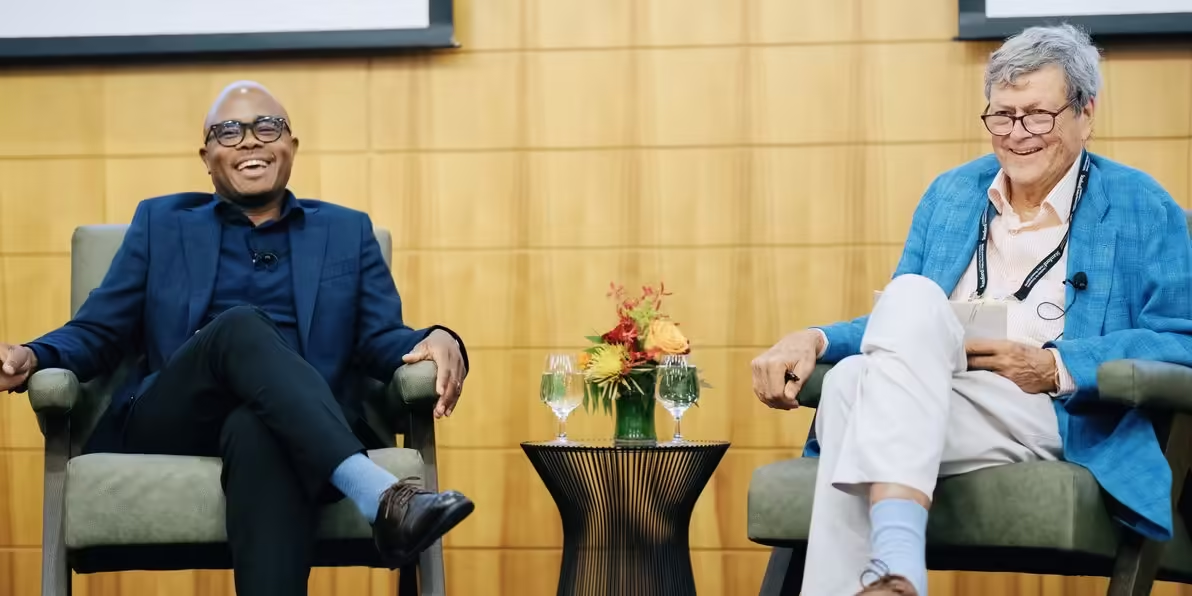
“What’s the one thing that we can beat China, we can beat the U.S., we can beat the world in? It’s in talent,” said Fred Swaniker, a Ghanaian entrepreneur and education innovator who Time Magazine named to its annual list of the “World’s Most Influential People.” Africans on average are 19 years old. Americans on average are in their late 30s, while Germans are in their late 40s, Swaniker said during a Q&A moderated by John Gunn, chairman emeritus of investment firm Dodge & Cox and the George P. and Charlotte M. Shultz Chair Emeritus of SIEPR’s advisory board.
To Swaniker, artificial intelligence will become a powerful driver of Africa’s economy, giving workers critical skills and creating new jobs in key sectors like agriculture and healthcare. And with AI, he said, Africa won’t need to follow China or India’s playbook in becoming an economic juggernaut.
“Africa’s story is misunderstood by the rest of the world,” Swaniker said. “We have the chance to redefine development on our own terms.”
Source: siepr.stanford.edu