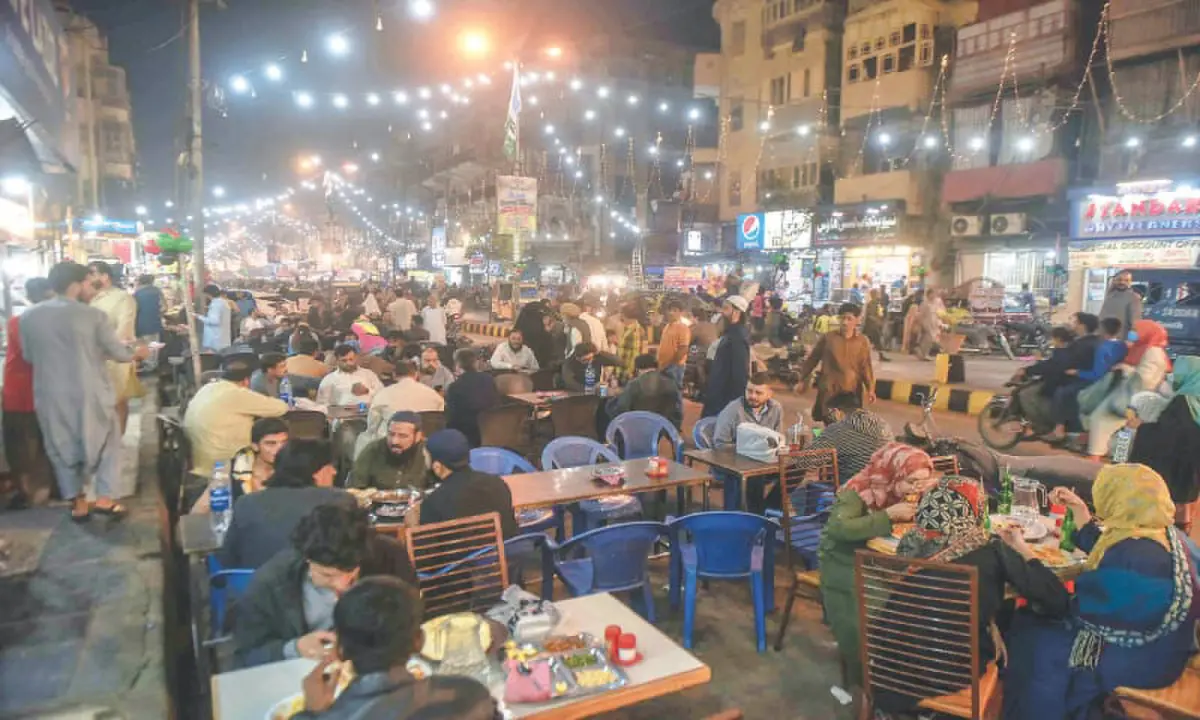

KARACHI: The City Council on Friday approved a proposal to designate Burns Road Food Street as a pedestrian-only area and allocate an estimated Rs249.823 million for its renovation and development, reviving the initiative that had previously faced judicial intervention.
The move comes despite a February 2023 Sindh High Court directive to the local administration to end the evening food street operating on a portion of Burns Road and restore the road to vehicular traffic.
The latest approval raises questions about how the city administration intends to proceed with the project in view of the previous court order and the concerns of local residents and motorists.
The resolution was among 34 approved during the general session of the Karachi Metropolitan Corporation (KMC) City Council, held at the Council Hall under the chairmanship of Deputy Mayor Salman Abdullah Murad.
Mayor Karachi Barrister Murtaza Wahab and Metropolitan Commissioner Abrar Jafar also attended the session.
The Burns Road proposal started a debate in the house, with opposition members raising concerns over restricting vehicular movement and the difficulties the pedestrian-only arrangement could create for residents and businesses in the surrounding area.
Defending the initiative, Mayor Wahab said: “Burns Road is a historical heritage site. We are going to restore our historical heritage. We will improve Burns Road and all the adjoining streets and provide the citizens with the best facilities,” the mayor said.
The meeting also witnessed heated exchanges over the Nehr-i-Khayyam project.
Opposition Leader Saifuddin Advocate expressed reservations, arguing that the waterway served as a drainage channel for rainwater from the surrounding areas.
Another resolution, however, seeking separation of sewage from the canal and installation of parallel sewerage lines was unanimously approved to prevent pollution and restore the waterway as a recreational facility.
Council member of Pakistan People’s Party (PPP) Najmi Alam supported the initiative, saying the project envisaged treating wastewater and introducing boating facilities.
Responding to criticism, Mayor Wahab said Nehr-i-Khayyam was not the project of any single political party or government but an initiative intended to benefit Karachi’s residents.
He also said opponents had approached the courts over the project and maintained that the people of Karachi should have a say in how their city was managed.
The mayor defended his administration’s performance, inviting scrutiny of its expenditure and assuring council members that development projects would be subject to accountability.
He said third-party consultant verification had been made mandatory for all major projects for the first time.
Earlier, Opposition Leader Saifuddin Advocate raised concerns over the powers and resources available to union committee chairmen, claiming that the withdrawal of sanitation staff and administrative authority had weakened their ability to address public complaints.
He also questioned the performance of the Karachi Water and Sewerage Corporation, citing repeated shutdowns at the Dhabeji pumping station and prolonged water shortages in several localities.
Among other major decisions, the council approved a Rs100 million annual grant to Karachi Metropolitan University to make the Quaid-i-Awam Block at Abbasi Shaheed Hospital operational.
It also approved an increase in long-pending allowances for KMC hospital nurses, revival of the Nursing College at Karachi Institute of Heart Diseases, and payment of Rs425 million in reconciled outstanding dues to K-Electric.
Published in Dawn, November 28th, 2026
Source: www.dawn.com