MULLURU KRISHNAPURAM, India — I did not expect to end up wrist-deep in a pile of fresh cow dung. But there I was, still recovering from a breakfast-induced food coma, instructed to stand in a circle and watch women dressed in their finest sarees pour fermented cow urine over the steaming brown mass.
Representatives set up several stations in the courtyard where we had eaten breakfast just hours earlier. I still could taste the steaming idlis and vadas, washed down with chai served in little Dixie cups. The awning where I sat dipping my idli into chutney thirty minutes earlier now sheltered vats of jeevamrit, a fermented liquid microbial formulation used in natural farming. In the main courtyard, a gigantic blue tarp held a mound of beejamrit, a cow dung-based preparation used to treat seeds. Two cows stood in the shade of a tree about 50 feet (15 meters) away. A woman beside me pointed them out, laughing. “It’s very fresh!”
G. Kalpanaa, a farmer in a shimmering copper-coloured sari, squatted beside me as I placed my hand in the warm muck, pursing my lips to avoid thinking about what I was touching or its squishy texture. Another woman gently tapped me and showed me how to make the mixture by example, plunging both hands into the pile and kneading it like dough.
I reluctantly stuck my other hand into the mixture and began kneading it in a steady rhythm. She then showed me how to roll it into balls, reminiscent of my days spent with neon green and pink Play-Doh. We stacked them to the right of my pink sneakers. The unfamiliarity of the experience remained, but as I knelt beside the pile and listened to women explain the importance of these balls in the fertilization process, I began to appreciate the ritual.
In India, more than 8,000 miles away from my current home in New Jersey, I spent six weeks studying the intersection of food systems, climate change, and health. Based at the Indian Institute of Science in Bengaluru, we spent several days each week travelling for field visits. On this particular July morning, we were visiting Mulluru Krishnapuram, a village in Andhra Pradesh’s Shantipuram mandal, to meet representatives of Andhra Pradesh Community-Managed Natural Farming (APCNF) and observe its practices in the field.
Andhra Pradesh’s agricultural landscape has long relied on chemical fertilizers to sustain crop production. But decades of input-intensive farming have raised concerns about soil health, particularly the loss of organic carbon that helps soil retain nutrients and maintain its structure. A 2026 study comparing natural and conventional farms across three mandals in the state found higher overall soil quality under natural farming. Against this backdrop, how is the sleepy village of Mulluru Krishnapuram embracing a different way of farming?
Before 2016, most farmers here used synthetic fertilizers, such as nitrogen, which would enter water systems and the air, ultimately affecting farmers’ livelihoods.
As a women-led initiative of the Government of Andhra Pradesh, APCNF is among the world’s largest natural farming and agroecology programs. It aims to improve farmers’ incomes while reducing their dependence on synthetic chemical inputs.
“Most of [India’s] population is dependent on agriculture. If it doesn’t make money, [people] can’t escape poverty,” said Vijay Thallam, founder of APCNF.
He declared that this solution is also “nature positive, low cost, and something every farmer can do by herself.” Although male farmers are part of APCNF, Thallam uses the female pronoun to highlight the large coalition of women farmers adopting this transition. They are often given plots of land with the most degraded soil and are struggling to cultivate farms when becoming involved with APCNF.
This June, APCNF won the 2026 Food Planet Prize, the world’s largest monetary environmental prize, for their transformative work. The APCNF program spans about 1.8 million farmers, almost 2.27 million acres (0.92 million hectares). Last year, it marked reductions in greenhouse gas emissions of up to 46% per acre.
Earlier in the day of my visit, leaders of the organization, which spans 28 districts and encompasses more than a million farmers, presented us with a beautiful diorama made of marigold petals, soil, and other plant materials.
After a brief presentation on the nine principles of natural farming, we walked around the wheel of oranges, yellows, and browns, split into nine sections for each guideline:
- Maintaining soil cover year-round
- Growing 15 to 20 crops at once
- Mulching with crop residues
- Minimizing soil disturbance
- Using indigenous seeds where possible
- Integrating livestock
- Applying formulations that activate soil biology
- Managing pests and diseases with botanical extracts, and
- Eliminating synthetic fertilizers, pesticides, herbicides, and weedicides
Natural farming takes many forms around the world and is often discussed alongside approaches such as regenerative agriculture, agroforestry, and agroecology. Unlike organic farming, which can still involve practices such as monocropping, natural farming emphasizes the use of local resources and the promotion of regional biodiversity.
After my return, I met Gina Talt, the food systems project manager at Princeton University, to talk more about natural farming. She wore a “composting time” T-shirt, ready to dive into the weekly composting session after our conversation. “[Natural farming] is farming with nature and using as much farm inputs as possible and not relying on external, synthetic chemicals. You know your land and work with it, rather than against it,” she said.
Most research on natural farming comes from Asia, with India producing the largest body of research. Korea and Japan also have advocates of the practice. In India, Zero Budget Natural Farming (ZBNF), the approach promoted through APCNF programs, has been found to increase farmers’ profits. Researchers also recorded 13 bird species exclusively in ZBNF areas, suggesting the practice may support greater biodiversity.
One of the pioneers of natural farming was Han-Kyu Cho, who grew up in a South Korean farm family and studied traditional Korean methods of farming in tandem with new agricultural science in the late 20th century. He focused on the restoration of soil health, a practice also followed in India’s APCNF 20 years after his initial study.
Today, insights from Han-Kyu Cho, along with research from institutions around the world such as the Rodale Institute, Mulloon Institute, and Soil Learning Center, inform APCNF’s approach to natural farming.
The Xylom’s student reporting is supported by hundreds of readers like you. Becoming an annual or monthly member is the best way to help us cultivate the next generation of award-winning journalists who resonate with a new generation of global citizens. Cancel anytime.
For APCNF, the nine principles form the foundation of its mission: “farmer prosperity, human health, and planetary health,” Krishna Rao, APCNF’s national resource organization team lead, told me over a Zoom call in the fall. “We have a strong scientific team, which works on the farmers’ fields. We have farmer scientists and farmer mentors, who work on their own field experiments.”
He went on to describe the Nine Principles as based on “a better understanding of the soil microbiome, plant microbiome, and their rules in plant physiology, nutrient cycling, water cycling, system management, weed management.”
During my visit to one of the personal nutrition plots later in the day, children from the village gathered around, all in their school uniforms.
The garden, about the size of my dorm room, could feed an entire family for a year, our guide explained. It followed a circular design, with concentric rings of plants arranged according to their needs and growing conditions. Fruits and herbs grew at the center. Like other APCNF farms, it followed the same principles: no synthetic chemical inputs and a biodiverse ecosystem that nourishes the soil and supports surrounding wildlife.
Food systems account for one-third of global greenhouse gas emissions and play a crucial role in the health and well-being of both consumers and producers. As Rao told me, “Food grown through natural farming is nutritionally dense, and it has faster outcomes. We want to make sure the food farmers grow goes onto their own plates.”
Part of APCNF’s poverty-alleviation mission is to improve local families’ access to nutritious food. Its community model includes school awareness programs, dedicated farm plots for families, and the introduction of nutritious snacks in local markets.
APCNF expects to expand its reach to 1.96 million farmers and 0.97 million hectares by 2027, partly through the Centre’s National Mission on Natural Farming (NMNF), launched in November 2024. The national mission shares several of APCNF’s principles, including community-based farmer education, traditional farming knowledge, chemical-free practices, and climate resilience.
Some researchers have questioned the program’s ambitious expansion plans. A 2024 study on Zero Budget Natural Farming (ZBNF) raises concerns about the labour-intensive nature of the practice, existing subsidies that favour chemical fertilizers, and insufficient evidence of its long-term effectiveness. The authors call for at least a decade of research and independent evaluation before the model is scaled up nationally.
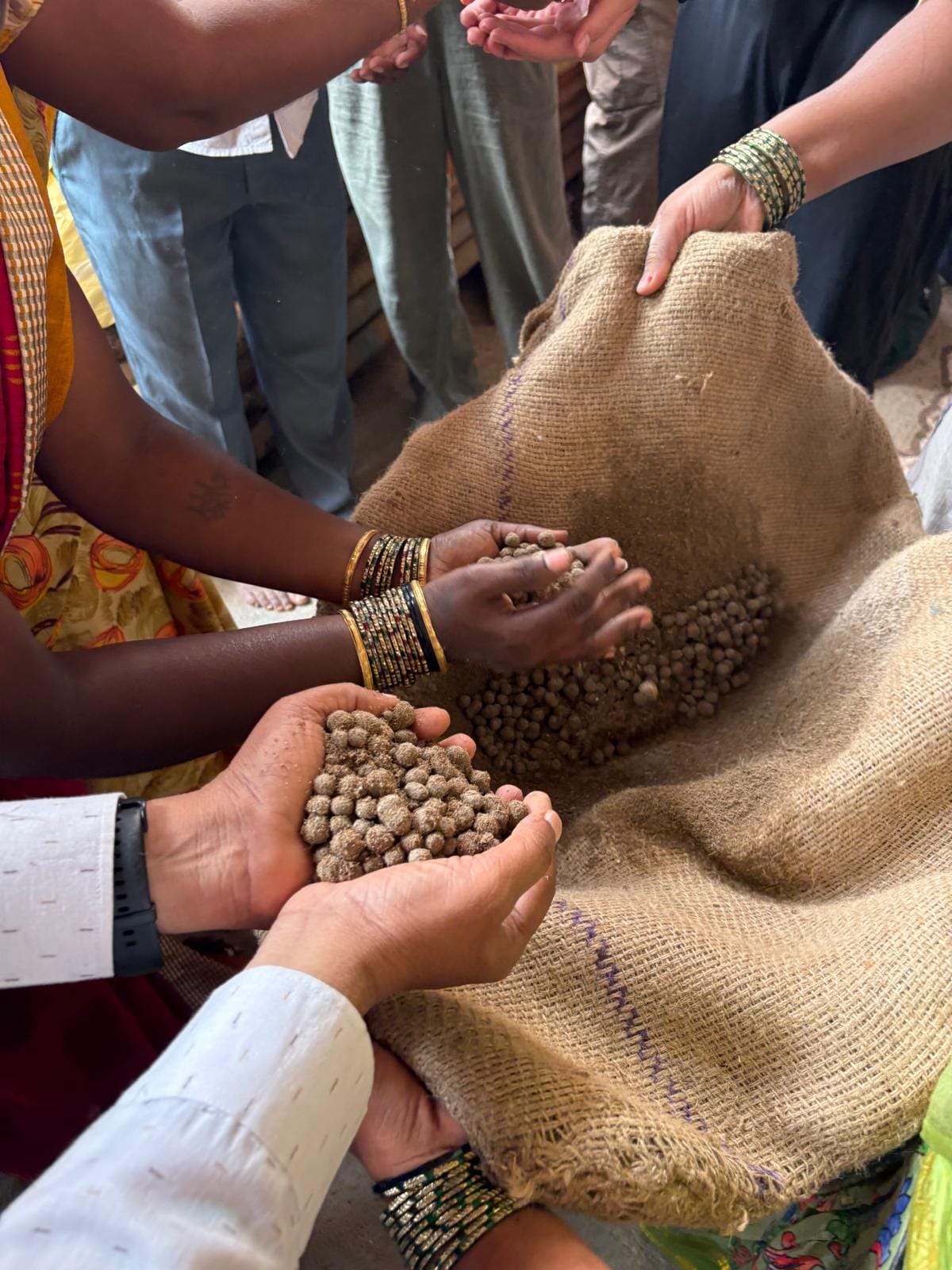
After working with the beejamrit, I washed my hands and moved to a much drier station. Two women placed about five handfuls of cowpeas on an old grain sack. Holding it at either end, they rocked the sack back and forth, tossing the peas so they were coated on all sides. They poured a dark yellow liquid — cow urine — over the peas, followed by lime powder. More cow urine, then more lime powder. They added some wood ash, too. The rhythmic rocking continued until the seeds were thoroughly coated and several times their original size.
If someone told me these women were reviving an ancient farming technique, I would have believed them. But seed pelletization was introduced in Andhra Pradesh only 18 months ago, around January 2025. APCNF adopted the practice to help farmers cope with increasingly erratic rainfall. The coating creates a protective layer around the seeds, helping them retain moisture and withstand harsh conditions. It can also extend their viability for up to six months.
How difficult is it to introduce the farmers to natural farming? Krishna Rao described farmers as “addicted to chemical farming.” The transition is challenging, he said, because it involves financial uncertainty and requires farmers to learn new skills.
For Vijay Thallam, APCNF’s most important feature is its mentorship program, which supports farmers through the transition. The organization assigns community resource persons (CRPs) to live in a village throughout the transition, which can take three to five years.
This model has also faced criticism. A 2021 Down To Earth investigation reported allegations of months-long salary delays for field staff, unpaid dues to nonprofit partners, and bureaucratic mismanagement within APCNF. GV Ramanjaneyulu, director of the Centre for Sustainable Agriculture, which works in Andhra Pradesh, said some nonprofit employees went months without pay. He further alleged that the APCNF (RySS) organization often sent unqualified mentors, without proper understanding of the natural farming process, to communities. The definition of “farmer” in this model is quite broad – a “farmer” could be a labourer, an individual with land, or even an academic with a background in agricultural science.
Since the investigation, changes have been made, and over email Ramanjaneyulu mentioned how “many of the problems raised then are sorted out… the program is showing better results in many areas.”
Thallam echoed this sentiment, promising me that “We have overcome that problem.” He mentioned that now, the issue is more about validating the legitimacy of community-based teachers who may not have formal education, but attested that “A master carpenter does not need a Ph.D. to teach carpentry.”
The Xylom is an independent nonprofit. We have no owners or shareholders, no corporate interests, and no government contracts. We have no paywalls. Everything we publish is free. Join our community of members and cancel anytime.
A 2024 study argues that APCNF reinforces existing inequalities in land ownership, caste and gender, potentially benefiting landowning farmers while marginalizing landless agricultural workers. Drawing on existing research and programme data, the authors contend that the model’s structure does little to challenge the social and economic hierarchies that perpetuate rural poverty.
Towards the end of my conversation with Talt, I asked her about the history of soil health. She leaned forward in her chair. “Many civilizations have failed because they weren’t able to feed their populations … [the problem is] they weren’t taking care of the soil.”
APCNF strives to be part of the solution.
Source: www.thexylom.com