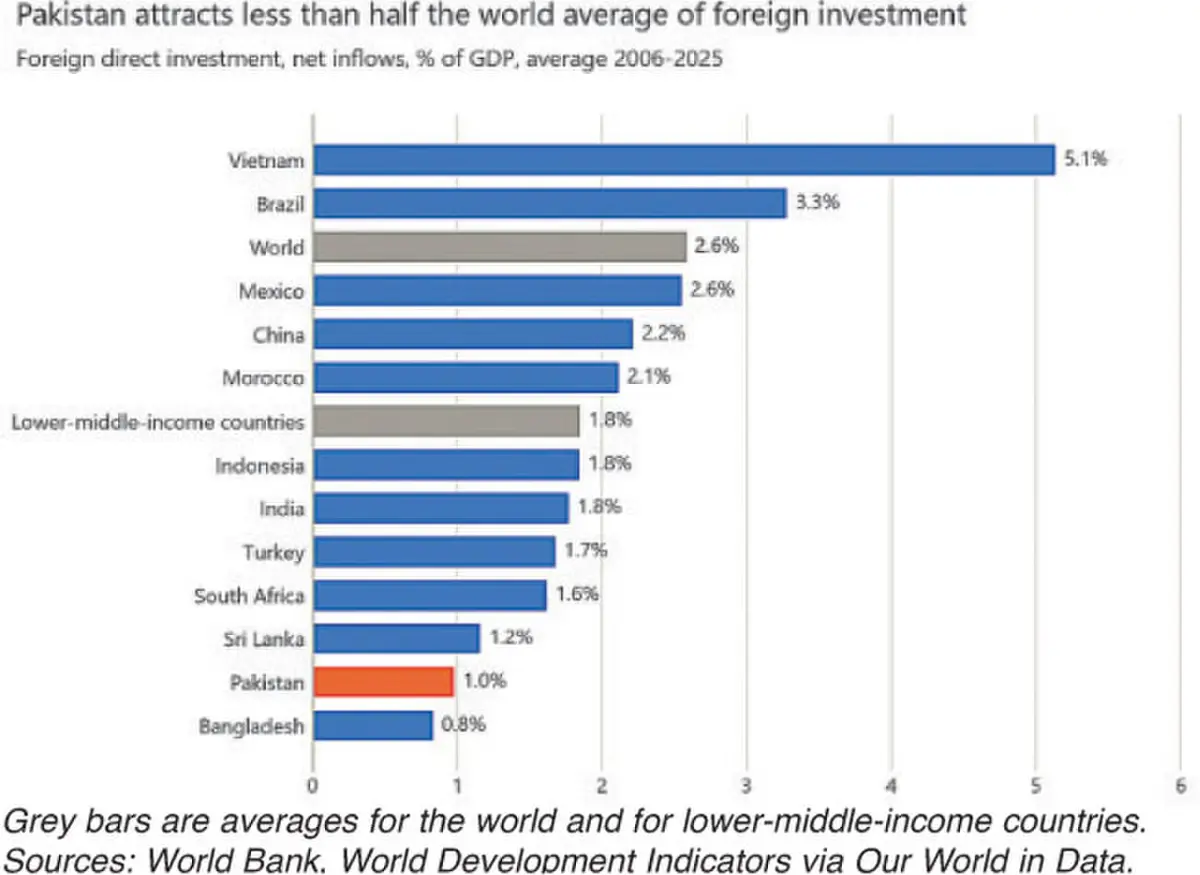

Limited access to finance is often presented as a key challenge preventing businesses, and the economy, from growing. Last year, the State Bank governor argued that weak investment is “directly linked” to low savings. The argument has serious consequences. Taken at face value, governments and policymakers should focus on promoting higher savings, encouraging foreign money to enter the economy, and decreasing the cost of financing. No doubt, successive governments have gone to great lengths to make elaborate foreign trips, sign memoranda of understanding, offer incentives and fast-track approvals through ad hoc arrangements in their attempts to attract foreign investment.
Yet, the overall story remains that of a failure. Foreign direct investment has averaged just under one per cent of GDP between 2006 and 2025, among the lowest in the world. The world average is 2.6pc. At home, governments have pushed for greater access to financial instruments to increase household savings, promoted Islamic finance to respond to people’s religious preferences, and launched schemes to decrease the cost of borrowing for businesses. However, between 2005 and 2025, investment averaged just 15.7pc of GDP, against an average of 29.8pc for lower-middle-income countries. Only eight of 168 countries invested less. Private investment has been even lower, at close to 10pc of GDP in recent years.
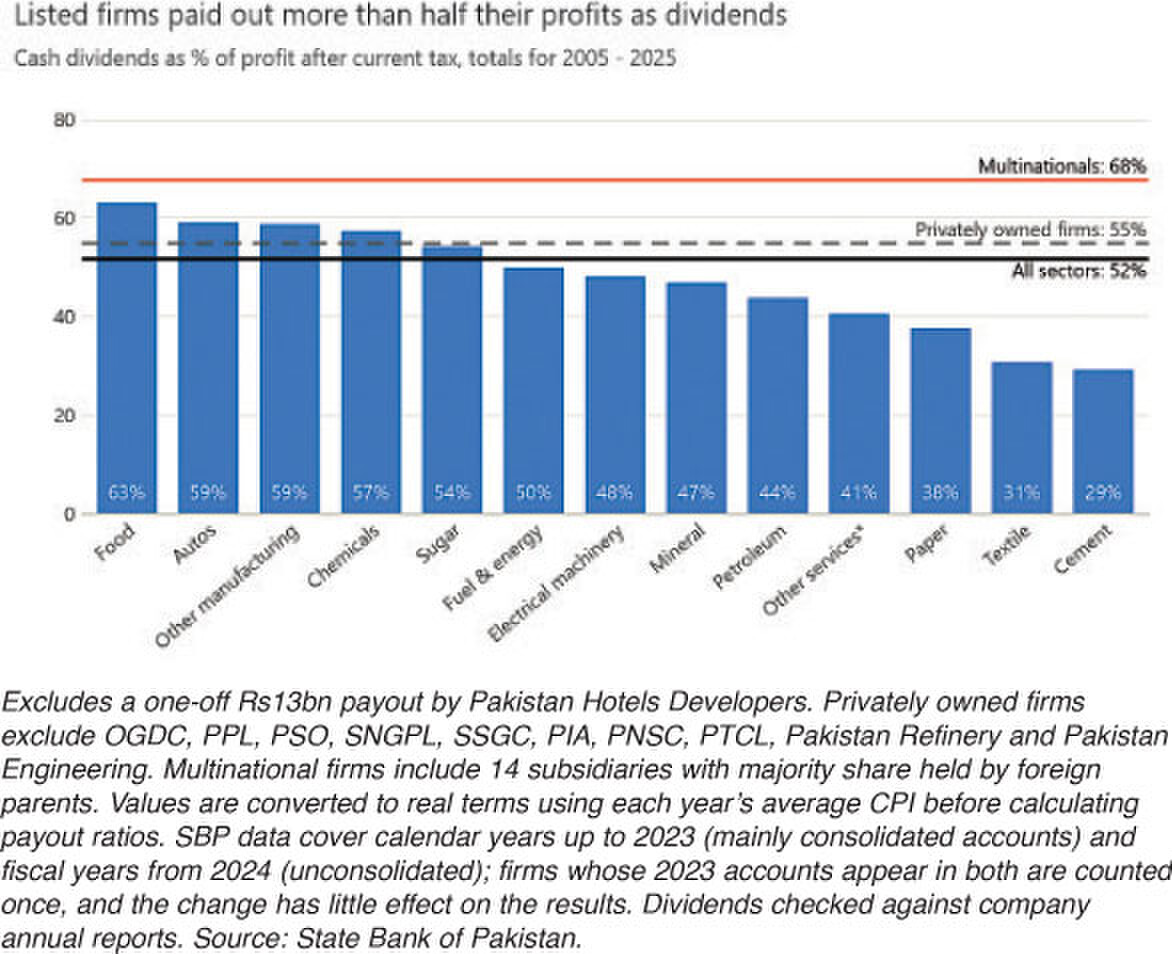
What if the problem has been misdiagnosed and access to finance is not the central problem facing the country? To see this, consider what the largest businesses – non-financial corporations listed on the stock market – do with the internal finance they already have in the form of profits. Data published by the State Bank of Pakistan show that, between 2005 and 2025, these firms earned, in today’s prices, Rs20.7 trillion after tax and paid out Rs10.7tr, more than half, as cash dividends. This result is not driven by a high payout in a few years. Instead, firms paid out more than half of their profits in dividends in 15 of the 21 years, and paid out Rs500 billion in FY25 alone. The share is higher still in food (63pc), autos (59pc), other manufacturing (59pc) and chemicals (57pc). Put simply, Pakistan’s largest firms are not short of money. Instead, they are short of reasons to invest it.
Policy measures must focus on reducing uncertainty for firms by providing a stable macro environment, consistent enforcement of regulation, and the rule of law, which ensures trust in the judiciary
The high dividend payout ratio is not driven by weak firms. The fifth of privately owned firms with the highest returns on assets earned 83pc of all private firms’ profits and paid out 54pc of them. The payout is even higher in the case of multinational subsidiaries, which paid out 68pc of their profits. In other words, while governments court new foreign investors, those already in the country send much of their profits home.
Paying dividends is not undesirable in itself. However, how much firms pay out also depends on the opportunities they have to invest. In a study published in 2000 in The Journal of Finance, La Porta and co-authors examine 4,000 firms across 33 countries and find that, in common-law countries, faster-growing firms pay lower dividends. Pakistan’s high payouts are consistent with the explanation that firms see few opportunities to invest at home. High dividends are, therefore, a symptom, not the problem.
What, then, is missing? Investment in plants and machinery takes years to pay back and is difficult to reverse. As a result, firms invest only when returns are predictable and contracts can be enforced. Pakistan performs poorly on both counts. First, the economy swings from boom to bust every few years, and the current IMF programme is the country’s 24th. Such uncertainty makes firms delay investment.
Second, institutions are weak. The World Justice Project’s 2025 Rule of Law Index ranks Pakistan 130th of 143 countries, 129th for civil justice and 127th for regulatory enforcement. This matters because complex production, which relies on contractual relationships with many suppliers, develops mainly when courts can be trusted and contracts are expected to be enforced.
Together the evidence points to a different diagnosis. While access to finance still matters, particularly for smaller firms, it cannot explain why the largest and most profitable ones pay out so much of what they earn. Another scheme focusing on providing cheap credit or another investment conference aimed at foreign investors is unlikely to change what firms do with their profits. Instead, policy measures must focus on reducing uncertainty for firms by providing a stable macro environment, consistent enforcement of regulation, and the rule of law, which ensures trust in the judiciary. The test of success is straightforward: whether Pakistan’s most profitable firms start reinvesting their own profits at home.
Recent policy, however, points the other way. Rather than strengthening the predictable rules and institutions that encourage investment, the government has increasingly relied on discretionary arrangements. The Special Investment Facilitation Council (SIFC), set up in 2023, can recommend relaxing regulations for individual projects, replacing rules that apply to all with case-by-case decisions. Even the government’s own reform agenda warns that limited transparency around SIFC initiatives could undermine policy predictability.
Nor can firms count on the courts. The International Commission of Jurists called the 26th constitutional amendment “a blow to judicial independence” and the 27th a “flagrant attack” on it, warning that the latter “will significantly impair the judiciary’s ability to hold the executive accountable.”
The writer is an Associate Professor at the University of Bristol and a member of the independent Economic Advisory Group (EAG).
Published in Dawn, The Business and Finance Weekly, November 23rd, 2026
Source: www.dawn.com