Mendoza and Chile They have the opportunity to strengthen their productive, industrial and service capacities through greater integration and cooperation in the face of the growth of mining activity. This was one of the main axes of the panel “Mendoza and Chile improving their capabilities as a mining region”, developed within the framework of the II Sustainable Mining Summitwhich brought together business leaders and institutions from both countries to analyze opportunities for complementarity and joint development.
The conversation highlighted the need to overcome the individual perspectives of each market and move towards a regional strategy that responds to the growing demand for goods, services, infrastructure, technology and human capital required by the mining industry. In that sense, Pablo Puerinopresident of Plan Pilares Foundation and member of Mendocino Business Councilstated that scale and cooperation will be decisive in facing the challenges presented by mining development on both sides of the mountain range.
Puerino maintained that integration will allow companies to expand their response capabilities and generate better competitive conditions, based on logistical, financial and regulatory coordination. He also highlighted the importance of working jointly between Argentina and Chile, with a vision aimed at sustainable development, the generation of economic activity and the well-being of the communities. “Here we are a team from both sides of the mountain range”he summarized when raising the need to deepen cooperation.
Cristian Cifuentessenior leader of Studies and Content at CESCO, highlighted the capabilities that Mendoza can contribute to this joint, especially based on his industrial career, experience in services, engineering and project development. In addition, pointed out the importance of strengthening the integration corridors that link different productive poles in Argentina and Chile, with infrastructure as one of the central factors to accompany the growth of activity.
Where is Mendoza-Chile integration
The study presented by the Center for Copper and Mining Studies (CESCO) of Chile and the Plan Pilares Foundation of Mendoza identifies seven areas of joint work to strengthen mining integration between both countries. These include binational logistics, with border crossings and corridors to facilitate the entry and exit of goods, supplies and mining products; the development of suppliers, through greater business linkage, shared standards and contracting monitoring; and the formation of human capital, with technological transfer and technical training. It also proposes advancing on issues related to the environment, water and territory, financing and investment, the regulatory framework of the Mining Integration and Complementation Treaty (TICM) and value addition based on regional productive capacities.
The proposal is based on the complementarities between Chile and Mendoza. Chile brings decades of experience in the construction and operation of large mines, a consolidated ecosystem of specialized suppliers and knowledge in the management of mega copper projects.
Mendoza, for its part, has a diversified industrial and services base, experience in medium-scale energy and mining projects, engineering capabilities and professional services, as well as experience in oil and mining operations.
The document presented in also highlights the logistical advantages of both territories: the Pacific ports and Chilean mining operators, along with National Route 7, the Pehuenche pass, the Mendoza Logistics Cluster and the dry port. In terms of training, CESCO has a track record of training more than 350,000 people in Chile over the last 30 years, while Mendoza has seven universities linked to the Pilares Plan and a base of technical professionals.
The panel also highlighted the potential of Argentine suppliers to participate in the Chilean market and expand their business opportunities. Jose Pablo Dominguezdirector of APRIMIN, pointed out that mining is a global industry that demands a wide variety of services, technology and specialized solutions, so the integration between both countries can facilitate new alliances, investments, business associations and supply chains. In that context, He stated that regional cooperation represents an opportunity for companies to expand their markets and participate in the projects that are developed in both territories.
The training of workers and the development of technical capabilities also occupied a central place in the debate. Antonella Tassarolipresident of the Tassaroli Foundation, shared the institution’s experience in promoting technical education, practical training and generating talent to respond to the needs of the productive matrix.
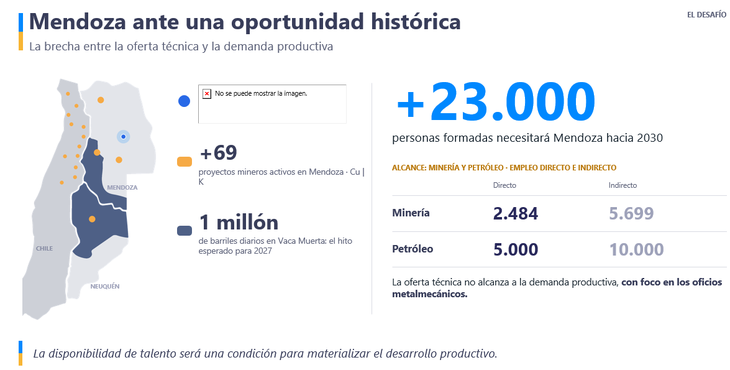
Another work presented on the panel revealed that Mendoza faces an opportunity for mining and energy growth that will require a strong investment in education and training. According to the projection presented by the foundation and CEIM, The province will need more than 23,000 trained people by 2030 to respond to the demand for direct and indirect employment in both sectors. In mining, 2,484 direct and 5,699 indirect jobs are estimated, while oil development would require 5,000 direct and 10,000 indirect jobs.
The scenario is based on a portfolio of more than 69 active mining projects in Mendoza and the expectation that Vaca Muerta will reach a production of one million barrels per day by 2027.
However, the report warns that the current technical offer is not enough to cover productive needs, especially in the metalworking trades. The availability of qualified workers thus appears as a key condition to transform the planned investments in economic development and local employment.
Tassaroli explained that the foundation emerged as an initiative to address the lack of specialized labor and promote solutions through training, coordination with companies and joint work with public institutions and communities.
In that line, Jose Antonio Diazgeneral manager of the Industrial and Mining Training Center (CEIM), presented Chile’s experience in training and certification of workers for the mining industry, through a model that articulates training, training and development of skills.
In this framework, the Chilean executive highlighted the importance of investing in education and technical preparation to improve job opportunities, strengthen productivity and generate social mobility in the communities linked to the activity.
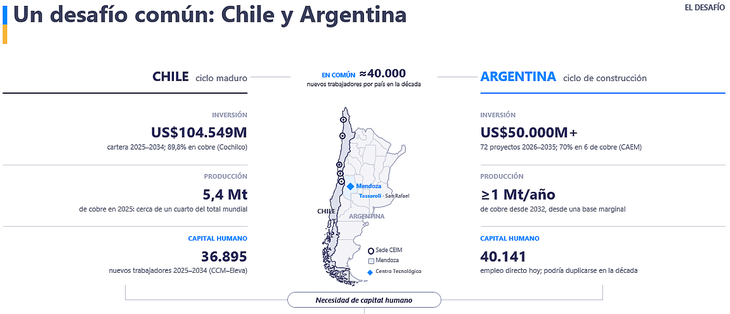
Díaz shared two lessons learned from the experience of large-scale Chilean mining in the formation of human capital. The first is that Around 68% of the large mining workforce has technical or secondary training. In mining companies, this profile represents 52% of the workforce, while in suppliers it reaches 73%, where 75% of workers have a technical profile.
The second learning is that near the 61% of the new positions projected towards 2034 will be linked to operation and maintenance. In these occupational groups, technical or secondary training is between 79% and 98%, depending on the function. The Chilean experience, Díaz explained, shows that mining development requires prioritizing technical, practical and certifiable skills, with training aligned to the specific needs of the industry.
The five participants moderated by the journalist Sebastian D. Penelli They agreed that the expansion of mining poses challenges that exceed national borders and require a regional perspective, with greater coordination between companies, institutions, governments and training centers.
The integration of suppliers, the development of infrastructure, the transfer of knowledge and the preparation of workers appear as strategic factors to accompany investments and enhance the economic impact of the activity.
The articulation between Mendoza and Chile is thus projected as an opportunity to build a region with greater capabilities, more competitive and prepared to respond to the demands of global mining, strengthening the productive network, expanding opportunities for local companies and promoting sustainable development on both sides of the mountain range.
Source: www.ambito.com