What does it mean to be well? How do policies and institutions shape the care people receive? And what can the experiences of patients and caregivers teach us about medicine?
UNC Greensboro’s new interdisciplinary Health, Medicine, and Society (HMS) major puts these questions at the center of undergraduate study, offering students a way to explore health and healthcare through the humanities and social sciences.
Housed in the College of Arts & Sciences (CAS), the program connects classroom learning with research and hands-on experience. The first degree of its kind in the UNC System, HMS prepares students to understand the people, experiences, and systems that shape healthcare.
For Cassandra L. Workman, the program’s first director, those connections are essential to understanding health and healthcare and to helping students imagine where their interests might lead. HMS complements programs such as public health and traditional premedical tracks by emphasizing the human experiences and social systems that shape care.
I’m a strong believer that perspectives from the humanities and the social sciences only strengthen those fields. I think what is most exciting about this program is it asks the big questions about health. It is asking what’s it like to be a patient; what’s it like to be a provider; what are these experiences of care; what are the systems that make these realities; what are the policies; how do you practice medicine ethically? These are all the big questions that are driving this program.
Dr. Cassandra L. Workman, Director, Health, Medicine, and Society Program
Connecting the Humanities, Social Sciences, and Healthcare at UNCG
When she began her role at UNCG in August 2025, Kelly Joyce, Dean of the College of Arts & Sciences, was already considering the opportunity to bring a medicine and society degree to the University. Across the country, institutions were developing majors that brought the humanities and social sciences together to examine health and medicine.
Joyce saw an opportunity to build on that approach while preparing students for healthcare careers they might not have considered.
“We all know healthcare is one of the biggest sectors of our country,” Joyce says. “And most of the time, people focus on the clinical side.”
Alongside nurses, therapists, and other clinical professionals, healthcare depends on people working in data analysis in insurance companies, patient foundations, and government agencies. Joyce wanted to ensure students were prepared for those opportunities, too.
UNCG already had the foundation for a new major: faculty teaching about medicine and the experience of healthcare in nearly every humanities and social sciences department in the College. Connecting those courses would allow students to study health through multiple perspectives while building on the University’s expertise.
“What I thought was really interesting about these degrees is they’re very unique to their institutions, so they lean into what they have expertise in,” Joyce says. “We’re trying to lean into what we have strengths here in: humanities and social sciences.”
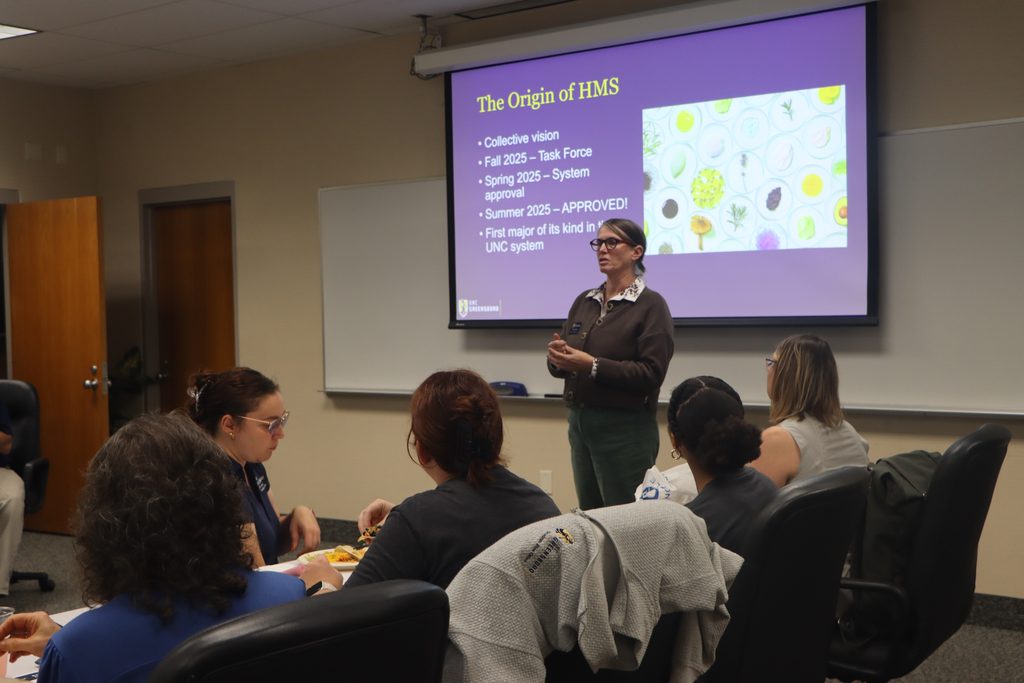
At the HMS launch luncheon Workman hosted for faculty across campus Nov. 12, participants discussed courses, research opportunities, and potential collaborations. The gathering reflected the vision behind the major: bringing existing expertise together and creating new ways for students to engage with it.
What Students Study in Health, Medicine, and Society
The HMS major combines a shared foundation with room for students to follow their interests. Students can explore health through fields such as anthropology, English, history, philosophy, psychology, political science, public policy, and sociology, connecting interests that might otherwise sit in separate parts of their academic schedules.
Coursework is structured around five distinct areas:
- Ethics
- Research Methods
- Social Organization of Health and Medicine
- The Human Experience of Health and Medicine
- Health Policy and Law
The curriculum includes an introductory HMS course and a capstone, with other coursework drawn from existing programs. The introductory course, HMS 101 Introduction to Health, Medicine, and Society, will first be offered in the Fall 2027 semester.
“[HMS] is giving students a chance to explore a breadth of interests,” Workman says.
A student interested in psychology, for example, can pursue that interest while exploring medical ethics through philosophy. The flexibility helps students connect familiar subjects with new perspectives while developing skills for employment or further study.
Hands-On Learning Through Research and Internships
Practical preparation is central to the major.
“We need to give the students hands-on experiences, research experiences, internships,” Joyce says. “So that is a major component of this degree.”
Students are required to take at least two methods courses and complete an internship or research experience, building skills they can apply in workplaces or further study. Depending on their interests, students can pursue research methods within different disciplines while learning to ask critical questions about how information is collected, interpreted, and used.
For Workman, that preparation includes helping students explain what they know and what they can do. One of her goals is for graduates to articulate their skills clearly to employers and graduate programs, connecting their coursework and experiences to their next steps.
“I am a firm believer that internships are incredibly valuable and so is independent research,” Workman says.
As HMS grows, she plans to build additional community connections while drawing on existing internship and research opportunities across the University.
Careers and Graduate Study in Health and Healthcare
The Health, Medicine, and Society degree opens possibilities in healthcare administration, communication, policy, research, community organizations, and public service. It also provides a foundation for graduate study in fields such as public health, law, and social work.
Students considering clinical careers can pair the major with the science coursework and prerequisites their intended professional programs require.
Across those paths, the questions students learn to ask will remain important: Whose experiences inform a policy? What barriers prevent someone from receiving care? How might a different perspective lead to a better approach?
For Workman, that willingness to keep asking and learning is part of what a college education should make possible.
“It’s just important to create lifetime curiosity about these topics,” she says.
HMS gives that curiosity a focus: understanding the lives behind healthcare decisions and the ways students might help shape them.
Story and photography by Amanda Kennison, College of Arts & Sciences

explore the human side of healthcare
Source: www.uncg.edu