Key Insights
- AI could deepen America’s economic mobility gap before it helps close it. Black and Latino workers are overrepresented in occupational categories where automation is projected to displace rather than augment much of the work. Many of these jobs are entry-level and middle-class occupations that have historically driven mobility. Black workers, for example, are represented above their overall workforce share in each of the six occupations with the steepest projected declines in labor demand.
- Deployed passively, AI may widen existing gaps further. According to Stanford’s AI Index, private AI investment reached nearly $345 billion globally in 2025, with funding increasingly concentrated in large deals. Our research finds that White workers are 30 to 50 percent more likely than Black and Latino workers to be employed in the arenas of the future where that capital, and the resulting jobs and wealth, are expected to concentrate over the next two decades.
- Deployed intentionally, AI could improve opportunity at five critical inflection points: maternal and infant health, K–12 education, postsecondary completion, workforce entry and progression, and building funds and assets. For example, model simulations suggest AI-supported risk tools could reduce adverse pregnancy outcomes by up to 31.8 percent. In financial services, a randomized field experiment found that AI-powered alerts helped reduce overdrafts by 9 percent.
- Failing to address structural risks could also stem widening disparities. About one in six households in the United States aren’t connected to the internet at all. Black adults are roughly 80 to 90 percent more likely and Latino adults roughly 50 percent more likely than White adults to lack broadband. This digital divide, algorithmic bias, capital that bypasses Black and other historically underfunded entrepreneurs, and environmental burdens that can undermine the health, well-being, and economic mobility of communities across geographies could become baseline barriers to AI-enabled mobility.
- Those who shape how AI is deployed will likely determine whether mobility gaps widen or close. With intentional design, investment, governance, and community partnership across the private, public, and social sectors, AI can become more than just a productivity tool; it can accelerate mobility.
Economic mobility is a reflection of whether each generation can do better than the one before, both in income and across the fuller dimensions of a good life. It is a core measure of whether a society is genuinely expanding opportunity and improving lifetime outcomes—through higher income, better health, stronger education, and greater ability to build wealth.
In the United States, that promise has weakened. According to the research and policy institute Opportunity Insights, the share of children who grow up to earn more than their parents fell from roughly 90 percent for the 1940 birth cohort to about 50 percent for children born in the 1980s. About 90 million Americans still live below two times the poverty line, a measure commonly used to define economic insecurity.
Mobility outcomes are especially constrained in low-income communities, where barriers to healthcare, education, credentials, employment, and wealth building compound over time. These barriers disproportionately affect Black, Latino, Native American, and rural communities. Black, Latino, and Native American residents experience higher poverty rates than White residents, and rural poverty rates have remained higher than metro poverty rates for decades. For the purposes of this report, we focus on the potential impact of AI on the economic mobility of Black, Latino, and rural populations, including through shifts in labor demand, occupational transitions, and access to new economic opportunities.
Artificial intelligence enters this uneven landscape not as a neutral force but as a technology already reshaping how economic value is created and captured. The current wave of AI has generated highly concentrated wealth among a relatively small set of firms, investors, and workers while raising unresolved questions about who benefits from the data, knowledge, and creative work used to build AI systems.
AI may lead to job growth overall, but the risk of displacement is uneven
New analysis from the McKinsey Global Institute (MGI) suggests AI could further exacerbate these disparities—not just through how much work it affects, but through how it affects work. AI can either automate work, displacing the need for a person to do it, or augment work, making a person more productive (for a deeper conversation on how we defined “displacement” and “augmentation,” see sidebar “About the research”). An average of 21 percent of current work hours in the United States, much of it routine and in entry-level jobs that have traditionally served as pathways to the middle class, could be reduced by automation (across technologies, and including physical or cognitive activities) by 2035, according to a new report from MGI. This decline in current work hours is what would push the need for worker transitions, as the nature of work and new occupations emerge. But the impact of that exposure splits unevenly by race and geography.
The data tells a seemingly uniform story: Automation adoption by 2035 is similar across racial groups and urban and rural locales. But the similarity in automation adoption does not result in similar impact across groups. When we examined not just whether work would be affected, but how—by displacement (a reduction in labor demand) or by augmentation—the results diverged. Of the automation-adopted work hours performed by Black and Latino workers, 40 percent and 41 percent of work hours, respectively, are projected to be displaced rather than augmented, compared with 37 percent for White and 36 percent for Asian workers (Exhibit 1). The gap in aggregate may be modest, but it more strongly affects groups that have faced the steepest barriers to upward mobility and are more likely to be displaced by it rather than empowered by it.
A key driver of these differences is the mix of activities that make up different workers’ jobs. Automation is most likely to displace work, rather than augment it, when activities are standardized, their outputs are easy to verify, and an occasional error carries low stakes. Answering a routine billing question is one example; a mistake is easy to catch and correct. Adjusting a patient’s medication dose is the opposite, which is why AI in such settings is more likely to support a human than replace one. Activities of the first kind account for a larger share of work hours performed by Black and Latino workers, which explains why more of their exposed hours are projected to be displaced.
Another perspective on structural job differences across demographic groups can be seen when mapping activities across physical and nonphysical work. Physical activities make up 35 percent of Black workers’ total hours and 39 percent of Latino workers’, compared with 26 percent for White workers. The pattern also holds geographically: 34 percent of rural workers’ work hours are physical, compared with 28 percent for their urban counterparts. These physical tasks are increasingly susceptible to automation through robotics and other AI-enabled systems (although the capital and infrastructure required may slow adoption relative to software-based automation). By contrast, other groups are more exposed to gen AI-driven adoption, with varying degrees of adoption being augmented rather than displacing.
Looking across the labor market as a whole can obscure where these impacts are concentrated. For example, across roughly 900 occupations, the occupational mix of rural and urban workers is relatively similar. But occupations facing the steepest expected declines in labor demand have different demographic profiles. Black workers, for example, are represented above their overall workforce share in each of the six occupations with the steepest projected declines in labor demand (Exhibit 2). In the case of postal mail sorters and processors, an occupation where demand is projected to decline by more than 50 percent between 2025 and 2035, Black workers hold 37 percent of the jobs, or roughly three times their share of the overall workforce. Latino workers, meanwhile, account for 43 percent of hand packers and packagers, or 2.3 times their workforce share, while rural workers account for 28 percent of both postal mail carriers and dishwashers, or roughly 1.2 times their workforce share. These concentrations mean that even where differences in projected displacement appear relatively modest across populations in aggregate, declines in particular occupations could be felt much more acutely by certain workers and communities.
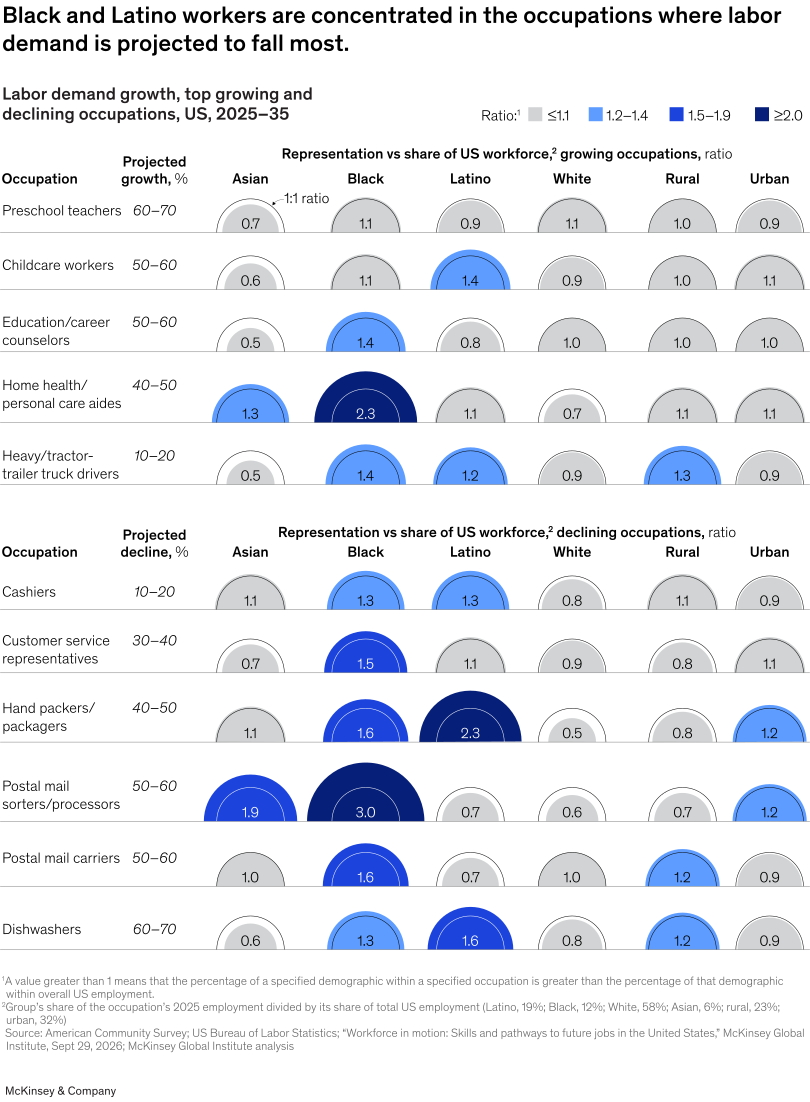
These differences in occupational mix also shape where future labor demand is headed. Based on today’s distribution of work hours, overall future work hours for Black and Latino workers are projected to increase more modestly, by 2.1 percent and 1.4 percent, respectively, between 2025 and 2035, compared with projected growth of 3.4 percent for White workers and 5.8 percent for Asian workers. Similarly, labor demand associated with rural workers is projected to grow more slowly than that of their urban counterparts (2.7 percent vs. 3.3 percent). In other words, while labor demand is projected to grow across all groups through 2035, that growth is expected to be substantially slower for Black, Latino, and rural workers, potentially widening existing differences in economic opportunity.
Transition risk and pathways vary across groups
The near-term workforce challenge is not simply whether AI eliminates jobs but instead how automation and other forces reshape labor demand. MGI estimates that automation could reduce labor demand by 36 million jobs over the next decade, while growth across existing and new occupations could add the equivalent of roughly 41 million jobs in MGI’s base case. A more challenging transition is the roughly 11 million workers who may need to move into entirely different occupations.
Understanding the jobs of the future requires looking at three different parts of the labor market: existing occupations where demand is growing (including healthcare, construction, and management), existing occupations where demand is shrinking (particularly office and administrative support, sales, and transportation-related roles), and entirely new occupations created as AI diffuses through the economy. Drawing on the history of earlier general-purpose technologies, MGI estimates that roughly 500,000 to two million US jobs could be created by 2035 in occupations that do not yet exist or are currently too small to measure—for example, AI infrastructure, agent engineering, workflow design, governance, human oversight, and evaluation.
The need to make transitions to the jobs of the future is also unevenly distributed. Lower-wage workers are 7.6 times as likely as higher-wage workers to need to transition into a new occupation, while workers without a bachelor’s degree are 1.8 times as likely as those with one. Some of these transitions may occur through normal job turnover, which is already relatively high in sectors such as retail, rather than displacement from long-held jobs. The need to transition may be particularly acute in rural communities, where poverty rates remain higher: 13.7 percent of people in nonmetropolitan areas lived below the poverty line in 2024, compared with 10.2 percent in metropolitan areas. Younger workers and women are each roughly 60 percent more likely to need to transition, and Black and Latino workers are about 20 percent more likely than White workers—a reflection of their greater representation in occupations where automation is more likely to reduce labor demand.
As noted in MGI’s 2026 Workforce in Motion report, having jobs available does not mean workers can easily reach them. Nearly every worker who needs to transition may have some pathway into growing work, but only about 14 percent have a direct pathway requiring minimal retraining and no wage loss. Roughly 41 percent face a winding pathway that may require meaningful new skills, a modest wage trade-off, or additional credentialing, while 45 percent face an unpaved pathway characterized by larger skill gaps, longer credentialing requirements, or other barriers. The workforce challenge is therefore not only to create enough jobs but also to make the pathways into them easier to traverse.
Those pathways are especially uneven for workers with the least financial cushion. Only about 10 percent of workers in the lowest wage quintile—those earning less than $38,000 a year—have a direct pathway, compared with almost 40 percent of workers in the highest quintile.
The workforce challenge is not only to create enough jobs but also to make the pathways into them easier to traverse.
AI will certainly affect economic mobility, but it’s still unclear whether its benefits will be broadly shared. Without intentional action, AI could widen existing gaps in wealth, health, skills, and opportunity. With responsible deployment, however, AI could also help underserved communities access better care, stronger learning, more resilient jobs, and wealth-building tools at lower cost and greater scale.
But employment is only one part of the economic mobility story. Economic mobility is rarely won or lost at a single moment in a worker’s career; it is shaped across a lifetime, as advantages and disadvantages compound from birth through education, work, and wealth building. A difficult birth can lead to a developmental delay; a weak start in school predicts dropping out; a lack of credentials ends in a low-wage job; a low-wage job leaves no room to save; and without savings, the next generation starts the cycle again. Closing that gap requires intervening at the moments where disadvantage compounds most sharply.
Five pillars that could help ease transitions
AI could help expand economic mobility not only by reshaping work but also by addressing barriers that accumulate much earlier and persist throughout a person’s life. AI’s potential therefore extends across the broader cradle-to-career (C2C) journey. In this report we focus on five areas across the C2C journey where barriers to mobility are steepest for low-income, Black, Latino, and rural communities—and where targeted intervention has the greatest potential to change long-term trajectories:
- Maternal and infant health. Ensuring healthy pregnancies, safe births, and the physical and socioemotional well-being of mothers and infants is the basis of everything that follows. Health equity at birth shapes foundational cognitive development and protects families from the long-term financial strain of medical debt.
- K–12 education. Providing high-quality, equitable academic instruction, socioemotional development, and continuous support from kindergarten through high school graduation is essential to closing early opportunity gaps. Equitable K–12 attainment substantially reduces dropout rates and serves as the fundamental prerequisite for higher-earning career pathways.
- Postsecondary education. Successfully enrolling in and completing higher education, vocational training, technical certifications, or alternative credentialing programs is where much of the economic return on education is realized. Specialized credentials and degrees are among the most reliable predictors of lifetime earnings.
- Entry and progression through the workforce. Successfully transitioning into the labor market with a living-wage job, coupled with access to quality jobs and continuous opportunities for career advancement and upskilling, drives immediate household economic stability and fuels broader economic productivity.
- Building funds and assets. Moving beyond income sufficiency to actively accumulate wealth through financial inclusion, homeownership, savings, and business ownership is what makes mobility durable across generations. Asset generation provides a critical safety net against unexpected economic shocks and enables the intergenerational transfer of wealth.
Across each pillar, we explore where AI could shift systems from reactive to proactive (such as flagging a maternal health risk before delivery, spotting a struggling reader before third grade, or catching dropout risk before a student disappears), alongside the risks the same shift could introduce (from prediction without a clinical response to biased hiring decisions and opaque credit denials) (table). We provide examples of cutting-edge solutions already in use and identify what leaders across the private, public, and social sectors could do for AI-enabled interventions to improve mobility, if deployed responsibly and at scale.
| Life stage | Potential AI solutions | Potential AI risks |
| Maternal and infant health |
|
|
| Learning and academic progression |
|
|
| Postsecondary education |
|
|
| Workforce entry and progression |
|
|
| Building funds and assets |
|
|
The examples included are illustrative rather than exhaustive. They are intended to make the discussion concrete, not to represent every promising application of AI or suggest that these are the only, or even the highest-priority, opportunities.
As AI capabilities and applications continue to evolve rapidly, leaders can use this framework as a starting point for a broader conversation about where AI can help address long-standing barriers to economic mobility and what it will take to deploy these technologies responsibly, equitably, and at scale.
Maternal and infant health are among the earliest points where health inequities become economic mobility gaps. Being born at a healthy birth weight is associated with stronger educational and labor market outcomes as well as an increase in lifetime income. Improving birth outcomes can generate intergenerational economic benefits, including higher educational attainment and adult earnings for children. The stakes are especially high for Black mothers and infants. Prior research from the McKinsey Institute for Economic Mobility (IEM) and McKinsey Health Institute (MHI) found that closing the Black maternal-morbidity gap could restore 350,000 healthy life years for Black women giving birth in 2025 alone.
Access to maternal and infant care is strained by two distinct pressures: insurance coverage stability and shrinking obstetric infrastructure. On coverage, while pregnant and postpartum Medicaid enrollees have continuous-eligibility protections not extended to other beneficiaries, those protections are uneven—the postpartum extension beyond 60 days is a state option, not a federal mandate. Procedural errors during the 2023 to 2024 Medicaid unwinding put some pregnant and postpartum people at risk of losing coverage despite their protected status. On infrastructure, obstetric access is contracting independently of coverage status. For example, only 41 percent of rural hospitals now provide labor and delivery services, and closures accelerated in 2025.
Even before accounting for these recent pressures, access to care has not been evenly distributed, with low-income mothers and infants facing higher barriers to timely, high-quality prenatal, delivery, and postpartum care. Those barriers disproportionately affect Black, Latino, and rural families, who are overrepresented in low-income populations and often face greater access constraints. The stakes are high given Medicaid’s central role in maternal care, financing 41 percent of births nationally and 47 percent in rural communities. While pregnant and postpartum individuals are exempt from H.R. 1’s Medicaid work requirements, reductions in federal Medicaid funding, including changes to provider taxes, could further strain rural hospitals and accelerate labor and delivery unit closures, exacerbating existing maternal care access gaps.
Within this broader low-income maternal-health gap, Black mothers and infants face especially severe disparities. The report from IEM and MHI found that Black women in the United States experience maternal mortality at two to four times the rate of White, Latino, and Asian women, based on 2023 data from the Centers for Disease Control and Prevention (CDC), and face higher burdens of conditions such as preeclampsia, gestational diabetes, hemorrhage, and postpartum depression.
Gaps in care delivery can also compound risk long after delivery. Women who develop pregnancy-related conditions such as preeclampsia or gestational diabetes carry elevated long-term cardiovascular risk, yet postpartum cardiovascular follow-up is inconsistent and often left to the patient to pursue. Infant health matters as well. Preterm birth, low birth weight, and fetal growth restriction are linked to infant mortality, child development, educational attainment, and future earnings.
How AI can strengthen maternal data, detect risks earlier, and expand access to care
The McKinsey Health Institute’s prior research on closing the women’s health gap identifies five dimensions of action to improve maternal health: counting women (with improved data collection), studying women (by increasing representation in research and prioritizing conditions that drive maternal morbidity and mortality), caring for women (by expanding maternal coverage and care), including women (by increasing representation in healthcare and embedding culturally responsive care practices), and investing in women (by increasing capital for maternal healthcare).
AI can play a role in all five dimensions. Here, we focus on the areas related to counting, studying, and caring where near-term impact could be strongest in closing maternal and infant health gaps across Black and rural mothers.
Build the foundation for standardized data collection
Better data is the starting point. AI could help count what matters by improving the data foundation for Black maternal and infant health, as well as for other communities where there is a gap. Maternity information is often split across prenatal records, delivery hospitalizations, postpartum care, infant records, claims, community services, and patient-reported data. The Office of the National Coordinator for Health Information Technology’s USCDI+ Maternal Health initiative calls for more longitudinal, interoperable maternal health data. AI can help strengthen the data foundation for Black maternal and infant health by integrating these fragmented sources into more complete longitudinal data sets. AI can help by extracting information from notes, linking maternal and infant records, mapping local codes to standardized measures such as the CDC’s 21 severe-maternal-morbidity indicators, and flagging missing race, geography, transportation, or follow-up fields. Those mappings should remain reviewable by human data stewards and shaped with input from the women whose records are being used.
The same data integration that creates opportunity could also create risk: AI-enabled maternal care also raises important privacy concerns. Pregnancy and postpartum records often contain highly sensitive information, including reproductive history, mental health, and social needs, and patients need confidence that these data will be collected only when necessary, securely protected, and used transparently. Yet that confidence is hard to earn when the legal protections are narrow and shifting. HIPAA covers only certain providers and insurers, not most pregnancy-tracking apps, wearables, or consumer AI tools; it also permits disclosure in law enforcement and legal contexts. A 2024 rule that added extra privacy protections specifically for reproductive health records was struck down by a federal court in June 2025, so this type of data is back under the older, less protective HIPAA rules. Strong privacy protections and human oversight—not just regulatory compliance—are essential to building trust in AI-enabled care.
Expand proactive risk identification
AI can improve care by shifting maternal health from reactive to proactive. Across preeclampsia, gestational diabetes, postpartum depression, fetal growth restriction, and preterm birth, AI tools could support earlier intervention by identifying risk earlier, flagging pregnant women who may be missed by traditional screening, and supporting more timely monitoring, referral, and care navigation. For example, a new machine learning model that incorporates social determinants of health data—including provider availability and distance to care—from more than 190,000 Medicaid-enrolled women across 26 states and Washington, DC, who had their first predelivery pregnancy-related visit between 2017 and 2019 identified pregnancy risks a median of 55 days before traditional clinical indicators emerged. Model simulations projected a 31.8 percent reduction in adverse pregnancy outcomes, with Black women seeing the largest absolute gains.
AI has the potential to strengthen proactive maternal care by enabling earlier, more precise identification of high-risk pregnancies and supporting timely clinical interventions. Early studies suggest AI can increasingly detect certain high-risk pregnancies. For example, one Danish study spanning 17 hospitals found that a deep learning model increased detection sensitivity from 58 to 70 percent for small-for-gestational-age fetuses and from 41 to 55 percent for large-for-gestational-age fetuses, compared with the current standard ultrasound-based method. Rather than relying primarily on a small number of clinical risk factors (such as blood pressure and urine protein), AI can combine hundreds of data points, including electronic health records, laboratory results, ultrasound findings, and social determinants of health, to identify subtle patterns of risk earlier in pregnancy. Preeclampsia illustrates the potential: It is one of the most dangerous pregnancy-related complications for mothers, with Black women experiencing it at roughly 1.5 times the rate of White and Asian women. Established non-AI screening algorithms, such as the Fetal Medicine Foundation (FMF) model, already detect approximately 75 percent of preterm preeclampsia cases. AI’s potential lies in further improving risk stratification, particularly for late-onset disease. By enabling clinicians to conduct earlier monitoring and tailor care interventions, accordingly AI could create more targeted monitoring, preventive interventions such as low-dose aspirin for eligible patients and timely specialist referrals, strengthening the ability of maternal healthcare systems to prevent complications before they escalate.
The same earlier-detection logic applies to infants. The mortality rate for Black infants is more than twice that of White, Latino, and Asian infants. AI tools can help identify risks such as congenital heart defects, abnormal fetal growth, and preterm birth earlier, giving clinicians more time to monitor pregnancies and plan appropriate care. For example, Mount Sinai recently became the first health system in New York City to deploy an FDA-cleared AI tool that enhances prenatal ultrasound screening for congenital heart defects. Because preterm birth, low birth weight, and congenital conditions are major contributors to infant mortality and long-term developmental risk, the value of AI is not prediction for its own sake. Rather, AI is enabling earlier intervention before risks become crises.
Personalize support and expand access
AI can also personalize and extend support to more distant communities by helping integrate data across dispersed settings, leading to more streamlined care. AI tools can also create more holistic maternal risk profiles and recommend tailored next steps, such as clinician follow-up, nutrition counseling, transportation support, mental-health referral, or changes to visit schedules. Maternal mental health represents a particularly important opportunity. For example, AI-supported screening tools could help identify signs of perinatal depression or anxiety and prompt timely referrals to behavioral health specialists. AI-enabled navigation tools could also help patients understand eligibility and access timely Medicaid coverage, transportation benefits, nutrition supports, and other resources that shape health outcomes. However, AI tools should augment rather than replace clinical judgment, particularly in mental health care, where chatbots may fail to recognize or appropriately respond to patients experiencing suicidal ideation or other crises, underscoring the need for human oversight and clear escalation pathways.
For women in rural or underserved areas, remote monitoring and telehealth can extend support between visits and through the postpartum period. For example, the Connected MOM program from Ochsner Health, Louisiana’s largest nonprofit healthcare system, uses Bluetooth blood pressure monitoring integrated with Epic and MyChart to help clinicians identify early signs of postpartum hypertension and preeclampsia and intervene virtually. AI could build on these models by analyzing more patient data, flagging patterns clinicians may miss, and prioritizing outreach for high-risk patients. Another example is the University of Maryland Medical System (UMMS)’s Virtual NEST, a centralized monitoring hub that uses AI-powered fetal heart rate surveillance to support labor and delivery teams across hospitals, enabling earlier identification of potential complications, timely clinical intervention, and more consistent access to specialized oversight. The underlying use case is compelling: AI-assisted care models have the potential to expand access to specialized maternal care and improve patient safety, particularly in underserved and rural communities by enabling 24/7 monitoring and triage support to help pregnant and postpartum patients recognize warning signs, identify potential complications earlier, and facilitate timely escalation to appropriate care.
The next step is to study whether these tools improve access and outcomes, especially for Black mothers. A qualitative and survey-based study could track whether AI-enabled tools make it easier to get appointments, understand symptoms, receive follow-up, and access transportation or social supports. This would strengthen both “count” and “include” by measuring patient experience more rigorously while ensuring Black mothers shape how AI-enabled maternal care is designed.
Realizing this potential will likely require targeted investment. The evidence base is growing, but most tools still need stronger validation, equity testing, and integration into real care pathways. Without it, AI risks becoming another promising technology that performs well in pilots but fails to reach the patients who need it most. With the right investment, AI could become more than a prediction tool. It could become a lower-cost front door to maternal care, helping health systems count disparities more accurately, identify risk earlier, and personalize and scale support where the need is greatest. Emerging AI care models offer a glimpse of what that could look like.
Achievement gaps compound as children progress from kindergarten through 12th grade, and early literacy and numeracy are strong predictors of age at graduation, employment status, and earnings potential. Children who read proficiently by third grade are substantially more likely to graduate high school, and math skill development from kindergarten onward serves as a key predictor of academic persistence and career attainment.
However, the systems responsible for closing early learning gaps are under growing strain. The expiration of federal pandemic relief, declining public-school enrollment, persistent chronic absenteeism, and teacher shortages are limiting districts’ capacity to provide individualized support. These pressures are especially consequential for low-income students and students of color, who are more likely to attend schools with fewer resources and greater staffing challenges.
These inequities translate into measurable differences in K–12 outcomes. Public high school graduation rates are about 81 percent for economically disadvantaged students, compared with 87 percent overall—and these students are disproportionately Black, Latino, and rural. These disparities do not reflect differences in aptitude, but rather long-standing inequities in access to resources, school funding, academic support, and broader social and economic opportunity. Graduation gaps persist across race as well: Roughly 81 to 83 percent of Black and Latino students graduate from high school, versus about 90 percent of White students and 94 percent of Asian students. Black and Latino students are also two to three times more likely to fall below basic proficiency in reading and math.
How AI could free teacher time and deliver more personalized learning support
Existing AI tools in K–12 fall into two broad categories: student centered and teacher centered. Their impact is strongest when they supplement, not substitute for, high-quality instruction. The use of AI with children is also among the most contested questions in AI deployment. Parents, educators, child development experts, and policymakers have raised questions about student privacy and data collection and effects on child and adolescent development and cognition, among other concerns. The evidence on large-scale student proficiency gains is mixed, and the high stakes have prompted pushback and moratoriums from school districts across the nation, including the two largest: New York City Public Schools (NYCPS) and the Los Angeles Unified School District (LAUSD). In early September 2026, NYCPS banned student-facing AI tools for all classrooms from the preschool programs for two-year-olds through eighth grade for one year (while allowing usage of select AI tools for pilots in high schools). LAUSD subsequently banned gen AI platforms for all students for the 2026–27 school year.
While evidence is mixed, some early research suggests that quality school-implemented EdTech tools could help with educational work when they are used with guardrails, while poorly designed tools can widen gaps or encourage overreliance and cognitive offloading. Below, we provide a few examples of where edtech has improved learning outcomes in classrooms. The clearest evidence today is that AI can free teacher time from non-instructional work and strengthen the support teachers provide.
Student-centered AI tools
Some early implementations of student-centered AI tools suggest success in improving foundational literacy and math outcomes, but benefits and risks differ by age. In literacy, AI tutors such as Amira can listen to students read aloud, provide real-time phonics feedback, and adapt practice to specific skill gaps, which has been associated with gains on state literacy assessments. However, adoption has drawn calls for transparency and guardrails where lawmakers question how tools are deployed and evaluated. For multilingual learners, student-facing tools such as Amira Lectura can listen as students read aloud, provide real-time feedback in English and Spanish, and support biliteracy development, while broader AI tutors can help explain vocabulary and scaffold grade-level content. In math, platforms such as Zearn can provide curriculum-aligned digital lessons, embedded supports such as step-by-step hints and visual models, and real-time data on where students are progressing or struggling.
For younger learners, the upside depends on whether tools work as advertised and are developmentally appropriate. Speech recognition can misread accents and speech differences, voice recordings raise privacy questions for small children, and an AI tutor may be a poor substitute for a human as a child’s core reading partner. For older students, the main tension is different: whether AI helps students practice and understand or simply lets them bypass learning through shortcuts and cheating. Across all ages, minors are less able than adults to use judgment in identifying when an AI tool may be hallucinating, understanding how data is being used, or giving meaningful consent. For that reason, many experts argue that student-facing tools warrant a higher bar for evidence, transparency, and oversight than tools built for adults.
At home, tools such as Khanmigo can act as an always-available AI tutor, guiding students through Khan Academy lessons with hints, questions, and step-by-step explanations rather than simply providing answers. By offering individualized practice and feedback outside school hours, these tools could expand access to supplemental academic support for students whose families cannot afford private tutoring—but only if students also have access to devices, broadband, adult guidance, and guardrails that encourage reasoning over answer-seeking, and only if families can see how the tool is being used and how their children’s data is handled.
Teacher-centered AI tools
The more immediate opportunity may be additional teacher capacity for instructional time. Prior McKinsey research suggests technology could help teachers reallocate 20 to 40 percent of their time, or roughly 13 hours per week, from planning, grading, feedback, and administration to activities that more directly support student learning. If even part of that time is redirected to small-group instruction, targeted intervention, or family engagement, AI could improve learning not only through student-facing tools but also by strengthening the instructional core.
Tools such as MagicSchool and Brisk Teaching are designed to help teachers draft lesson plans, generate differentiated materials, create assessments and rubrics, provide feedback, and write family communications more efficiently. Educators using both MagicSchool and Brisk report that these tools can save multiple hours per week and that they often reinvest that time into instructional planning and feedback. However, the evidence on whether time saved through AI tools translates into measurable gains in student outcomes is still emerging. Some of these tools also embed in the teacher platform student-facing programs that are carefully controlled by instructors. For example, Brisk Boost provides guided practice to students through teacher-selected texts or videos. Brisk is one of the five centrally approved tools for New York City’s high school AI pilot program.
AI can also make it easier for schools to engage with students’ families. Tools such as ParentSquare Intelligence can help schools draft clearer family communications, translate updates into families’ home languages, and surface engagement gaps. Such capabilities allow teachers to spend less time on administrative messaging and more time on instruction and targeted support.
Finally, AI can also support teachers and tutors to deliver better instruction. In a randomized controlled trial of Tutor CoPilot, a real-time AI coaching tool for tutors, students whose tutors had access to the tool were four percentage points more likely to master math topics than students whose teachers did not, with gains rising to nine percentage points for students working with lower-rated tutors.
A more ambitious frontier for teachers is an AI-enabled classroom “learning radar,” which aims to help teachers see which students are stuck on which concepts in real time—not only after a unit test but during daily instruction. If scaled responsibly, this could turn classrooms from one-size-fits-all environments into dynamic learning systems where teachers can quickly regroup students, assign targeted practice, and intervene before small gaps become grade-level deficits.
Given mixed evidence, the next step is not simply to scale AI tools but to scale them well. McKinsey’s research on how school systems can improve suggests school systems could anchor in the evidence, build a durable coalition for change, create delivery capacity, and drive and adapt with data. For AI, that likely means selecting tools tied to clear learning goals, training teachers to use them well, engaging families so tools reinforce learning beyond the classroom, and measuring whether the tools improve outcomes for underserved students. It could also mean setting clear thresholds for adoption: Tools that improve learning and free teacher time should be scaled, while tools that increase distraction, deepen inequities, or fail to improve outcomes should be redesigned or stopped. For student-facing tools, that bar should include child-specific safeguards, compliance with student privacy laws, and best practices around data collection, design, and transparency.
Postsecondary education shapes lifetime earnings, employment prospects, and access to opportunity. Completing a degree is where much of the economic return is realized: Bachelor’s degree holders earn roughly $30,000 more annually than high school graduates.
Yet access to postsecondary education is becoming more fragile, with financial and basic-needs insecurities and institutional budget pressures making it harder for low-income and first-generation students to enroll and persist. These pressures can turn postsecondary education from a mobility engine into another point where financial, informational, and institutional barriers compound.
Additionally, postsecondary gains are not evenly shared. In an NCES longitudinal cohort study, 14 percent of low-socioeconomic-status (SES) students attained a bachelor’s or higher degree within eight years of high school completion, versus 60 percent of high-SES students. Black, Latino, rural, and first-generation students are disproportionately represented among lower-income populations and face lower completion rates and more friction at every stage of the college journey. Latino adults are about 46 percent less likely than White adults to hold a bachelor’s degree, and Black adults are 35 percent less likely. Disparities persist even with equal attainment, as Black graduates earn about 15 to 20 percent less than their White peers. Rural attainment lags behind urban areas (25 percent versus 37 percent), reflecting deep geographic barriers to access and completion.
How AI-enabled guidance could help more students enroll, persist, and graduate
AI is becoming able to apply interventions from the college application to the graduation pipeline to boost overall graduation rates. While AI alone will not propel outcomes without human oversight, targeted AI combined with proper supports and outreach for first-generation, Black, and Latino students could enable a structural boost in attendance and graduation rates.
Pre-entry into institutions
AI could increase applications by matching students to good-fit schools, making applications easier to write, and connecting students directly to scholarships and financial aid. It can increase accepted populations by enabling better-quality applications—say, by serving as an accessible writing tutor.
AI can reduce “summer melt” (the 10 to 40 percent of students who are admitted to and intend to enroll in college but never show up on day one) by sending personalized nudges that help students complete the administrative steps that derail enrollment—especially financial aid verification, course registration, and location of missing documentation. In a 2021 study from East Carolina University, an AI chatbot named PeeDee texted admitted students tailored reminders and real-time answers about matriculation tasks. Among first-generation students, those receiving chatbot outreach were three percentage points more likely to enroll in the fall and eight percentage points more likely to accept needed loans; loan uptake also rose four percentage points for the full sample. More recent evidence from California State University, Northridge, shows that similar tools can sharply increase completion of time-sensitive steps such as fall registration, though impacts on overall enrollment have been harder to detect at scale. Across studies, the pattern is consistent: AI chatbots appear most effective when they target specific, deadline-driven tasks rather than sending generic encouragement.
Year-over-year retention
AI could also increase retention through the detection of early dropout risk, proactive nudges to take actions required to stay enrolled, automatic course enrollment, and other student success levers.
Taking detection of early dropout risk as an example, the typical first-year retention rate for Black and Latino students is lower than average: 56.6 percent of Black students and 63.6 percent of Latino students returned to their starting institution for year two, compared with 68.2 percent overall nationally across all students. Predictive analytics and AI-enabled tools can support student retention by identifying dropout risk early and triggering timely supports such as adviser outreach, enrollment nudges, and course-planning interventions. Georgia State University’s GPS Advising system illustrates the potential of predictive analytics: By tracking more than 800 risk factors and prompting adviser intervention, the university has facilitated more than 1.2 million alert-driven advising meetings since the program’s inception, and reported a seven-percentage-point increase in four-year graduation rates.
A next frontier could be an AI “degree GPS” that helps every student chart the fastest, most valuable path to a credential, selecting courses based on degree requirements, prior credits, skills, career goals, schedule constraints, and labor market returns. If scaled nationally, this kind of tool could reduce wasted credits, missed prerequisites, registration errors, and late-stage account or course-sequencing issues that delay graduation. For first-generation and low-income students in particular, AI could make the hidden rules of college visible, turning complex degree navigation into a personalized, semester-by-semester road map to completion.
Most lifetime wage growth occurs during a worker’s first decade in the labor market, making early employment experiences critical to long-term economic outcomes. First-job characteristics—such as starting salary, industry, and employer quality—account for much of the earnings gap between low- and high-income graduates five years after college. Jobs that offer skill development, mentorship, and advancement opportunities accelerate wage growth, while low-wage jobs can lock workers into lower earnings trajectories. Access to high-quality first jobs is therefore a key driver of economic mobility.
However, the labor market’s newest entrants have faced a surge in unemployment associated with the AI-enabled reduction in entry-level work, overhiring by companies during the pandemic, and high interest rates. Oxford Economics estimated that 85 percent of the rise in unemployment since mid-2023 has been concentrated among new entrants to the labor market. Even recent graduates who are employed face challenges: a large share is working in jobs that do not require a degree, with an underemployment rate of 42.5 percent, the highest since 2020.
Additionally, access to first jobs with strong wage growth and advancement opportunities is unequal, particularly in low-skilled work disproportionately held by racial minorities. Black workers earn 19 percent less in median weekly earnings than White workers, while Latino workers earn 21 percent less in median weekly earnings on average. These disparities limit access to early-career jobs that build skills, raise wages, and support long-term economic mobility.
How AI is reshaping the economy and changing how workers can thrive
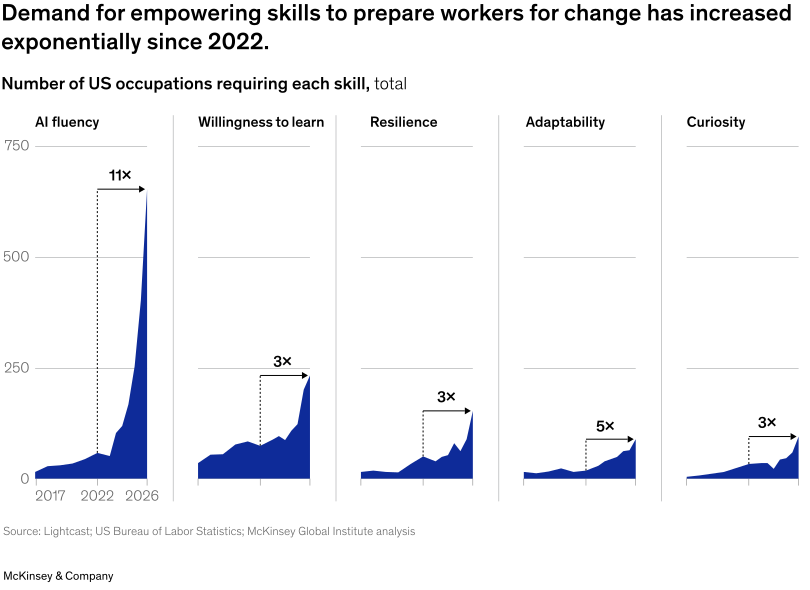
AI is likely to reshape the workforce through a sustained reallocation of work, not simply a one-time wave of job losses. MGI estimates that roughly 11 million US workers may need to move from declining occupations into growing ones by 2035. That implies a net shift in the occupational mix of about 770,000 workers a year, roughly 3.6 times the historical pace. The challenge is particularly acute because the jobs losing demand and the jobs gaining it frequently sit in different occupational groups, requiring workers to acquire new skills and overcome credential, wage, geographic, and other barriers. Many roles now require workers to collaborate with AI tools, emphasizing skills like critical thinking, creativity, communication, problem-solving, and AI literacy. According to the recent MGI Workforce in Motion report, between 2022 and 2026, demand for AI fluency increased 11-fold (Exhibit 3). For students and early-career workers, this means technical adaptability and the ability to use AI effectively are becoming increasingly important alongside traditional subject knowledge.
The question for economic mobility is therefore not simply whether new jobs exist but whether workers facing disruption can reach them quickly enough and without moving backward economically. AI tools can support workers through job matching, reskilling, résumé building, interview preparation, and career coaching. But they cannot, on their own, overcome barriers such as credential requirements, childcare and transportation constraints, or limited access to good jobs.
Skills-based matching
AI can improve job and internship matching by identifying demonstrated skills and transferable experience, rather than relying only on degrees, titles, or keywords. Skills-based matching platforms can translate experience from retail, logistics, food service, production, community college, military service, caregiving, or on-the-job learning into adjacent roles with better pay and lower automation exposure.
Research from Opportunity@Work, a national nonprofit focused on improving economic mobility, suggests that skills-based hiring could expand access to higher-wage opportunities for workers “skilled through alternative routes” (STARs)—including Black and Latino workers, who are more likely than White workers to be STARs. By recognizing competencies gained through community college, military service, caregiving, or on-the-job experience, AI-enabled matching platforms can widen access to higher-paying roles and improve economic mobility. However, these benefits depend on design. Poorly trained algorithms can reinforce existing labor market bias if they rely too heavily on historical hiring patterns.
Reskilling and upskilling for growing and reinvented roles
Reskilling could be organized around growing demand and pathway quality, not simply around finding jobs with less AI exposure. The workers at greatest risk are those in occupations where labor demand is declining and where the route into growing work is constrained by large skill gaps, credentials, wages, geography, or employer screening. At the same time, workers who remain in their current occupations will likely need new capabilities as AI reshapes the mix of tasks they perform.
AI can lower the cost of reskilling and upskilling through personalized learning plans, role-based simulations, and AI tutors. This matters because AI exposure is already reshaping early-career employment. According to Stanford’s latest revision of the Canaries Dashboard, employment among workers ages 22 to 25 in some occupations with higher AI exposure (that is, a higher proportion of tasks that can be automated by AI tools) is 19 percent lower than where it would be if it had kept pace with employment growth in occupations with lower AI exposure. The broader picture for young workers is more mixed. The Economist reports that young workers overall are holding up well; the gap between the unemployment rate of 20- to 24-year-olds and the overall rate is near a multidecade low. The strain appears sharper for recent graduates entering AI-exposed fields, consistent with the elevated underemployment among recent graduates noted earlier.
While there is risk of further displacement associated with AI automation, a recent survey conducted by the Federal Reserve Bank of New York found that, rather than laying off workers, many firms adopting AI are instead retraining their workforces to use the new technology. In situations where AI has displaced workers, reskilling programs can help them build skill sets necessary to enter occupations that have lower AI exposure or offer strong compensation and pathways for upward mobility. Among lower-income displaced workers who participated in job-training programs, those who trained for highly AI-exposed occupations saw earnings returns to training that were 25 percent lower than those of workers who trained for less AI-exposed occupations.
In the near term, the focus could be placed on helping displaced workers move into adjacent roles that are more automation resilient and build on skills the workers already have. For example, cashiers, stockers, and order fillers are more likely to face displacement risk from AI, whereas roles in areas like environmental services, transportation safety, or assistant store management may be more resilient. Over the longer term, it could be beneficial for employers, educators, and workforce systems to build stronger pathways for Black and Latino workers into high-growth sectors such as AI software and services, e-commerce, and electric vehicles through targeted training, credentials, apprenticeships, and employer partnerships.
Additionally, workers can build AI skill fluency by using coding copilots, prompt-writing practice, and low-code tools to create undeniable evidence of capability. This expanded access to reskilling and upskilling is important because Oxford University found that job postings that specify AI skills in the UK offered a 23 percent wage premium. According to a new report from the McKinsey Global Institute (MGI), demand for AI fluency has increased roughly 11-fold since 2022, while demand for adaptability has increased about fivefold and demand for resilience, curiosity, and willingness to learn has roughly tripled. Investment will be needed to ensure there will be enough high-quality training programs with capacity to meet coming upskilling and reskilling demand.
AI-enabled career preparation and navigation
AI can help workers navigate an increasingly complex transition landscape by identifying likely pathways, highlighting wage differentials, surfacing the specific skills and credentials they are missing, and connecting them to training and job-search support. This matters because a pathway that looks viable on paper may still be difficult to navigate in practice, due to credential requirements, training time, wage trade-offs, or other barriers. AI-enabled career tools can help workers better understand those trade-offs and determine what it will take to reach a new role.
Large-scale field experiment research found that job seekers who received AI algorithmic writing support were hired 8 percent more often than those who did not receive assistance. The research found that the benefits of AI assistance were concentrated among workers with weaker initial writing quality, suggesting that AI tools may help level the playing field for workers who lack access to strong educational, professional, or language resources, where low-income workers are overrepresented.
However, a Stanford Institute for Human-Centered Artificial Intelligence (HAI) study of four million job applications found that AI hiring tools can produce racial disparities at scale. Twenty-six percent of Black applicants and 15 percent of Asian applicants applied to positions where the AI system discriminated against their racial group, and an estimated 40,000 additional Black and Asian applications would have advanced if the tool had recommended them at the same rate as the most-favored group. AI hiring tools risk introducing algorithmic bias through historical training data, speech and language patterns, facial analysis, and proxy indicators tied to demographic traits. These systems may unintentionally disadvantage candidates based on accent, communication style, disability, socioeconomic background, or nontraditional career paths, while recruiters may be overly trusting of AI recommendations without fully understanding how decisions are made.
Creation of new, AI-enabled occupations
Drawing on the rate at which previous general-purpose technologies created new occupations, MGI’s Workforce in Motion report estimates that AI could create roughly 500,000 to two million new US jobs by 2035 in occupations that do not yet exist or are currently too small to measure. While that is a small share of the roughly 176 million total US jobs projected for 2035, it is meaningful relative to the 5.9 million net new jobs the US Bureau of Labor Statistics expects the economy to add over the coming decade. These could include roles spanning model development, AI infrastructure, agent engineering, workflow design, AI governance, human oversight, and evaluation. LinkedIn data cited by the World Economic Forum estimates that AI has already contributed to more than 1.3 million new jobs globally. Economists compare AI to earlier “general purpose technologies” such as electricity and the internet, which initially disrupted labor markets but ultimately created entirely new industries and occupations that previously did not exist.
Both the public and private sectors will need to play a role in ensuring that AI is ushering in quality new jobs, as opposed to solely eradicating old ones. Governments could influence labor market outcomes through workforce development, regional investment, and tax incentives. Strategies such as workforce partnerships, innovation hubs, community college programs, apprenticeships, and AI-focused training could help workers transition into emerging occupations. Policies that make retraining and AI upskilling more tax advantaged could encourage firms to invest in workers alongside technology. Ultimately, long-term employment outcomes may depend less on AI itself and more on whether companies use it to replace workers or augment them with new complementary roles.
Financial security depends not only on current income but also on the ability to save, weather financial shocks, and invest in future opportunities. Families with savings and assets are better positioned to manage income volatility, avoid predatory debt, purchase homes, pursue education, and start businesses—all of which contribute to long-term upward mobility and are enablers of intergenerational economic mobility.
However, Americans are finding it harder than ever to save because wages have not kept pace with the rising costs of essentials like housing, food, energy, healthcare, and insurance. According to the US Bureau of Economic Analysis, the US personal savings rate fell to 3.8 percent in September 2026, down from 4.4 percent in June. Since 2017, average earnings rose about 43 percent, but home prices rose by 81 percent, and rents by 54 percent.
Additionally, the impact of the affordability and savings crisis on Americans is distributed unequally. White families hold more than six times the wealth of Black families and five times the wealth of Latino families. Homeownership remains one of the largest contributors to wealth accumulation, yet Black homeownership rates remain significantly lower (by about 28 percentage points) than White homeownership rates because of historic and ongoing discrimination in housing and lending markets. Differences in business ownership and business equity also contribute to the gap, as White households are more likely to own appreciating financial assets and private businesses. Finally, unequal access to affordable credit forces many households of color to rely on higher-cost financial products, limiting their ability to build savings and assets over time.
How workers can build wealth in an AI economy
AI-powered financial tools have the potential to help reduce the racial wealth and savings gap by expanding access to critical resources, reducing burdensome fees and interest payments, and lowering the cost of delivering banking services in underserved communities.
Helping eligible households navigate assistance programs
AI-powered tools can help eligible households identify, enroll in, and stay enrolled in underused assistance programs such as SNAP, tax credits, rental assistance, and childcare subsidies. This matters because nearly five million Americans who are eligible for SNAP did not participate, often because of complex, time-consuming, and documentation-heavy application processes. Helping eligible families access these programs can stabilize income, reduce financial stress, and build savings.
AI can reduce these barriers through personalized eligibility screening, chatbots, automated document review, reminders, and real-time application support. For example, nonprofits are using AI outreach tools to identify eligible families, answer questions, and guide applicants through the SNAP process. In a South Carolina pilot, AI-based document checking increased first-time document completion rates by 20 percent while reducing manual review burdens.
Improving cash-flow stability, credit health, and access to investing
AI-driven coaching and financial management tools could provide personalized guidance that helps consumers avoid overdraft fees, improve credit scores, access lower annual percentage rates (APRs), and identify lower-interest loan products. These tools can help households reduce reliance on high-cost debt and retain more income for savings and asset building. Because AI tools can sometimes hallucinate, they work best as part of a broader financial literacy tool kit, complementing rather than replacing consumers’ own knowledge and access to trusted guidance.
A randomized field experiment published in Management Science found that AI-triggered financial alerts can reduce overdraft fees. The researchers sent 39,000 users of a personal financial management platform simplified AI-based messages about avoiding overdraft fees, and during the following week, the platform experienced a 9 percent drop in overdrafts.
Additionally, AI could lower borrowing costs by helping consumers choose better credit products. Many low-income and subprime borrowers face high search costs, limited transparency, and lender steering that can lock them into expensive products. Personalized AI agents could compare offers, explain trade-offs, flag predatory terms, and recommend lower-cost options based on a borrower’s actual needs and repayment capacity.
AI tools have also created alternative underwriting models that can expand access to and lower costs of credit for populations with thin credit profiles. AI-enabled underwriting can incorporate alternative data—such as rent, utility, and cash flow history—to better assess borrowers with limited traditional credit histories. Doing this could potentially expand access to affordable credit for consumers who may be overlooked by conventional credit scores.
Beyond expanding access to affordable credit, AI could also lower barriers to the financial tools that help households turn income and savings into longer-term wealth. AI-powered robo-advisers can make investing and wealth management more accessible by providing automated, personalized portfolio recommendations at lower cost and with lower minimum investment requirements than traditional advisory services. By reducing these barriers, such tools could help more households move from short-term saving to longer-term investing and asset building.
Reducing operational costs and risk for banks
AI can reduce operational and customer acquisition costs for banks and credit unions by automating administrative tasks, streamlining underwriting, and improving customer service, making it more economically viable for financial institutions to operate in low-income and historically underserved communities. Together, these innovations could expand access to affordable financial products and services that support long-term wealth creation and economic mobility. McKinsey estimates that gen AI could generate between $200 billion and $340 billion in additional annual value for the banking industry through productivity gains.
Optimizing bank operations directly drives economic mobility, especially for community development financial institutions (CDFIs). Because CDFIs serve low-income, underbanked populations, they naturally bear higher risk profiles and operating costs. Reducing these operational burdens achieves two goals: It ensures CDFIs can sustainably serve disadvantaged communities, and it lowers the barrier to entry for new banks, ultimately expanding financial inclusion for the historically unbanked.
Business ownership and stewardship
AI can support wealth building not only by helping entrepreneurs start businesses but also by making it easier for more people to buy, improve, and sustain existing businesses. This could be especially timely as the United States enters a “great ownership transfer.” Recent McKinsey Institute for Economic Mobility research found that by 2035, roughly six million small and medium-size businesses are expected to face ownership transitions as Baby Boomer owners retire, including more than one million viable candidates for sale. If these transitions succeed, they could preserve jobs and local wealth; if they fail, communities could lose productive businesses, employment ladders, and locally rooted ownership opportunities.
AI could make this market more accessible in two ways. First, it could lower the cost and complexity of acquisition by helping prospective buyers identify targets, benchmark valuation multiples, surface risks, and accelerate diligence. That could make smaller business acquisitions more feasible for buyers who have historically lacked access to expensive advisers, search infrastructure, or institutional capital. Second, AI could increase the value of local service businesses by improving operations such as marketing, customer service, bookkeeping, and tax preparation, creating more upside for new owners and more resilient businesses after transfer.
Uneven starting point and risks
AI could accelerate mobility, but it could also widen the very gaps this report seeks to address. We are starting from an already unequal labor market baseline. Black and Latino workers are disproportionately represented in frontline occupations, which often offer lower wages and limited opportunities for advancement.
Moreover, Black and Latino Americans are underrepresented in the industries that are growing the fastest. White workers are 30 percent to 50 percent more likely than Black and Latino Americans to be employed within the 18 “arenas of competition” identified by MGI. These industries—for example, AI software, semiconductors, robotics, and biotech—are where jobs, wages, and wealth are expected to concentrate over the next two decades, poised to generate up to $48 trillion in global revenue by 2040, but Black and Latino workers remain largely on the outside of these sectors.
The opportunities described in this report are real, but so are the obstacles. Addressing the following four structural risks that could just as easily widen the gaps this report identifies, could help institutions across the public, private, and social sectors realize AI’s potential for mobility.
Infrastructure and access
Every use case in this report assumes connectivity; the rural maternal monitoring, at-home tutoring, reskilling platforms, and low-cost banking tools could all collapse if a family lacks a device or broadband. AI-enabled services cannot expand mobility if communities lack broadband, devices, digital literacy, or trusted entry points. According to the National Telecommunications and Information Administration, roughly one in six US households are not connected to the internet at all. Forty percent of households earning less than $25,000 lack high-speed internet. Black adults are roughly 80 to 90 percent more likely and Latino adults roughly 50 percent more likely to lack broadband than White adults.
Besides shutting out certain populations from AI productivity gains, this lack of access to broadband makes it harder for these groups to learn the AI skills and fluency needed to adapt to today’s employer demands. A lack of access to AI-enabled training and reskilling platforms could result in greater difficulty navigating the job market. Closing these gaps will require pairing broadband and device access with AI literacy training.
Bias and trust
AI systems can encode and scale discrimination in high-stakes settings such as hiring, dropout risk flags in postsecondary education, and risk prediction models in maternal health—settings discussed in this report as opportunities. A comprehensive review published in Computational Linguistics found that large language models (LLMs) can perpetuate and amplify social biases, including those related to race, gender, and religion, underscoring the importance of rigorous bias evaluation and mitigation. If models are trained on biased data or deployed without oversight, they could make inequitable systems faster rather than fairer.
Many of these tools also rely on highly sensitive data, such as health records, student work, financial histories, and benefits applications. That data often comes from people who may have limited ability to opt out or seek redress if it is misused. Children and people in crisis face added risks, making rigorous safety testing especially important for tools designed for these groups.
If models are trained on biased data or deployed without oversight, they could make inequitable systems faster rather than fairer.
Approaches such as independent audits, bias testing, strong privacy protections, clear documentation, human review, and appeal mechanisms can help mitigate these risks, as can involving affected communities in how tools are designed and governed.
Capital and investment
AI’s economic gains could concentrate among builders, investors, and firms outside underserved communities. Early evidence suggests AI’s economic gains are concentrating among a select group of firms and investors that already control capital, compute infrastructure, and technical talent. Stanford’s AI Index found that private AI investment reached nearly $345 billion globally in 2025, with funding increasingly concentrated in large deals. According to the OECD, 73 percent of AI venture capital investment went to deals exceeding $100 million.
Across every pillar, the tools with the most mobility potential (such as maternal-health models built for Medicaid populations, tutoring for underresourced schools, and credit models for thin-file borrowers) are often the least profitable to build, which is why they are most likely to be overlooked absent targeted capital. Without targeted capital, entrepreneurs and institutions who often experience barriers may be consumers of AI rather than owners or beneficiaries of AI-driven growth. A mobility agenda could expand access to venture funding, CDFI lending, procurement opportunities, technical assistance, and AI adoption support for small and midsize businesses in target communities.
Environmental burden
The physical infrastructure behind AI—data centers, energy generation, transmission systems, and water use—can contribute to disproportionate costs related to pollution, water stress, higher utility costs, and health risks for Black, low-income, and other communities located near this infrastructure. Data centers already account for over 100 million tons of CO₂ emissions annually in the United States. Researchers found that after a large AI facility began operating in one major city, peak nitrogen dioxide levels rose sharply in the surrounding area, with a smaller increase in a nearby predominantly Black community. Understanding where and how these impacts are distributed is important to assessing whether AI’s economic benefits are broadly shared.
For low-income, Black, Latino, and rural communities to avoid absorbing the environmental burden of the AI economy, transparent siting decisions, enforceable environmental protections, community benefit agreements, cleaner energy investments, and local workforce commitments will be essential. In the past, the Environmental Protection Agency’s (EPA’s) tightening of emissions standards for industrial facilities significantly reduced emissions and related poor health outcomes. Standards applied to AI data centers could include limits on gas turbine backup systems, emissions monitoring, and requirements for renewable energy procurement.
Beyond these four structural risks, AI may also carry a less visible health cost for the workers who remain employed. As AI reshapes jobs, a faster pace, heavier cognitive demands, and reduced autonomy could contribute to burnout and cognitive offloading. Those effects could fall hardest on entry-level and frontline workers, who often have the least capacity to recover. Research from the McKinsey Health Institute (MHI) links employees’ work experience closely to their holistic health. Employers adopting AI could track worker health alongside productivity.
From productivity shock to mobility strategy
Economic mobility has always turned on access to the right support at the right moment—a timely diagnosis, a strong tutor, a college adviser, an affordable loan, a path into a better job. Yet access to those supports remains uneven across communities. AI’s potential promise is changing that equation: creating resources for communities that have had the least access to them, at a scale and cost that was previously impossible.
None of this potential is achieved by default. Without intentional action, the highest-value mobility use cases are overlooked, tools miss the people they could serve, and models reproduce the inequities they could help dismantle. Leadership across three sectors, each with a role in expanding access to AI’s benefits and guarding against new inequities, could help build an inclusive AI economy.
AI’s potential promise could create resources for communities that have historically had the least access to them.
Private sector
For companies, the opportunity is to deploy AI in ways that expand opportunity, rather than solely improving productivity. Employers, investors, AI developers, and financial institutions have opportunities to build AI fluency across the workforce, direct patient capital to high-value mobility use cases and underserved founders, and lower the cost of serving low-income customers. They could also bias-test high-stakes tools before deployment and hire on skills rather than credentials. More specifically, we can break down these opportunities by role:
- CEOs can leverage AI across their businesses to lower the cost of serving low-income customers and create new products and services to meet these customers’ needs. In addition, CEOs can prepare their workforces to compete in an AI-enabled economy. Employers can make AI fluency a broad-based organizational capability, not an advantage concentrated among technical teams, senior leaders, or already high-performing employees. To do this, they can provide workers across roles and levels with practical training, access to AI tools, and opportunities to apply those tools in their day-to-day work. Walmart’s Live Better U and Academy programs, for example, now integrate AI literacy and tool training into career pathways for frontline associates.
- Human resources can leverage skills-based hiring methods for more roles and can also develop targeted worker transition plans where AI is expected to materially reshape or eliminate roles. The HR team could identify affected positions, map realistic pathways into adjacent jobs, and provide advance communication, reskilling, and internal-mobility support.
- Investors and boards can add AI-specific diligence for high-stakes tools, requiring performance data by race, income, language, and geography; testing for bias and foreseeable failure modes; and confirming that predictions are connected to a credible human response. A maternal-risk model, for example, should not be deployed without a named escalation pathway and capacity for timely care. Similarly, a college dropout flag could trigger adviser, financial-aid, or course-planning support.
Public sector
For public-sector leaders, AI raises questions about access, services, and safeguards. Areas some policymakers, agencies, and workforce systems could explore include reskilling support for the highest-displacement occupations, modernization of public services so benefits reach eligible residents, standards for responsible AI use, transparency in consequential decisions, and the local effects of AI infrastructure.
- Digital access. Broadband, devices, and AI literacy can shape who is able to benefit from AI-enabled services. States and territories can use their approved Broadband Equity, Access, and Deployment (BEAD) plans to expand broadband access to unserved communities. Complementary efforts could expand device access and AI literacy training through trusted institutions such as libraries, schools, and workforce centers. An example is New York City’s AI literacy pilot with its public library systems.
- Standards. Governments and standards-setting bodies have developed frameworks for responsible AI use in areas such as hiring, education, healthcare, credit, and public benefits. These frameworks emphasize impact assessments, bias testing, human oversight, transparency, and mechanisms to contest consequential AI-driven decisions.
- Workforce agencies. State and local agencies may find it useful to identify the occupations and communities facing the greatest displacement risk; fund short and employer-linked pathways into adjacent, more resilient roles; and measure job placement, retention, and wage gains, not training completions alone. The US Department of Labor has encouraged states to use Workforce Innovation and Opportunity Act (WIOA) funds for AI skills.
- Schools and hospitals. Public-school systems, colleges, and health agencies could also use their own evaluation systems and work with vendors for evidence of impact. Examples include monitoring whether AI is narrowing or widening learning gaps, verifying whether risk alerts lead to actual student support, and measuring whether earlier detection produces faster treatment.
Social sector
For social-sector leaders, the opportunity to leverage AI to close economic mobility gaps could involve serving as both translator and watchdog. Nonprofits, foundations, and community organizations could scale AI tools for health, education, and financial mobility; advocate for governance that centers affected communities; and equip those communities to challenge the AI decisions that shape their lives, so they become builders and stewards of these systems, not only their subjects.
- Philanthropy. Philanthropy can test and accelerate what works. Foundations could fund the missing middle between a promising pilot and scaled adoption: independent evaluation, implementation support, shared evidence standards, and replication in underresourced settings. It could also provide patient or first-loss capital for mobility applications the market may underbuild, such as maternal-health tools for Medicaid populations, tutoring in Title I schools, completion supports for Pell recipients, and AI adoption by community financial institutions. For example, Gates Foundation support has helped bring Khan Academy’s Khanmigo tutor into Title I schools such as Elliott Street Elementary in Newark. Beyond funding innovation, foundations could use AI to make their own organizations more effective—expanding reach, reducing administrative burden, and serving more people faster with the same resources.
- Nonprofits. Nonprofits and community organizations could recruit affected residents to test AI tools before launch; document bias and access barriers; help people appeal AI-influenced decisions in hiring, credit, benefits, and care; and build pathways for underserved communities to develop, govern, and benefit from these systems.
AI’s economic mobility impact should be judged at the end of the pathway, not at the point of prediction or adoption. Did a maternal-risk alert lead to care? Did teacher time savings become targeted instruction? Did a persistence flag keep a student enrolled? Did lower-cost banking leave a household with more savings? Those are the tests that can help distinguish an AI demonstration from a mobility intervention.
Deployed passively, AI will most likely reward those who already hold capital, skills, and access. Deployed intentionally, it could become more than a technology shift. It could become a mobility strategy: a way to expand opportunity, strengthen agency, and help more people not just weather the next economy but build it.
Source: www.mckinsey.com