
The first international issue of Uruguayan debt in euros In more than two decades it had a positive reception among investorsaccording to the evaluation of the analysts consulted by El País. The operation made it possible to raise 1,250 million eurosequivalent to about US$ 1,372 million at the reference exchange rate of the European Central Bank (ECB)with a term of eight years and with an annual interest rate of 4.75%.
The demand reached 3,502 million euros2.8 times the amount placed. The bond matures in 2034 and 77% of the investment accounts that participated were European.
With the operation, Uruguay reissued debt in the european currency for the first time since 2005 and completed its financing program in the external market by 2026.
One of the indicators that reflected market interest was the reduction of the issue spread during the placement process. Uruguay initially went out to look for financing with a spread of 160 basis points on the Mid-Swap Reference Rate (MS)but finally closed the operation at 130 basis points.
The spread is the additional amount paid by the issuer over a reference rate. In this case, the reference used was the Mid-Swap Rate, a fixed rate used in the financial market for operations in euros. Therefore, the reduction of 30 basis points implied that Uruguay managed to close the operation under more favorable conditions than those initially proposed.
According to the Ministry of Economy and Finance (MEF)the demand received and the amount that the government proposed to place made it possible to reduce that margin by 30 basis points, equivalent to 0.30 percentage points.
148 investment accounts participated in the operation. 77% came from Europe, 12% from USA7% of Asia2% from Uruguay and the remaining 2% from other regions. Among the European accounts there were participants of the United Kingdom, Germany, Swiss, Italia, France and nine other countries. According to the ministry, many of them participated for the first time in an operation in Uruguay.
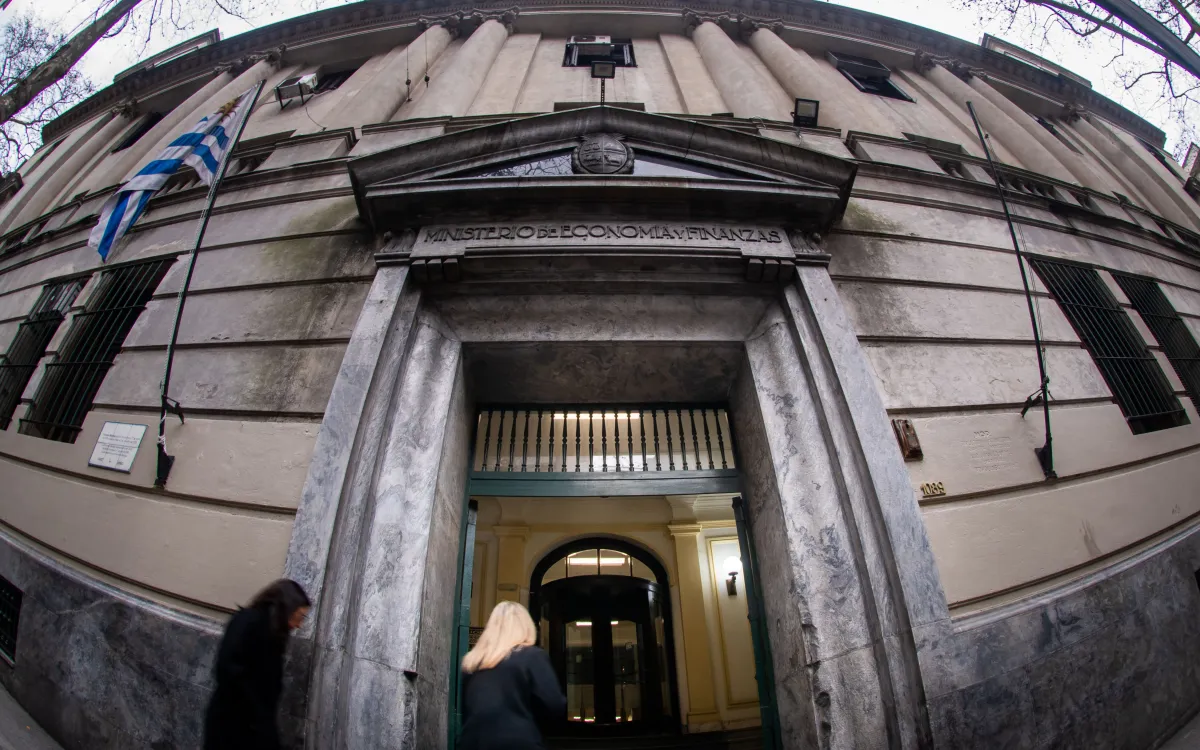
Photo: Ministry of Economy and Finance
Investors included asset managers, private and central banks, insurance companies, pension funds and hedge funds. Before the placement, the government held meetings with 70 investment accounts. The round included a tour of London, Frankfurt, Amsterdam, Paris, Zurich y Baselin addition to virtual meetings. The banks in charge of the placement were BNP Paribas, HSBC y J.P. Morgan.
With the issuance, the government incorporated the euro into the foreign currencies in which it is financed, along with the dollar, the Swiss franc and the yen. According to the MEF, the objective is to expand the investor base and access a market with lower nominal rates, which can move differently than dollar rates. Likewise, it considered that the conditions obtained were competitive with those of recent issues in euros from countries with a similar credit profile.
In dialogue with El País, the president of the Montevideo Stock Exchange, Angel Urraburuhighlighted that Uruguay has completed the placement in the midst of the volatility of international markets. He described the global financial situation as “one of the worst moments in recent times” and mentioned, among the factors weighing on investors, geopolitical uncertainty and instability of the American bags.
In this scenario, he appreciated that the government has obtained eight-year financing in a currency that is unusual in its placements.

Francisco Flores/El Pais Archive
Urraburu also highlighted the weight of European investors in the operation. In his opinion, the issuance made it possible to expand the universe of buyers of Uruguayan debt and bring the country closer to a market that has less presence in its usual placements. He considered it “absolutely strategic and very intelligent” to advance the financial link with Europa in parallel to commercial integration. Regarding the cost, he described the rate as “absolutely modest and limited” and estimated that Uruguay would have paid more if “it had issued in dollars”.
The stockbroker told El País that, during the morning of this Thursday, he received a message from the director of the Debt Management Unit of the MEF, Herman Kamilwhen the conditions of the issue were still being analyzed. Once the final data was known, he said that the general result was in line with what he expected, although the magnitude of the orders surprised him. “I didn’t think it was that much,” he said about the demand, which almost tripled the amount placed.

Hernán Kamil. Photo: MEF.
In his opinion, the offer of titles in euros from investment grade countries is limited and that also helped spark interest in the new bond. Along these lines, Urraburu maintained that this qualification was “key to that demand.”
To Nicolas Coccinomanaging partner of WealthMan Stock Corridorthat movement was a sign of good demand. “The initial reference was 160 basis points over the swap rate in euros and the issue closed at 130. This drop of 30 basis points during the placement is a sign of good demand for the bond,” he said in dialogue with El País.
The analyst also valued the 4.75% coupon that the Uruguayan State will pay for the securities. As he explained, in nominal terms, this percentage is below the 6% that he estimates he would have had to pay. Uruguay for an issue in dollars with a similar term. In any case, he clarified that the effective cost will depend on how the exchange risk associated with the debt in euros is managed.
“In addition, broadcasting in euros “It allows Uruguay to reach a broader base of investors and diversify its financing sources,” he added.
The issue was carried out at a price of 99.974% of the nominal value. The 4.75% coupon corresponds to the annual nominal interest rate that the State agrees to pay on the face value of the securities.
As part of the preparation for the operation, the previous week Kamil, together with Victoria Buscio y Juan Labattoured Europa to maintain contacts with potential investors.
Uruguay’s last exit to the international market had been on July 28 of this year, when it reopened the global bond in nominal pesos maturing in 2035 and the global bond in dollars maturing in 2037. On that occasion it obtained the equivalent of US$ 1,697 million.
For his part, the economist PwC Uruguay, Ramón Pampínconsidered that the placement “is a sign of confidence in Uruguay.” In dialogue with El País, he maintained that the volume of orders, the reduction of the spread with respect to the initial reference and the return to a market in which the country had not issued since 2005, reflect how the international investors they value the Uruguayan debt.
In his opinion, some aspects of the operation were even better than could have been expected. He highlighted that the differential over the reference rate in euros will drop from the 160 basis points indicated at the beginning to 130 at closing, in a placement that received orders for more than 3.5 billion euros. So, Uruguay was able to raise 1,250 million euros with a margin 30 basis points lower than what it had proposed when going on the market.

Photo: Freepik
Pampín also evaluated the result from the point of view of cost. He considered that Uruguay is financing itself “quite cheaply” both in relation to what it paid historically and with the conditions it can access today in international markets. He put that assessment in the context of a volatile global market and rising rates, two factors that, in his opinion, should be taken into account when judging the cost of the issue.
Beyond the rate, he noted that returning to the market in euros strengthens the financial position of Uruguay because it expands the currencies and the sources to which it can resort for financing. He also saw in the operation a sample of the country’s institutional capacity to manage its debt, which he defined as “an asset of the country.”
The president Yamandú Orsi He also referred to the broadcast this Thursday, during the inauguration of a new free service zone in Colonia. “Uruguay has not done this for more than 20 years,” said the president, who highlighted the previous work with financial authorities from different European countries to explore financing opportunities. In that sense, he mentioned Kamil, who led the tour of Europaand recalled that he himself talked about these opportunities during his recent visit to Spain. “It is another way to find the necessary support,” he added.
Source: www.elpais.com.uy