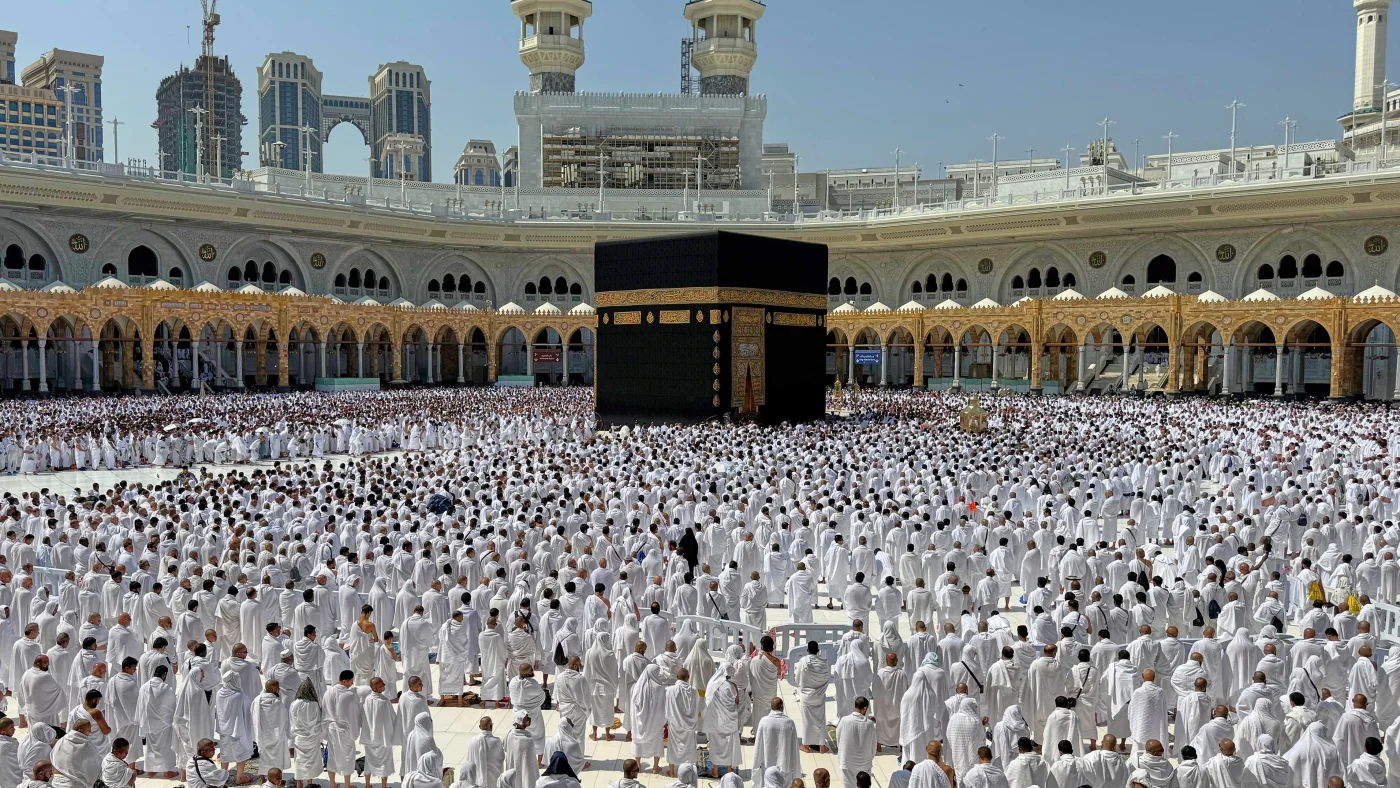

Pilgrims pray in front of the Kaaba, Islam’s holiest shrine, at the Grand Mosque in Mecca, Saudi Arabia. Muslims will outnumber Christians by 2035, according to a new report.
STR/AP
hide caption
STR/AP
Muslims will soon become the largest religious group on the planet, according to a new report by the Pew Research Center released today.
Christians will be the second-largest cohort by 2035. The Muslim and Christian populations are both expected to grow, but researchers anticipate Muslims will grow faster.
If recent demographic trends continue, Pew expects the world’s Muslim population will reach 3.6 billion by 2070 while the Christian population will be just under 3 billion.
The Pew Research Center arrived at its projections using data from national censuses worldwide, combined with data on fertility rates and religious switching patterns. The projections also use findings from United Nations reports and global migration estimates, along with Pew Research Center’s earlier studies on religious migration.
Hindus and Jews are projected to grow in absolute numbers but decline as an overall percentage of the world population. Buddhists, meanwhile, are expected to shrink in both number and portion of the global population in the coming decades.
Some of these trends, according to Pew, can be explained by population growth trends. For instance, most of the population growth in the 21st century is expected to occur in Africa.
By 2070, more than a quarter of the global population will live in sub-Saharan Africa. The vast majority of those who live there are either Christian or Muslim. The region’s high fertility rate and lengthening lifespans mean the numbers of both faiths there are expected to grow, with the Muslim population growing faster than the Christian one.
In fact, Pew projects that by 2070, the Democratic Republic of the Congo in sub-Saharan Africa will surpass the United States as the country with the largest total number of Christians. The Pew Center’s religion research director Alan Cooperman calls this a “global change in what one might think of as the center of gravity of Christianity.”

Congolese men holding Christian paintings arrive for the yearly national parade in Kinshasa, Democratic Republic of Congo.
Geert Vanden Wijngaert/AP
hide caption
Geert Vanden Wijngaert/AP
Birth rates drive religious shifts
Pew points out that differences in fertility rates have major effects on religious populations. Around the world, Muslims tend to have more children than people of other faiths. In recent years, the fertility rate for Muslims has been 3.1 children per woman. The average rate for non-Muslim women has been about 2 per woman.
Among the other religious trends anticipated by 2070 in the Pew Research Center’s report: The overall populations of China, Japan, and South Korea will shrink, and their Buddhist populations will shrink by half. And, an increasing portion of the world’s Jews will live in Israel. In 2020, 46% of global Jewry lived there, but Pew projects that by 2070, 62% of Jews will live in Israel.
One of the more surprising projections is that while the percentage of people who identify as having no religious affiliation will increase in many countries, the global population of “nones” is expected to drop. The reason for this is that a very large portion of the religiously unaffiliated live in China, and that country is expected to have dramatic population losses in the coming decades due to dropping birth rates there.
U.S. religious trends reflect overall global patterns
The report also details how religious change will affect the United States. Pew says the U.S. will no longer have a Christian majority by 2070, yet Christians will remain the largest single religious group in the country. Christians are expected to decline to just under 48% of the population. (They currently make up 62% of the U.S.) During this same period, the percentage of the population of those who are religiously unaffiliated is expected to rise to 41%.
The anticipated population change in the U.S. among Christians and the religiously unaffiliated will be driven mostly by people changing their religion rather than by birth rates, according to the report. Christians tend to shed more adherents than they gain through what demographers call “religious switching,” most of whom switch to being religious “nones” rather than taking on another tradition.
The U.S. is expected to become increasingly religiously diverse, with Pew projecting that both Muslims and Hindus in the country will outnumber Jews by 2070 if current demographic trends continue.
Source: www.npr.org