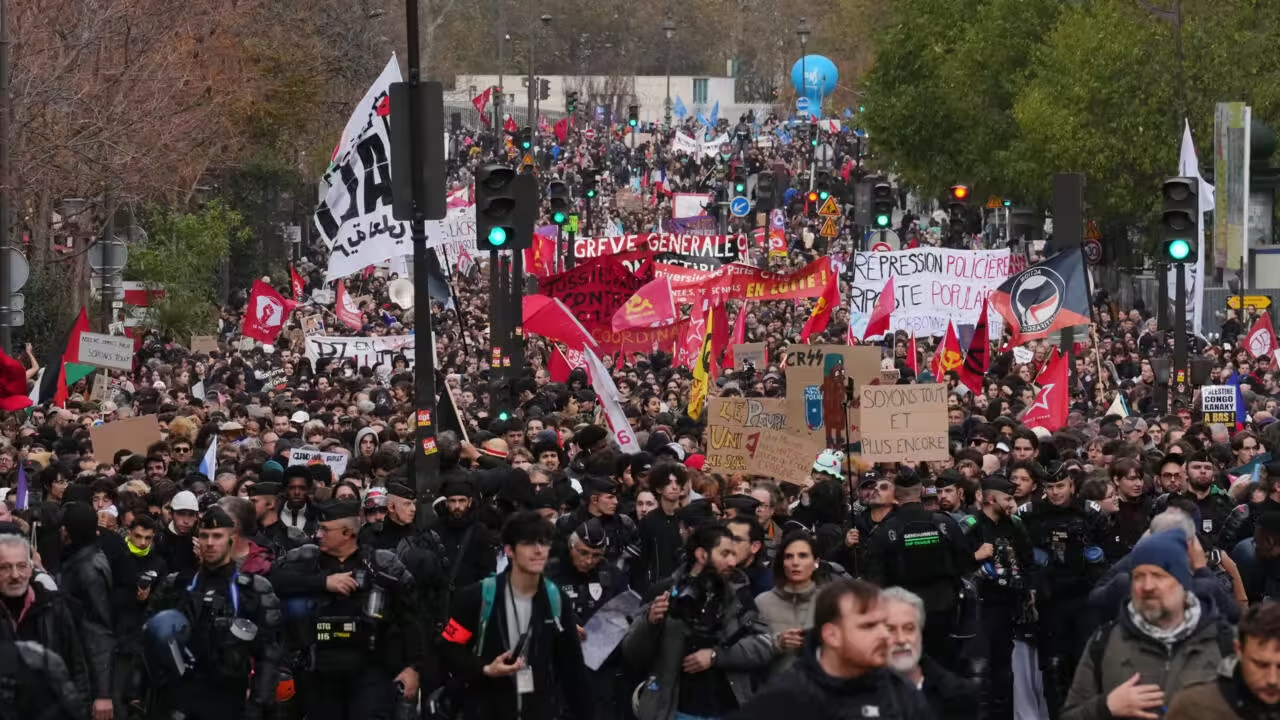

Turnout drops at public sector protests across France
Turnout was down sharply on Tuesday at largely peaceful demonstrations across France marking a one-day strike called by public sector workers seeking pay rises.
Tuesday’s strike, which was supported by high school and university students, was the third unified work stoppage in the public sector since the start of the school protests in September
The interior ministry said 146,000 people participated in protests around the country, including 28,000 in Paris
That compared with 575,000 across France, including 65,000 in Paris, for the previous unified protest day on November 5.
‘A lot of anger and a weak government’: Why are French public sector workers striking?
Tens of thousands of people took part in protests across France on Tuesday after unions called a new nationwide public sector strike to demand pay rises. It follows more than a month of unrest and often violent protests led by students that the government has failed to quell. France 24’s Marc Perelman explains.
Organisers hoping for ‘joyful’ protests
France braced for another day of protests Tuesday while organisers were hoping for a “joyous and festive” occasion in contrast to the violence that has marred earlier protests. FRANCE 24’s Claire Paccalin reports from a march in Paris.
‘We’re kind of at a stalemate’: French government wants to delay union negotiations
Amid continuing protests in France and tense negotiations between the government and trade unions, FRANCE 24’s Delano D’Souza talks to Paul Smith, Associate Professor in French and Francophone Studies at the University of Nottingham.
Smith explains that the government wants to delay negotiations until after trade union elections on December 10, while the unions want an agreement as quickly as possible. With talks “more or less broken down” over a two-point difference in public sector pay proposals, he describes the situation as “kind of at a stalemate.”
French public sector workers ‘in survival mode’ amid flat wages
French public sector workers are striking on Tuesday, joining cost of living protests that have shaken France for more than a month ahead of presidential elections next year.
The minimum wage in the private sector increases every year according to inflation, but a figure that determines the salary of 5.8 million people working in the public sector does not.
The so-called “index point”, which is applied according to job and rank to become a base salary then topped with incentives, has not been increased in three years. And the government does not plan to give it a boost in the 2027 budget.
The effect is that some workers in the lower rungs are now earning a base salary, without the incentives, of less than the minimum wage of around €1,470 net per month.
Fred Kajak, 31, manages a municipal games library outside the southern city of Toulouse, even though he has not been appointed manager.
“Right now, I’m in survival mode,” he said. In five years, his promotions have only brought him 25 euros gross.
He lives on a net monthly income of €1,550.
“I always have to watch what I spend,” he said.
France hit by fresh nationwide public sector strike
Demonstrators gathered across France on Tuesday after unions called a nationwide strike by public sector workers in a bid to secure pay rises, despite government efforts to ease tensions as demonstrations roil the country. Watch our report below.
Protesters, unions march in Paris
Students gather during a demonstration calling over issues for public sector wage increases, the cost of living and better school conditions, in Paris, Tuesday, Nov. 17, 2026.
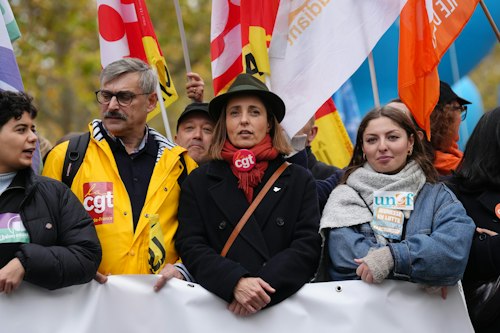
CGT union secretary general Sophie Binet, center, and secretary of UNEF student union, Manon Moret, right, attend a demonstration calling over issues for public sector wage increases and the cost of living, in Paris, Tuesday, Nov. 17, 2026.
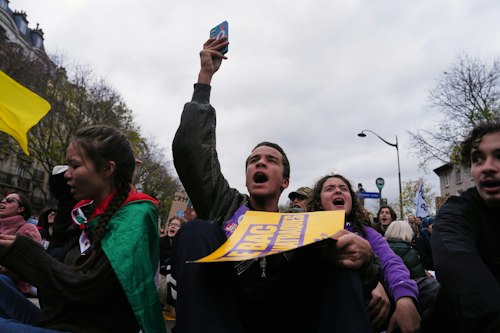
Students march during a demonstration calling over issues for public sector wage increases, the cost of living and better school conditions, in Paris, Tuesday, Nov. 17, 2026.
(© Aurelien Morissard, AP)
Public sector mobilisation: 3% of French national education employees strike
About 3 percent of France’s national education employees were on strike Tuesday, a day of mobilisation by public sector workers seeking pay raises amid discussions on the 2027 budget, according to figures from the ministry.
The national education ministry reported an overall average strike participation rate of 3.14 percent and a strike rate of 3.76 percent among teachers.
School support staff, including guidance counselors and supervision aides, were more heavily involved, with 9.28 percent participating in the strike.
This is the third call for mobilisation and a unified strike in the public sector since the start of the school year.
Students and university personnel begin Paris protest march
Police and demonstrators clash at Nantes protest
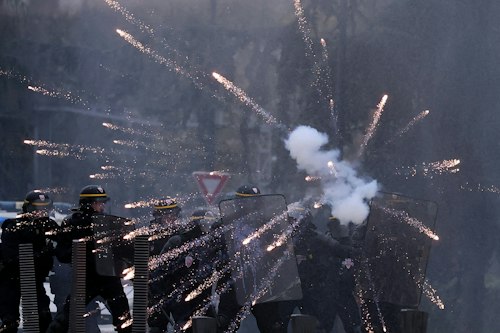
Fireworks explode near French CRS riot police amid clashes during a demonstration in the city of Nantes in northwest France.
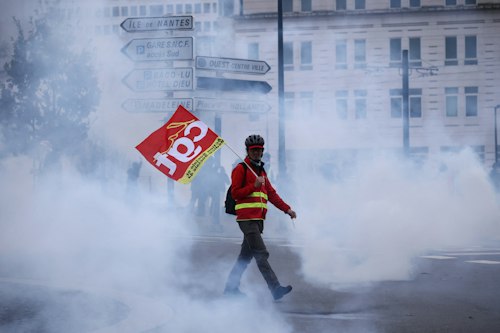
A protester holding a CGT labour union flag walks through tear gas amid clashes with French police.
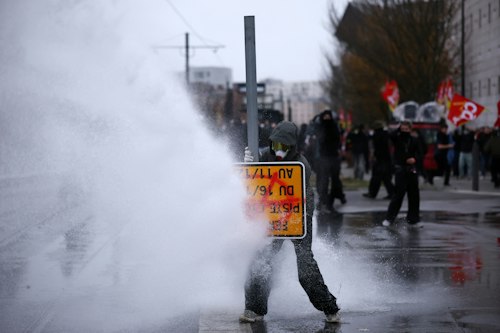
A masked protester takes cover behind a road sign as French riot police use a water cannon amid clashes during a demonstration in Nantes.
(© Stephane Mahe, Reuters)
Route for the Paris protest match
Protests in Paris are about to begin in the east of the city following a route from the Place de la Nation to Place d’italie.
3% of France’s education staff join strikes, ministry says
Some 3.14 percent of national education staff were on strike on Tuesday, a day of action by public sector workers seeking pay rises amidst discussions on the 2027 budget, according to figures from the Ministry of Education.
Among teachers the strike rate rose to 3.76 percent the ministry said in a press release.
School support staff, including head form tutors (CPEs) and teaching assistants (AEDs), were more actively involved in the strike, with 9.28 per cent taking part.
Demonstrators in Lyon dance ahead of protest
France’s Le Pen promises to lower the retirement age if she wins election
French far-right leader Marine Le Pen vowed on Tuesday to repeal President Emmanuel Macron’s pension reform if she is elected next spring and bring down the retirement age to 60 to 62.
She also set out plans to create a fund worth €900 billion ($990.54 billion) to help fund pensions in the long term, she added. It would take a generation to build up the fund, she added.
Candidates clash over cost of living in French presidential debate
Government defends ‘concrete response’ to union unrest
The government on Friday gave a “very concrete response” to demands made by trade unions including pay rises for cilvil servants, said government spokesperson Mathieu Lefèvre speaking on France’s Sud Radio.
Lefèvre said this included making sure “no civil servant earns below the national minimum wage, and pay rises of up to €650 gross for more than 1.3 million civil servants”.
But, he added that the government had little “room for manoeuvre” in negotiations due to political divisions in parliament and the upcoming presidential election.
“We do not have a majority in the National Assembly, and since we have only a few months left to provide concrete answers to the French people, we are making promises that we are capable of keeping,” he said.
Government response ‘too little, too late’, union leader says
Sophie Binet, general secretary of the CGT union told French radio station RMC that the government response to nationwide unrest, including a planned 1.6% increase in the minimum wage, had been “too little, too late”.
“There is an unprecedented level of social anger, yet the only response we’ve had is an extra five euros a month on top of the minimum wage. Frankly, that’s not nearly enough,” Binnet said.
Asked to comment on a message posted by Emmanuel Macron on X, in which the President acknowledged “mistakes”, Binet said that Macron issued ‘mea culpa’s’ every year but nonetheless “stubbornly refused to change his economic policy, which serves the interests of the wealthiest”.
“The result in France is a surge in inequality; there have never been so many billionaires, who have never been so numerous or so rich, and there have never been so many poor people,” she said.
SNCF says trains will be disrupted due to protests
National rail operator SNCF said there will be “minor to major disruption” to overground TER services in several regions and to the RER D in the Paris region due to planned strikes.
TGV services will not be affected, it said.
Source: www.france24.com