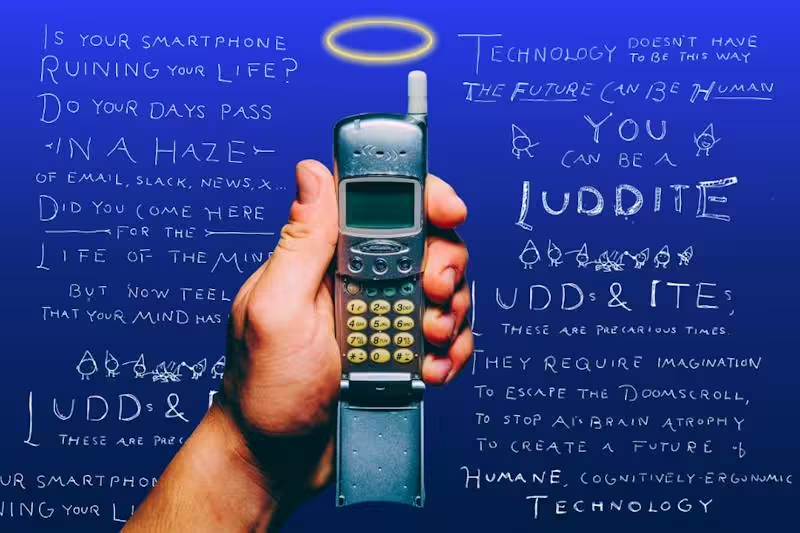

“The young are restless. Born in near utopia, and given the means of near-contentment and near omnipotence, they cast them off, their all-seeing devices, and, like Huxley’s Noble Savage, venture unarmed into the night calling one word: ‘Ludd!’”
Thus reads a recent “Dispatch” from the Princeton Luddite Club, available in print at Campus Club every Friday. The Luddites, in simple terms, want to enhance human connection through decreasing, or even rejecting, the use of modern technology. As the aforementioned Dispatch puts it, they strive to “build alternative social infrastructure.” Luddites believe that “to change societal habits,” it is necessary to “first shift the culture.”
The term “Luddite” originated with nineteenth-century British textile workers who protested against industrialization. These workers created a fictional character named Ned Ludd to represent them and be their “leader.” Two hundred years later, a group of high school students in Brooklyn founded the first modern Luddite Club, popularizing the term and propelling the movement forward.
It may come as a surprise, then, that the Montanan leader of Princeton’s Luddite movement is a Ph.D. candidate in the Department of Computer Science. Kincaid MacDonald GS, who studied math and cognitive science at Yale University as an undergraduate, believes that changing the culture around technology is only part of the Luddites’ motivation.
“There’s also a large motivation that comes from people who grew up on screens becoming aware that they’ve been unwitting participants in this massive social experiment, wanting to opt out,” MacDonald explained. “Those two halves, it seems, complement each other, but it takes some time to get them together.”
The Luddite Club hosts numerous events every month, including biweekly Luddite Supper Club, as well as weekly Sunday meetings that have ranged from book swaps to “speed ludding.” On Friday, Nov. 13, the Luddite Club met at Small World Coffee on Witherspoon for a letter writing circle, where I spoke with MacDonald before the event.
“I finished high school in the late 2010s when people were first starting to think about the anxious generation and the social dilemma, and so [I was] always aware about these problems with technology in our lives,” Kincaid told me.
At Yale, he started out pursuing math and writing to avoid this dilemma, but turned to machine learning to make a “real impact.” This was during the pandemic, when MacDonald says that using a screen “was the only way you [could be] effective.”
“There’s a period of a couple years after that where I was torn between these worlds of wanting to use fountain pens to take all of my notes, versus trying to be effective with technology,” Kincaid said. “For a while, I thought that you could solve this just by being smarter about how you use technology. Eventually, I came to the conclusion that I, at least, could not, and started moving in the Luddite direction.”
As for founding the Luddite Club at Princeton, MacDonald says it was “accidental.” He was sitting on a couch one day perusing websites when he found the New York Luddite Club’s “glorious website.”
“It was one of those moments where ideas you’ve had in your unconscious mind suddenly bubble to the surface,” MacDonald said. “[I thought] it would be fun to do something like that. It was a unification of things I cared about for a while, so I sent them an email, and they responded to the email … with good haste and approved usage of their name and gave some tips.”
This summer, MacDonald traveled to the “Summer of Fluff” festival in New York for a “conference of different Luddite Clubs.” At least a dozen other clubs attended, according to MacDonald, as well as “veteran activists from Occupy Wall Street, people who’ve been protesting the development of the military-industrial complex for years, and a lot of young people who just wanted to remake their relationship with the world.”
MacDonald owns a laptop and phone, and says that he frequently uses SMS text messaging. He carries around a flip phone and a Boox Palma — a “little tiny e-reader shaped like a phone” — most days. He keeps his laptop in his office for necessary tasks, like preparing presentations, but finds it a different and less preferable experience from “sitting down and reading a paper in the library.”
However, MacDonald pointed out that artificial intelligence is the only reason that he can ditch his overstimulating laptop for a less distracting, e-reader tablet.

“One way of using [AI] is to engage with ideas in the form that you find most conducive to thinking well,” he explained. “You no longer have to sit in front of a giant monitor and review separate files of code. If you want to read your code in the form of a PDF, you can do that very easily now … We have the freedom to work in all sorts of fantastic new ways that I think people are beginning to explore.”
When asked if there was any contradiction in being a computer science Ph.D. candidate and being a Luddite, MacDonald said it makes perfect sense to him.
“A lot of my colleagues have this contradiction in their professional lives where they work on technology while also thinking about the social effects of technology … They’ve been thinking a lot about privacy and surveillance for a decade plus, now,” MacDonald said. “When I tell people I’m a [Center for Information Technology Policy] Ph.D. student, it seems like a contradiction. That’s the place where it’s the least contradiction.”
Nevertheless, the Luddites’ apparent anti-technology stance attracts many students. According to MacDonald, 160 students have signed up for the Luddite Club, including one in six incoming grad students. These students were attracted to the homemade poster the Luddites presented at the graduate orientation fair, opposed to the “sea of artificiality” and AI-generated posters of other clubs. Member attendance still varies from event to event.
“I think the curious feature is that there is a chasm that people have to cross from being interested in the club to going into the club. I think we have a lot of people who like the idea of the Luddite Club, who either find themselves too busy or not quite ready to commit there,” MacDonald said.
Most members are in the same boat as MacDonald: “balanced skeptics who were finding their own ways to opt out” and who haven’t fully relinquished their phones or laptops. Others ordered dumb.co’s “dumbphone 2” — a modified TCL flip phone — following the announcement of a student-organized “Month Offline” event sent out via HoagieMail in late September. “Month Offline” encourages students to commit to “ditch” their smartphones for the month of November.
“Might I say, I don’t have many problems with my phone. It’s a useful tool to me. I’ll continue to refine my relationship with it,” MacDonald said.
At 4 p.m., MacDonald and I moved to the back of Small World so he could start the letter-writing event and await members. Maya Gambhir GS, who was one of the “first class of graduates in the Artificial Intelligence major” at the University of Pennsylvania and is also a Ph.D. candidate in computer science at Princeton, was the first to arrive. MacDonald pulled out a baggie full of greeting cards with “Take to Luddite(s)” scribbled on it — he explained that it had been left for him by an anonymous well-wisher at Campus Club.
Several members trickled in and out of the letter-writing circle over the next hour. While I wrote a letter to my parents, MacDonald wrote a letter to the Chicago Luddite Club, which the present members signed. Kara Schechtman GS, another Ph.D. candidate in computer science, arrived with a Ziploc bag of stickers, including popcorn-scented scratch-and-sniffs. She explained that Luddite events usually have signature popcorn available for attendees.

“I heard about the Luddite Club from Kincaid, who is my officemate. We sit next to each other, and I think I was feeling pretty sad and fed up with recent trends in technology and wanting to be in community with other people who are feeling similar,” she explained. Schechtman usually uses a dumbphone 2, but admits that she “occasionally [encounters] a day that’s too complex” where she has to use her iPhone.
Gambhir also explained her reasoning for being a Luddite.
“The core mission of [the Luddite Club] really resonates with me,” she said while holding her “Jelly” phone — an ultra miniature android — in her left hand.
Gambhir also explained her work with the Center for Information Technology Policy, saying: “I’m looking in the realm of making sure technology is being good and helpful, and big tech companies are behaving themselves.”
Lucia Zschoche is an assistant Features editor, an associate Archives editor, and a News contributor for the ‘Prince.’
Please send any corrections to corrections[at]dailyprincetonian.com.
Source: www.dailyprincetonian.com