
ISLAMABAD: The government on Wednesday said it received the first cargo of 15,000 tonnes of liquefied petroleum gas (LPG) from Abu Dhabi after it introduced policy changes earlier this month to arrange imports through state-owned enterprises (SOEs) to ease supply constraints and contain rising prices in winter.
In a statement, the Petroleum Division said that SSGC LPG Limited (SSL) – a subsidiary of the state-run Sui Southern Gas Company Limited (SSGCL) – had imported a record 15,000 metric tonnes of LPG cargo, the largest of its kind that berthed at Engro Vopak Terminal Limited (EVTL).
The shipment marks the first “major” import under the new LPG guidelines aimed at ensuring the availability of LPG at affordable rates for the public, the statement said.
The SSL arranged the cargo through competitive bidding at a price yet to be disclosed by the company.
Petroleum Division officials said the company would publish details of the pricing components on its website in a couple of days, but claimed the SSL import had already dented market prices by Rs100 to Rs120 per kg.
Separately, Petroleum Minister Ali Pervez Malik informally told journalists that another shipment arranged by Pakistan State Oil (PSO) was on its way to Karachi and would reach over the next two days, followed by others.
He said LPG availability would address the pricing distortions in the market.
On November 3, the federal cabinet approved new LPG pricing guidelines to enable SOEs to play a leading role in securing LPG supplies.
Previously, formal sector companies had exited imports due to regulatory constraints that prevented them from recovering procurement costs.
Under the cabinet decision, the government also directed state-owned companies to lead LPG imports and strengthen the country’s supply chain, especially in winter.
The increased influx of LPG is expected to further improve market availability, ease supply constraints and help bring prices down through greater product availability.
It will also enhance supplies to hilly, remote and far-flung areas, particularly during peak winter season.
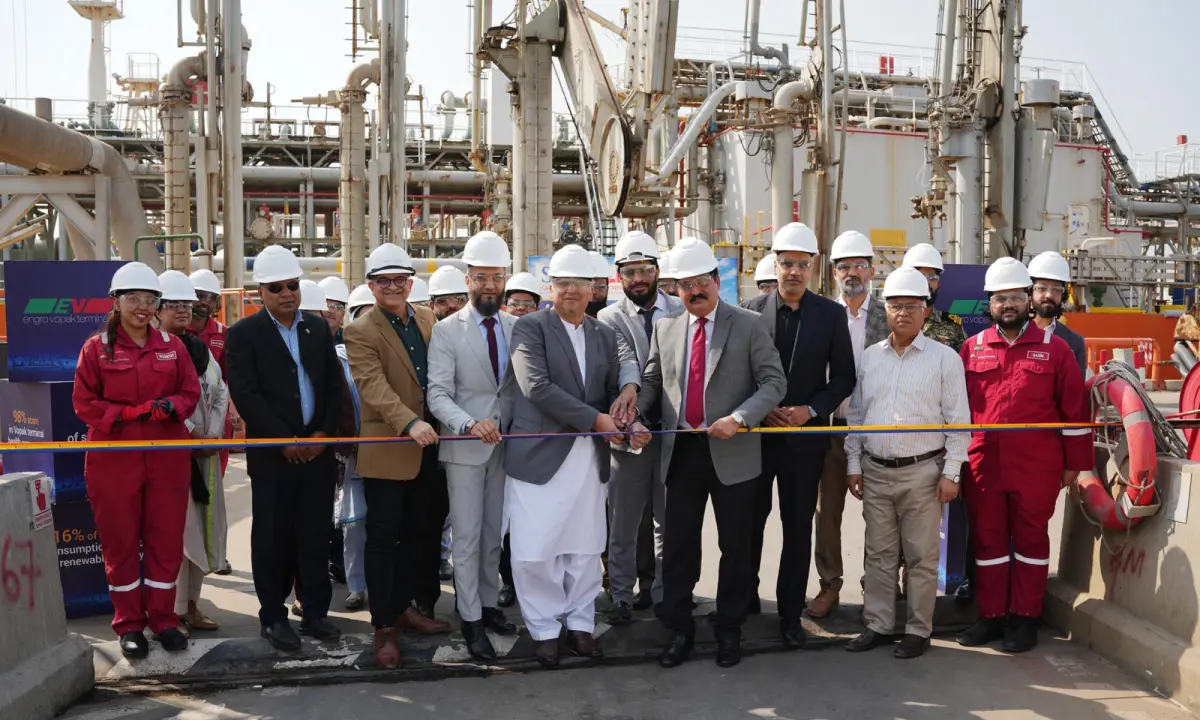
A welcome ceremony was held at Port Qasim to mark the arrival of the shipment, with Special Secretary Petroleum Mirza Nasir ud Din Mashood as the chief guest.
SLL Managing Director Jawad Ali Khan, Oil and Gas Regulatory Authority (Ogra) Senior Executive Director (LPG) Sarmad Aslam, and other senior officials were present at the occasion, according to the statement.
Speaking at the ceremony, Petroleum Special Secretary Mirza Nasiruddin Mashood said that the prime minister and the petroleum minister had issued directives to take effective measures to ensure LPG availability to the public.
He said the arrival of the record shipment marked a new era for the LPG sector and would further strengthen the country’s supply chain. He congratulated SLL on this achievement.
The government said the LPG pricing change was meant to create competition in the market through procurement of LPG by four SOEs on government-to-government (G2G) and business-to-business (B2B) arrangements and flood the market.
LPG, often described as the poor man’s fuel, has been in short supply even before the onset of winter as western borders faced disruption. Resultantly, unscrupulous elements started taking advantage by selling the product to consumers at Rs700 to Rs800 per kilogramme against Rs295 per kg maximum price set by Ogra for November.
LPG pricing
The government is working with the Benazir Income Support Programme (BISP) to provide LPG to the “most deserving and vulnerable” at Rs300-350 per kg through a subsidy mechanism to be funded by a new account arising from the differential between LPG import parity price and auction of local LPG produced by refineries and exploration and production companies under a clawback mechanism.
The SOEs — PSO, Pakistan LNG Ltd, SSL and Parco-LPG — have been engaged with various suppliers from Saudi Arabia and Oman for LPG supply.
Apart from imports through SOEs, the cabinet has also decided to put an end to the existing quota system for domestic LPG enjoyed by influential groups, and local producers would auction their LPG in 5 to 10 tonnes through a competitive process under Ogra and the Petroleum Division’s supervision.
Under the new arrangement, these SOEs would announce the base price —freight-on-board (FOB) linked with the Saudi Aramco contract price (CP) — along with other costs including the premium, freight (CFR), insurance, incidental costs and import taxes actually incurred by PSO or any other SOE in the preceding month (monthly average landed cost) on their websites.
Ogra would stop issuance of price notification for local (or imported) LPG forthwith.
The local producers shall be entitled to this producer price only discovered through auction and the differential between the producer price (Saudi CP-linked FOB) and the base price of PSO shall be deposited in the fund account to subsidise poor consumers through BISP.
The private sector has been demanding an end to the Saudi-CP-linked price, considering that most of the imports originate from other countries, including Iran and Oman.
In case of no imports by SOEs in a month, the preceding month’s premium, incidentals and taxes shall apply with the current month’s CP on the pattern of diesel and petrol pricing.
There would be an increase in margins for LPG marketing and importing companies to Rs50,000 per tonne floor instead of the existing Rs35,000 per tonne as inflation adjustment since the 2016 LPG policy.
Ten per cent of the indigenous LPG produced by exploration and production (E&P) companies, refineries and other producers shall be allocated to state-owned marketers at producer price, to guarantee supply to the northern areas, Gilgit-Baltistan and other remote, hilly and hard-to-reach areas for supply through cylinders or already installed LPG air-mix plants.
The remaining 90pc will be allocated, through a transparent monthly auction with a floor price equal to 5pc of import-parity price of PSO, to prequalified bottlers to increase investment in infrastructure and storage, cylinders in circulation, geographical reach and operational capability, with safeguards against cartelisation.
Ogra would be required to convene product review meetings on the pattern of oil products to ascertain supply-chain position, including the import plan and winter stock planning, and instruct specific import volumes to SOEs to ensure demand and supply balance in the market, especially during the winter.
Source: www.dawn.com