
In October 2026 in Vienna, the only Indigenous delegation at COP13 of the U.N. Convention against Transnational Organized Crime (UNTOC) helped win a historic vote. Eighty-three governments supported opening negotiations on a protocol against crimes that affect the environment. But the resolution did not guarantee Indigenous Peoples a seat in those talks. Now the task is to define what that response looks like, and it must draw on what communities have learned in their territories.
The stakes are urgent. Criminal networks are already present in 67% of Amazonian municipalities and 32% of Indigenous territories, and drug trafficking, illegal gold mining, and land trafficking now work as one system. In the Peruvian Amazon alone, 274 Indigenous communities live with illicit economiesincluding more than 12,000 hectares of coca inside their territories. Powerful global markets, corruption, and government complicity sustain these economies. Yet enforcement targets the weakest link in the chain, the producers on the ground, while militarized responses leave communities caught in the middle.
The ten proposals below come from years of territorial defense by Indigenous Peoples in Brazil, Colombia, Ecuador, and Peru, and from Amazon Watch’s work standing alongside them. They build on the Pucallpa Declarationwritten in February 2026 by more than 60 Indigenous leaders from those four countries, which calls Indigenous territorial autonomy the best response to organized crime in the Amazon. Amazonian governments can put these proposals into practice, and the new UNTOC protocol should include and support them.
1. Recognize Indigenous Peoples and their autonomy as actors of justice, protection, and security
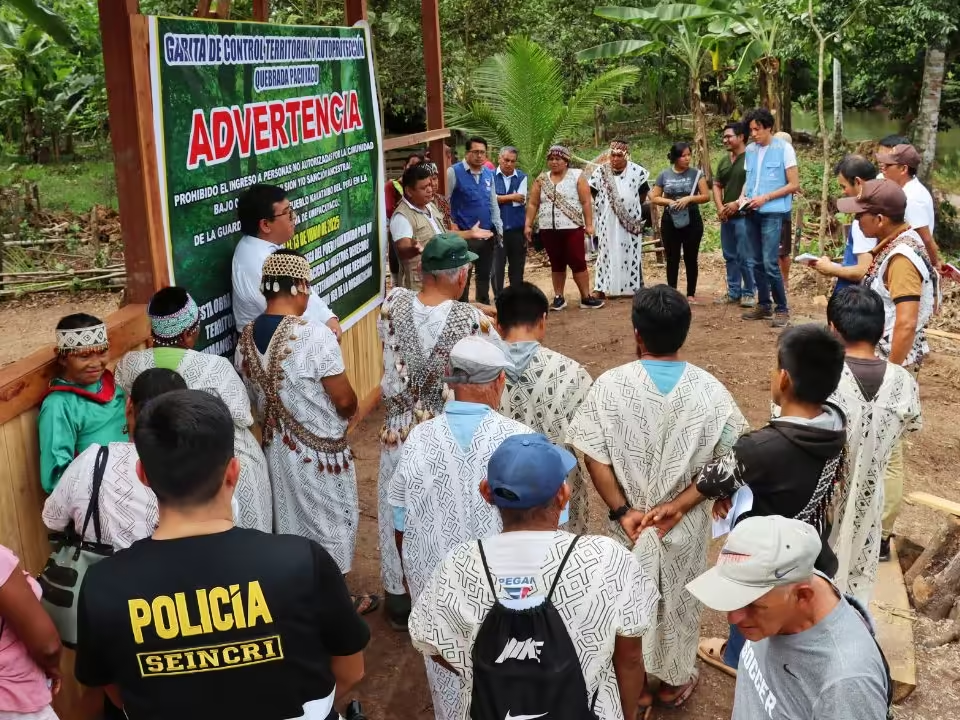
Indigenous Peoples are authorities, guardians, and holders of knowledge about their territories. They have cared for the forest for centuries and still do, even as they defend their rights and their future as peoples. Indigenous guards and autonomous territorial governmentslike that of the Wampís Nation, already defend territory the government does not reach.
Governments must legally recognize and back Indigenous security and justice systems, as the Pucallpa Declaration demands. That recognition must be built with the peoples themselves, so it strengthens their systems without co-opting them or putting them at greater risk. Governments fulfill their duty to protect rights by backing Indigenous autonomy and self-protection, protecting the defenders, and enforcing the law against those who profit from forest crime.
2. Title Indigenous territories and support their governance
A community without legal title to its land leaves the door open to invaders, coca growers, and illegal miners. Governments must title Indigenous territories and give communities the resources to manage them, as Colombia already does with its resguardos (legally recognized Indigenous territories).
Each Indigenous People also builds a life plan from its own vision of the future. These plans, together with agreed territorial planning, must guide long-term decisions and every government intervention, always with the people’s free, prior, and informed consent.
3. Build a strategy for each territory on local knowledge
Not every territory faces the same threat. Some are still free of illicit economies, some face early warning signs, and some are already controlled by crime. Governments must map each one and respond accordingly, by protecting, preventing, or acting urgently.
Research must happen alongside Indigenous Peoples, and information must flow safely in both directions between communities and institutions. There is evidence that this works. The Munduruku in Brasil, or Aidesep and its base organizations in Peru combine territorial knowledge with sophisticated technology to monitor invasions to their territories.
4. Disrupt criminal supply chains and corruption
Destroying dredges and seizing shipments makes headlines, but it does not change the reality on the ground. Governments must go after the conditions that let crime thrive and the supply chains that sustain it. They must stay in these territories, with a permanent presence, fixed checkpoints, and a way to measure real results.
None of this will work without a head-on fight against the corruption that protects crime inside governments, parliaments, armed forces, and police. Every policy to block illegal activity must also assess its impact on human rights and avoid criminalizing communities.
5. Follow the gold and the money
The Amazon’s gold and coca end up in markets in Europe, North America, and Asia. For Indigenous leaders, gold reaches developed countries “bathed in blood.” In Vienna, the delegation urged governments to strengthen traceability through measures such as mandatory GPS for mineral transport or chemical detection schemes, and to require buyers and exporters to prove the lawful origin of gold. Governments must investigate financiers, suppliers, and buyers, not only whoever operates the dredge.
The United States frames its cooperation in the Amazon around the “Shield of the Americas” and the pursuit of criminal organizations, a purely military approach. But FinCEN, the Treasury’s financial intelligence unit, and the Department of Justice must also investigate investment advisors and private banks to stop illegal gold from being used to launder money. Globally, the London Bullion Market Association certifies gold’s purity, but there is no equivalent guarantee that gold is free of deforestation, death, and poisoning.
6. Bring specialized justice to the territory
Without prosecutors and judges, impunity wins. Governments need to provide sufficient resources, logistical support, and political backing for decentralized environmental prosecutors’ offices and courts, forensic laboratories in critical regions, and teams that unite environmental prosecutors, money laundering experts, and satellite analysts. Satellite images should be presented promptly as evidence at trial.
Governments must also review laws that obstruct interdiction or restrict civil society. That justice must work through Indigenous Peoples’ own systems rather than ignore them.
7. Protect those who defend
Leaders who confront crime face threats, attacks, and far too often death. Governments need real protection mechanisms backed by sufficient funding and technical support, because a support network without effective protection puts defenders at even greater risk.
That protection must be preventive, collective, and respectful of Indigenous cultures. Governments must design it together with communities, and it must also cover defenders’ families, women defenders, and Indigenous guards.
8. Heal the territory and its people
Mercury poisons rivers, fish, and the people who depend on them. Governments must map contaminated areas, pay for cleanup and health care, and back community health programs. When authorities destroy illegal dredges, they need protocols that prevent further contamination.
In zones of violence, humanitarian protection cannot wait, particularly for women, girls, and young people who are trafficked, disappear after false job offers, or are recruited by armed actors. Healing also means rebuilding community and spiritual life through each people’s own practices and medicines. Indigenous Peoples living in voluntary isolation demand special care: unwanted contact with miners, loggers, or drug traffickers can unleash epidemics and wipe out entire communities.
9. Support sustainable and dignified local economies with direct financing
Crime recruits where people have no alternatives, and poverty and insecurity are its best allies. Governments must open fair markets for Indigenous products and finance communities’ own economies and sustainable businesses directly, with community funds and solutions designed for each territory.
Part of the money recovered in operations against crime should also go back to the affected peoples, to improve their living conditions and strengthen their economies.
10. Strengthen regional cooperation and shared responsibility
Crime does not respect borders, and the response cannot either. Amazonian countries must continue the coordination they began through the Amazon Cooperation Treaty Organization (ACTO) and the Andean Community. They must share information, align their laws, and support the cross-border commissions that Indigenous Peoples have already created.
The countries and markets where gold and coca are sold must take their share of responsibility, and the international community must back this regional effort with resources. The new UNTOC protocol can provide the framework to make it possible.
Moving forward
One condition runs through all ten proposals. Indigenous Peoples, with the full participation of women and youth, must take part in designing, implementing, and evaluating each one, from their territories to the U.N. Without them at the table, governments write the rules blind.
Over the next two years, governments will write the new protocol in four negotiating sessions before COP14. Securing Indigenous participation is the work ahead. The protocol will decide whether the response to crime in the Amazon is built with its peoples or behind their backs.
There is no security in the Amazon without Indigenous Peoples, and no true security unless it protects life, collective rights, and the nature we all depend on. Demand that your government support Indigenous Peoples’ participation in the negotiations.
Source: amazonwatch.org